
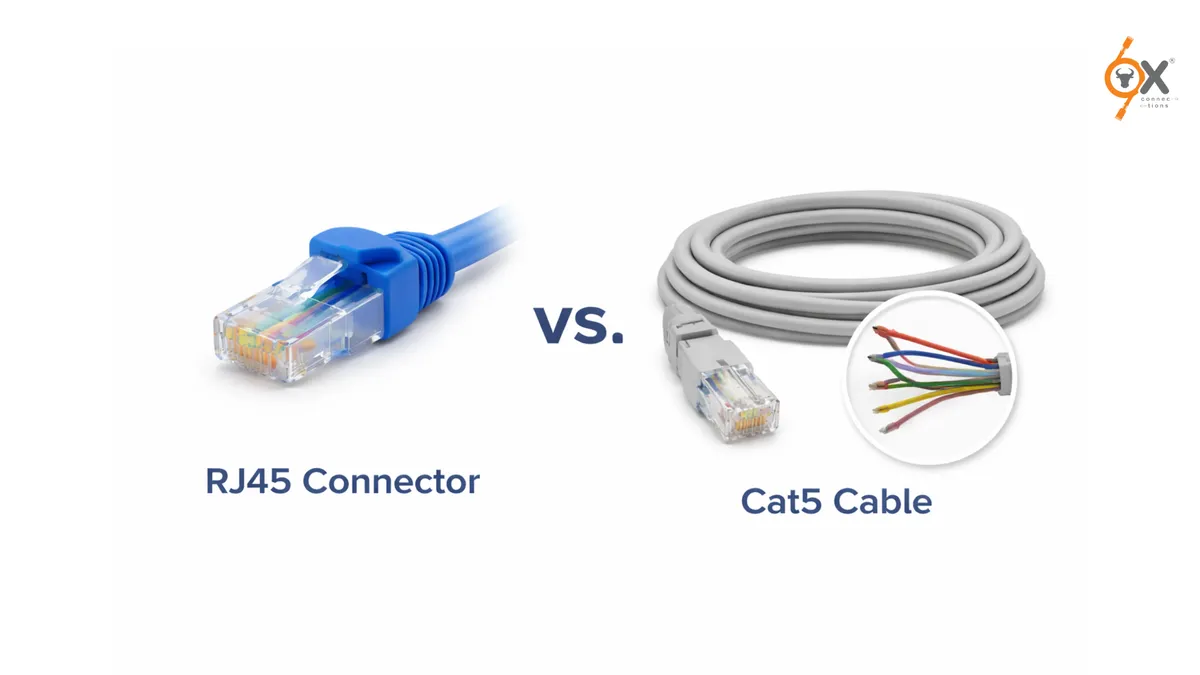
If you work with LAN cables, office networking, factory automation systems, or industrial communication setups, you have probably heard people use RJ45 Connector and CAT5 Cable as if they mean the same thing. This is one of the most common misunderstandings in Ethernet networking, especially among buyers setting up new infrastructure for factories, offices, solar plants, and OEM manufacturing units.
The truth is simple – RJ45 Connector and CAT5 Cable are related, but they are not the same.
Understanding this difference is important because the wrong assumption can lead to poor buying decisions, slower networks, higher maintenance costs, and performance issues in industrial systems. Across Mumbai, Pune, Ahmedabad, Bengaluru, and other major industrial hubs in India, many businesses still use these terms interchangeably, even though they serve completely different purposes.
Let’s break it down in the simplest way possible.
What is an RJ45 Connector ?
An RJ45 Connector is the plastic plug attached to the end of an Ethernet cable. It is the part that physically connects the cable to networking devices like routers, switches, computers, PLC systems, CCTV cameras, servers, and industrial machines.
It contains 8 pins and is designed to connect the internal wires of the Ethernet cable to the device port. Without this connector, the cable itself cannot complete the connection.
Think of it this way: if the cable is the road carrying the data, the RJ45 connector is the bridge that allows the data to reach the destination.
In industrial environments, the quality of this small connector matters a lot. A poor-quality connector can cause loose fitting, unstable signals, network drops, and machine communication failures. This is why experienced OEM buyers pay close attention not just to cables, but also to connector quality.
What is a CAT5 Cable ?
A CAT5 Cable refers to the Ethernet cable itself, not the connector.
“CAT” stands for Category, and CAT5 is one of the earlier categories of twisted-pair Ethernet cables used for networking. It was originally designed to support standard LAN communication in offices and commercial spaces.
Inside a CAT5 cable, there are 8 wires arranged as 4 twisted pairs. These twisted pairs help reduce electromagnetic interference and improve signal stability. This structure makes Ethernet communication faster and more reliable.
While CAT5 was once widely used, most modern industries now prefer CAT5e or CAT6 because they offer better speed, stronger performance, and improved future readiness.
Still, many people casually call every LAN cable “CAT5,” which creates confusion in the RJ45 vs CAT5 discussion.
The Real Difference Between RJ45 vs CAT5
The easiest way to understand the difference is this:
| Feature | RJ45 Connector | CAT5 Cable |
| What it is | Connector | Ethernet cable |
| Function | Connects cable to device | Carries network data |
| Location | Attached at cable ends | Main cable body |
| Used for | Plugging into ports | Data transmission |
| Common with | CAT5, CAT5e, CAT6 | Uses RJ45 connector |
This table makes it clear – one is the connector, and the other is the cable.
They work together, but they are not direct alternatives.
Most Ethernet cables including CAT5, CAT5e, and CAT6 use an RJ45 Connector, which is why people often assume they are the same thing.
Why This Difference Matters for Industrial Buyers
In industrial networking, details matter.
If a factory installs a high-speed CAT6 cable but uses a low-quality RJ45 connector, the overall performance suffers. Similarly, using outdated CAT5 infrastructure for automation-heavy environments can slow down operations and create future upgrade problems.
This becomes especially important in industries like solar manufacturing, EV production, medical equipment, renewable energy systems, home appliances, and factory automation. These sectors depend on stable machine communication, remote monitoring, and uninterrupted data transfer.
Even a small connector issue can lead to downtime, delayed production, and expensive maintenance.
That is why understanding RJ45 vs CAT5 is not just technical knowledge – it directly affects business efficiency.
Should You Still Use CAT5 Cable Today?
For small office setups and basic LAN usage, older CAT5 cable may still work.
However, for modern industrial applications, CAT5e and CAT6 are usually the better choice. They offer better speed, stronger bandwidth, improved interference resistance, and long-term reliability. Since industrial networking demands consistency, most OEM buyers now prefer CAT6 for better future-proofing.
But regardless of the cable type, the RJ45 Connector remains equally important.
Even the best cable cannot perform properly with a weak connector. This is where many buyers make costly mistakes – they invest in cable quality but ignore the connector.
Reliable networking always depends on both.
Why Many OEMs Choose OX Connections
One of the biggest challenges for Indian manufacturers is the high cost of imported connector brands. Many global connector suppliers come with long lead times, high MOQ requirements, and expensive pricing that adds unnecessary pressure to procurement.
At OX Connections, businesses get equivalent connector solutions that deliver the same performance standards at nearly half the price, without long waiting periods.
Their products are widely used across solar, medical equipment, renewable energy, EV manufacturing, home appliances, and industrial automation industries. Along with RJ45 Connector solutions, OX also supplies JST equivalent connectors, TE equivalent connectors, terminal blocks, modular plugs, and wire-to-board connectors.
The biggest advantage is simple – better pricing, faster delivery, lower MOQ flexibility, and certifications like UL, RoHS, and CE compliance.
You can explore more at OX Connections.
For OEM buyers looking for quality without premium imported pricing, this becomes a practical and reliable long-term solution.
Final Thoughts
So, are RJ45 Connector and CAT5 Cable the same?
No , they are connected but they are not the same.
The CAT5 Cable is the Ethernet cable that carries the data. The RJ45 Connector is the plug that helps that cable connect to devices.
Understanding this difference helps businesses make smarter purchasing decisions, especially in industrial environments where reliability directly affects productivity.
For OEM buyers, choosing the right cable matters.
Choosing the right connector matters just as much.
And choosing the right supplier often makes the biggest difference of all.
FAQs
1. Is RJ45 Connector the same as CAT5 Cable
No. RJ45 is the connector attached to the cable, while CAT5 refers to the category of Ethernet cable used for networking.
2. Can a CAT5 Cable use an RJ45 Connector ?
Yes. CAT5, CAT5e, and CAT6 Ethernet cables commonly use an RJ45 connector for network connections.
3. Which is better for industrial networking – CAT5 or CAT6?
For most industrial applications, CAT6 is preferred because it offers better speed, stronger performance, and improved long-term reliability.