
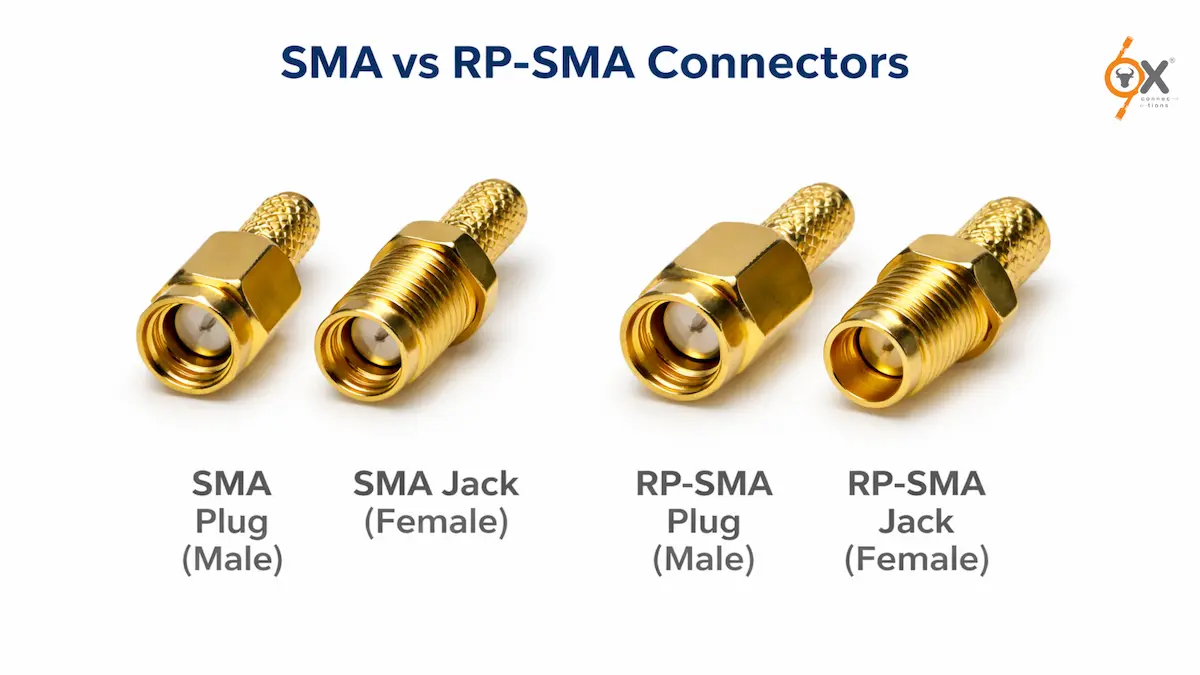
Learn the differences between SMA vs RP-SMA Connectors, their applications, compatibility considerations, and how to choose the right RF Connector for your wireless and antenna systems.
In RF system design, even a small connector mismatch can create significant challenges during installation, testing, or deployment. Engineers and procurement teams frequently encounter confusion when selecting between an SMA Connector and an RP-SMA Connector, particularly in wireless communication, antenna integration, and IoT applications.
At first glance, the two connector types appear nearly identical. Their dimensions are similar, their coupling mechanisms are the same, and both are widely used across RF applications. However, a critical difference in their center conductor configuration means they are not directly interchangeable.
Understanding these differences is essential for avoiding compatibility issues, reducing procurement errors, and ensuring reliable RF performance throughout the product lifecycle.
This guide explores the key distinctions between SMA vs RP-SMA Connectors, typical applications, selection considerations, and best practices for engineers and OEMs.
Understanding the SMA Connector
The SMA Connector (SubMiniature Version A) is one of the most widely used threaded coaxial connectors in RF and microwave systems.
Originally developed for high-frequency applications, SMA connectors are valued for their compact size, secure threaded coupling mechanism, and reliable electrical performance.
They are commonly used in:
- RF communication equipment
- Test and measurement systems
- GPS modules
- Industrial wireless devices
- Cellular infrastructure
- RF instrumentation
- Aerospace and defense electronics
A standard SMA Connector follows conventional gender definitions:
- Male connector = center pin
- Female connector = center receptacle
This straightforward configuration has made SMA connectors a long-standing industry standard for many RF applications.
What Is an RP-SMA Connector?
The RP-SMA Connector stands for Reverse Polarity SMA.
Despite the name, the connector’s threaded body remains the same as a standard SMA. The difference lies in the center contact arrangement.
With an RP-SMA design:
- RP-SMA Male = center receptacle
- RP-SMA Female = center pin
In other words, the polarity of the center conductor is reversed while maintaining a similar external mechanical interface.
This distinction was originally introduced in wireless networking equipment to discourage the use of unauthorized antennas and accessories.
Today, RP-SMA Connectors are commonly found in:
- Wi-Fi routers
- Wireless access points
- WLAN antennas
- Consumer wireless equipment
- IoT gateways
- RF antenna assemblies
SMA vs RP-SMA Connectors: The Critical Difference
The most important distinction between SMA vs RP-SMA Connectors is not the threaded body but the center contact configuration.
Many procurement teams mistakenly assume that matching thread dimensions automatically ensure compatibility.
Unfortunately, this is not the case.
Even though the connectors may appear mechanically compatible, the center conductor arrangement differs significantly.
As a result:
- Electrical connection may fail.
- RF performance may be compromised.
- Assembly delays may occur.
- Procurement errors can increase project costs.
Before placing connector orders, engineers should always verify both the mechanical interface and the center-contact gender.
Why Connector Selection Matters in RF Systems
Selecting the wrong RF Connector can create problems that extend far beyond installation difficulties.
In RF systems, connector integrity directly influences:
- Signal transmission quality
- Return loss performance
- System reliability
- Field maintenance efficiency
- Product certification processes
A mismatch discovered during final assembly can result in rework, production delays, and additional sourcing requirements.
For OEMs managing high-volume manufacturing, connector standardization becomes especially important for maintaining consistency across product lines.
Typical Applications for SMA Connectors
The SMA Connector remains the preferred choice for many professional and industrial RF applications.
Common use cases include:
RF Test Equipment
Laboratory instruments frequently use SMA interfaces because of their reliability and widespread industry acceptance.
Cellular Communication Systems
Many RF modules and communication devices incorporate SMA connectors for antenna and signal connections.
GPS Systems
Navigation modules often utilize SMA connectivity for antenna integration.
Industrial Wireless Equipment
Industrial communication devices commonly rely on SMA connectors in environments where secure connections are essential.
Aerospace and Defense Applications
Many mission-critical RF systems continue to utilize SMA interfaces due to their proven performance characteristics.
Typical Applications for RP-SMA Connectors
The RP-SMA Connector is particularly common in wireless networking and consumer RF applications.
Examples include:
Wi-Fi Routers
Many external Wi-Fi antennas use RP-SMA interfaces.
Wireless Access Points
Networking equipment manufacturers frequently specify RP-SMA connectivity for antenna attachment.
IoT Devices
Numerous wireless IoT gateways and communication modules incorporate RP-SMA connectors.
Consumer Wireless Products
Various RF-enabled consumer products continue to use RP-SMA configurations for antenna connectivity.
Understanding these application trends can simplify sourcing decisions and reduce compatibility issues during deployment.
Key Procurement Considerations
For procurement professionals, connector selection extends beyond technical specifications.
Several practical considerations should be evaluated:
Compatibility Verification
Always confirm whether the device requires an SMA or RP-SMA interface.
Supply Chain Availability
Maintaining access to dependable inventory helps prevent production disruptions.
Product Consistency
Standardizing connector types across product families can simplify procurement and inventory management.
Quality Assurance
Connector quality can influence long-term reliability and maintenance requirements.
Future Scalability
Connector decisions made during product development often affect future design revisions and upgrades.
Common Mistakes to Avoid
Even experienced teams occasionally encounter connector selection errors.
Some of the most common mistakes include:
Assuming SMA and RP-SMA Are Interchangeable
This remains one of the most frequent sourcing errors in RF applications.
Focusing Only on Thread Size
Mechanical appearance alone should never determine compatibility.
Ignoring Documentation
Always verify connector specifications against manufacturer documentation.
Delaying Connector Selection
Choosing connector types early in the design process helps avoid later redesigns.
How to Choose the Right RF Connector
When selecting an RF Connector, engineers should begin by answering several key questions:
- What connector type does the equipment specify?
- Is antenna compatibility required?
- Will the product be deployed in industrial or commercial environments?
- Are future upgrades anticipated?
- Does the project require standardized connectivity across multiple products?
Answering these questions early can help streamline sourcing and prevent costly procurement mistakes later in the project lifecycle.
Conclusion
Although they look remarkably similar, the differences between SMA vs RP-SMA Connectors are significant from both engineering and procurement perspectives.
The reversed center-contact arrangement found in an RP-SMA Connector means it cannot simply be substituted for a standard SMA Connector without careful compatibility verification.
For OEMs, system designers, and sourcing teams, understanding these distinctions helps prevent assembly issues, reduce procurement errors, and maintain reliable RF system performance.
OX Connections: Your RF Connector Supply Partner
OX Connections supplies a comprehensive range of RF Connectors, including SMA Connectors, RP-SMA Connectors, and related connectivity solutions for OEM and industrial applications.
As a stocking distributor, OX supports engineering and procurement teams with consistent product availability, competitive commercial terms, and dependable quality. With experience supporting OEMs across multiple industries, OX helps customers secure reliable connector supply for both new product development and ongoing production requirements.
For organizations seeking a long-term RF connectivity partner rather than a one-time purchase source, OX Connections provides access to a broad connector portfolio backed by responsive support and dependable supply continuity.