
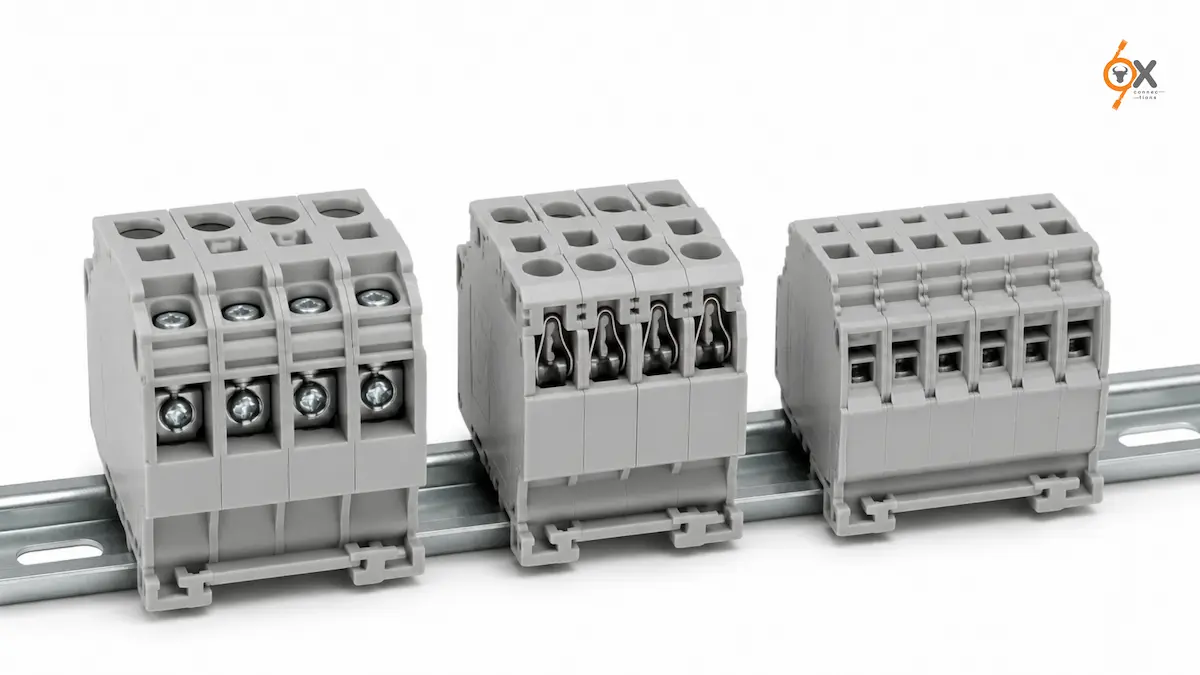
If you have specified Phoenix Contact terminal blocks on your panels for years, this article isn’t asking you to stop. It introduces an option many Indian panel builders don’t know about yet. OX Connections supplies terminal blocks that work as a direct Phoenix Contact terminal block equivalent. They match the pitch, footprint, and rating while reducing landed cost.
Phoenix Contact has earned its reputation through decades of consistent engineering. The CLIPLINE complete system remains one of the industry’s most respected terminal block architectures. Nothing in this article takes away from that. Our position is simple. We have spent over fifteen years supplying terminal blocks and connectors to Indian OEMs. During that time, we built a range that matches the major Phoenix Contact series on the parameters that matter. We support every product with certifications and test reports and price it for Indian production volumes.
Phoenix Contact terminal block equivalent
Who OX Connections Is, and Why This Comparison Exists
OXConnections has spent over fifteen years supplying terminal blocks and connectors to OEMs across India. We also manufacture wire harnesses in-house across three dedicated factories. These harnesses connect directly to the same terminal blocks and connectors we supply. Our customers range from small job shops assembling ten panels a month to large system integrators running continuous production lines. Despite their size, they all ask us the same question in different words. Can you give us what we’re already using, at a price that makes sense for an Indian production budget, without a certification gap we’d have to explain to our own customers?
That question is exactly why this guide exists. A lot of panel builders in India assume the only path to Phoenix Contact quality is through Phoenix Contact pricing. It isn’t. We supply a range built specifically to serve as a Phoenix contact terminal block alternative India panel builders can actually verify on paper and on the bench, not just take our word for.
Matching the Series You Already Use
Most Indian panels built around Phoenix Contact use three connection technologies under the CLIPLINE complete system. These include UT screw connection, ST spring cage and push-in connection, and PT push-in connection. Rather than explain Phoenix Contact’s catalogue, here’s how our range matches each series.
For panels wired with screw terminals, our range offers a UT series equivalent with the same pitch and mounting. It clips onto your existing DIN rail layout and accepts the jumpers, end plates, and marking strips already in your stores. Your panel design stays the same. Only the part number on your purchase order changes.
If your production line has moved to tool-free wiring, our ST series equivalent follows the same spring cage principle. It keeps conductors under constant pressure and prevents connections from loosening under vibration. For panels that rely on quick push-in termination without a lever mechanism, we also offer a PT series equivalent. It matches the cross-section range and current rating.
In every case, the standard we hold ourselves to is the same. A part that shares a pitch but forces you to buy a new set of accessories isn’t really an equivalent. Ours are built to slot into the panel you already design, with the certifications and test reports to back up every electrical claim on the datasheet.
Why Panel Builders Are Looking Beyond the Big Three Brands
This isn’t really about Phoenix Contact, WAGO, or Degson doing anything wrong. Each of those brands has built a genuinely strong product line, and for certain applications, hazardous area installations, export orders with a client mandated bill of materials, panels running at the edge of their rated current, the original brand is worth every rupee of the premium.
But most control panels built in India run standard voltage and current, sit indoors in a switchboard room, and get opened for maintenance a couple of times a year. On those panels, the terminal block still needs to be reliable and properly certified. It doesn’t need to carry an import premium on top of that. That gap between what a panel genuinely requires and what buyers end up paying is where OX Connections has built its business, and it’s why more Indian panel builders are asking their suppliers for a certified equivalent instead of renewing the same purchase order out of habit.
This holds even if your panels are headed outside India. Our equivalent range carries UL certification, so if you’re building for export and your customer’s bill of materials requires that mark, you’re not restricted to the premium brand to meet it.
What You Get With an OX Connections Equivalent
Every OX equivalent comes with full certifications and test reports. Your quality team gets the same documentation expected from any established brand. We price our products well below the landed cost of premium brands in India without compromising electrical ratings or build quality. We also maintain deep inventory across our warehouses in Bangalore, Mumbai, and Delhi. That means you don’t have to wait for import shipments to keep production moving.
If your project needs something outside a standard catalogue part, our team works directly with panel builders to develop it. This includes custom pitches, specific accessory configurations, and wire harness assemblies built around non-standard terminal blocks. That level of support usually comes only with premium brands. We believe it should come as standard.
Before You Make the Switch
We would rather you test this claim than take it on faith. Pull the dimensional drawing for the part you currently use. Compare it with your panel bill of materials. Then request samples and test-fit them on an actual DIN rail alongside your existing jumpers and end plates before placing a live production order.
If you would like to run that check on your own bill of materials, get in touch and we’ll send samples of the OX equivalents that match the series you use most.