
If you’re assembling connectors on a production floor in Mumbai or managing wiring for EV systems anywhere in India, you already know – small components can cause big problems. That’s especially true with Molex Mini-Fit Jr Connectors assembly.
On paper, it’s a straightforward process. But in real-world Indian conditions – heat, humidity, long operating hours – even a slightly weak crimp or incorrect wiring can lead to overheating, voltage drops, or system failure.
So instead of overcomplicating things, let’s walk through how this is actually done in practice – and how to get it right consistently.
Why Assembly Quality Matters More in India
In controlled environments, connectors perform exactly as per their ratings. But Indian manufacturing environments are far from controlled.
In cities like Mumbai, factors like:
- High ambient temperatures
- Humidity
- Dust exposure
- Continuous load cycles
put extra stress on connectors.
This means your Molex Mini-Fit Jr Connectors assembly needs to be more precise than standard recommendations. A connection that “looks fine” might not hold up over time.
That’s why experienced OEMs in India don’t just focus on specifications – they focus on assembly quality and consistency.
Understanding the Basics Before You Begin
Every Mini-Fit Jr setup comes down to three simple components:
- The housing
- The crimp terminals
- The wires
The goal is to create a connection where the wire and terminal behave like a single unit—secure mechanically and efficient electrically.
This is where Mini-Fit Jr crimping becomes critical.
Mini-Fit Jr Crimping: Where Most Issues Begin
If something goes wrong in a connector, it usually starts here.
Proper Mini-Fit Jr crimping ensures:
- Low resistance
- Strong mechanical grip
- Stable current flow
A good crimp should feel tight and uniform. The wire shouldn’t move when pulled lightly, and the terminal shouldn’t appear crushed or uneven.
However, in many Indian workshops, especially smaller setups, generic tools are still used. While this might work initially, it leads to inconsistent crimps – and over time, failures.
In high-load environments like Mumbai factories, even a minor inconsistency can result in heat buildup.
How the Assembly Comes Together (In Real Terms)
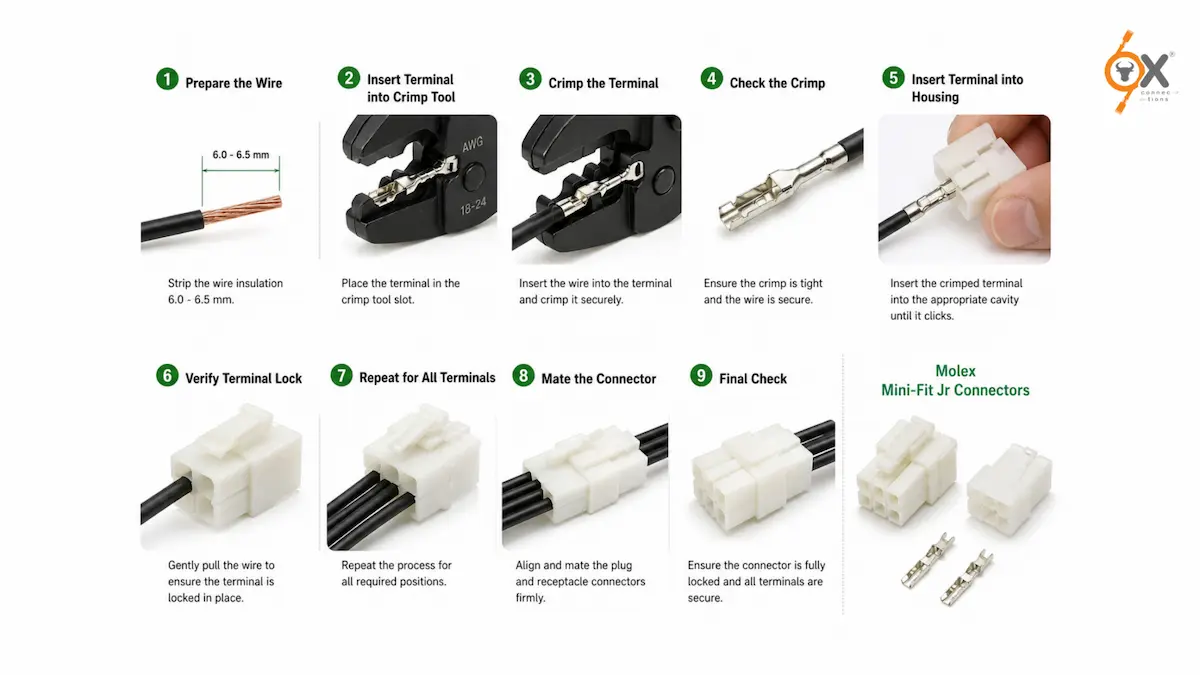
Once the wire is stripped correctly, the process becomes straightforward.
The stripped wire is inserted into the terminal, ensuring the conductor sits properly within the crimp area. This is followed by crimping, where the terminal grips both the conductor and insulation.
After that, the terminal is inserted into the housing. You’ll feel a subtle click – that’s the locking mechanism doing its job.
This step should never be rushed. Misalignment or forceful insertion can damage the connector and affect performance.
Once everything is in place, a simple pull test and visual check help confirm that the assembly is secure.
Getting Molex Connector Wiring Right
Even with perfect crimping, incorrect Molex connector wiring can lead to serious issues.
Each connector follows a defined pin configuration depending on the application. Some pins carry power, others handle ground, and in certain cases, multiple voltage levels are involved.
Mixing these up doesn’t just stop functionality – it can damage the entire system.
This is why professionals always verify the pinout before completing the assembly. It’s a small step, but one that prevents major failures.
Common Mistakes Seen Across Indian Manufacturing
Across India, the same connector issues tend to repeat.
Sometimes the wire is stripped incorrectly, affecting the crimp. In other cases, the wrong terminal size is used. And quite often, connectors are pushed beyond their rated capacity – especially in high-power applications.
Another common issue is mixing inconsistent component quality. Using a reliable housing with a low-grade terminal (or vice versa) creates weak points in the system.
These aren’t rare mistakes – they’re seen regularly in real production environments.
Why Sourcing Matters Just as Much as Assembly
Here’s something many teams overlook – assembly quality is directly linked to the quality and availability of components.
In India, OEMs often deal with:
- High cost of imported connectors
- Long lead times
- Large minimum order quantities
This creates pressure on procurement and sometimes leads to compromises.
This is where , We ; OX Connections, based out of Mumbai, become highly relevant.
Instead of relying entirely on imports, many manufacturers now use:
Mini-Fit Jr compatible connectors from us
Ox offer’s :
- Equivalent connectors at nearly half the cost
- No long lead times
- Certifications like UL, RoHS, and CE
- Ready availability across India
For industries like EV, solar, home appliances, and medical equipment, this helps maintain both quality and production timelines.
A More Practical Way to Approach Assembly
Instead of treating connector assembly as a one-time activity, it works better as a standardised process.
When you maintain consistency in:
- Mini-Fit Jr crimping
- Molex connector wiring
- Component sourcing
you reduce variability and improve long-term performance.
This is exactly how large-scale manufacturers in Mumbai and across India ensure reliability.
Final Thoughts
Getting Molex Mini-Fit Jr Connectors assembly right isn’t about complex techniques – it’s about doing the basics consistently well.
The difference between a connector that lasts and one that fails often comes down to:
- Crimp quality
- Wiring accuracy
- Assembly care
In India’s fast-paced manufacturing ecosystem, these small details have a big impact.
And when you combine proper assembly practices with reliable, locally available solutions like OXConnections, you’re not just building connectors-you’re building systems that last.