
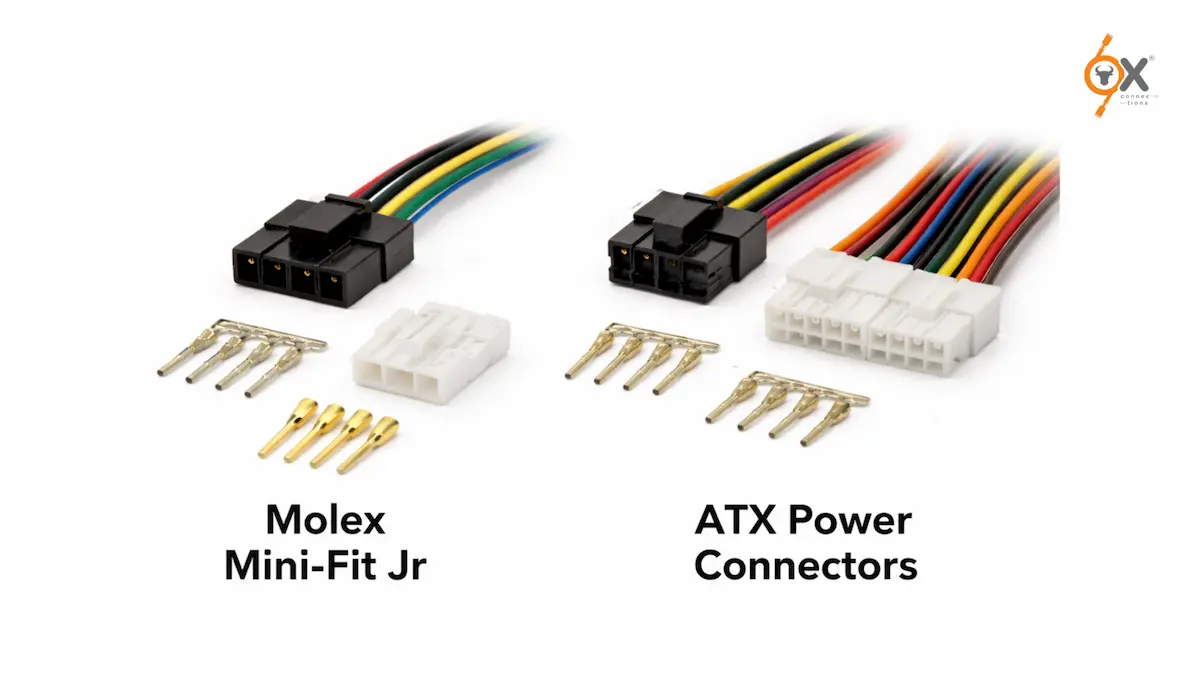
Molex Mini-Fit Jr vs ATX power connectors differ in pinout, current rating, and applications understanding this helps avoid costly mistakes.
If you’ve ever worked with a desktop power supply, industrial control panel, or even an EV charging system, you’ve probably come across connectors that look similar – but behave very differently.
One of the most common questions engineers and buyers ask is this:
Is an ATX power connector the same as a Molex Mini-Fit Jr connector?
At first glance, they seem interchangeable. Both are used for power delivery, both are common in power supply systems, and both are widely used across industries. But when you look closer – especially at pinout, current rating, and application purpose – the differences become much clearer.
This is exactly why understanding Molex Mini-Fit Jr vs ATX power connectors choices matters, especially for manufacturers in India where performance, sourcing, and production timelines all go hand in hand.
Let’s break it down in a practical way.
Understanding the Basics: What Is a Molex Mini-Fit Jr Connector?
The Molex Mini-Fit Jr connector is a wire-to-wire and wire-to-board power connector system designed for medium- to high-current applications.
It is widely used in:
- Computer power supplies
- Industrial automation systems
- Home appliances
- EV subsystems
- Battery management systems
What makes it popular is its balance between compact size and strong power handling. It uses a 4.2 mm pitch and a secure locking mechanism, making it reliable in demanding environments.
Interestingly, many ATX connectors used inside desktop power supplies are actually based on the Mini-Fit Jr family.
That’s where the confusion usually begins.
What Is an ATX Power Connector?
An ATX power connector pinout refers to the specific connector layout used in computer power supply units (PSUs), especially for motherboards and GPUs.
Examples include:
- 24-pin motherboard connector
- 4-pin CPU connector
- 8-pin EPS connector
- PCIe power connectors
These are not separate connector families – they are applications built using Mini-Fit Jr style connectors.
So technically:
- Mini-Fit Jr is the connector system
- ATX is the application standard
This is the most important difference people often miss.
Pinout: Why It Matters So Much
This is where Mini-Fit Jr vs ATX connector comparison becomes practical.
A standard Mini-Fit Jr connector can be configured in multiple circuit sizes depending on industrial use. It’s flexible and application-dependent.
But an ATX power connector pinout follows strict predefined layouts.
For example:
- Specific pins are assigned for +12V
- Others for +5V or +3.3V
- Multiple ground pins are fixed in place
This means while the physical connector may look similar, the wiring must match the correct ATX standard.
Using the wrong pinout can lead to serious damage – not just connector failure, but motherboard or PSU failure too.
This is why professionals always verify pin configuration before assembly.
Current Rating: Performance Under Real Conditions
Another major difference lies in current handling.
The Molex Mini-Fit Jr connector is designed for high current applications and can typically handle significant load per circuit, depending on wire gauge and operating conditions.
However, in ATX applications, the current capacity depends on how the PSU distributes power across multiple pins.
This matters a lot in Indian environments.
In cities like Mumbai, where high ambient temperatures and long operating hours are common, connectors experience more thermal stress. A connector operating close to its limit may heat up much faster than expected.
This is why derating and proper assembly matter more than catalogue specifications.
Reliability and Locking Mechanism
Both systems rely on secure retention, but the use case changes expectations.
The Molex Mini-Fit Jr connector is built for broader industrial reliability – vibration resistance, repeated use, and secure power transfer.
ATX connectors focus more on stable internal system power delivery inside computers and electronic systems.
In manufacturing environments like EV assembly or industrial automation, Mini-Fit Jr connectors are often preferred because they handle harsh conditions better than consumer-grade expectations.
This makes them a strong choice beyond just PSU applications.
Why Indian Manufacturers Need to Think Beyond Just Compatibility
Here’s where the conversation becomes more than technical.
Across India, especially in Mumbai’s manufacturing ecosystem, sourcing original branded connectors often comes with:
- High pricing
- Long lead times
- Large minimum order quantities
For OEMs working on strict deadlines, waiting weeks for imported components is rarely practical.
That’s why many teams are shifting focus from just “brand” to: performance + availability + cost efficiency
This is where we step in at OXConnections.
We provide Mini-Fit Jr compatible connectors that help manufacturers maintain performance without production delays.
Instead of high import dependency, businesses can access:
- Reliable equivalent connectors
- Faster availability across India
- Certifications like UL, RoHS, and CE
- Nearly half the cost compared to traditional branded sourcing
This is especially valuable for industries like solar, home appliances, medical devices, EV manufacturing, and industrial automation.
Which One Should You Choose?
If your application is based on a computer PSU or motherboard system, you’ll need the correct ATX power connector pinout—there’s no shortcut there.
But if you’re working on industrial systems, power modules, battery packs, or equipment where flexibility matters, the Molex Mini-Fit Jr connector offers much broader usability.
This is why the better question isn’t:
“Which one is better?”
It’s: “Which one fits the application correctly?”
That’s where good engineering starts.
Final Thoughts
The discussion around Molex Mini-Fit Jr vs ATX power connectors often creates unnecessary confusion because both are closely related – but they are not the same thing.
ATX refers to a specific power standard, while the Molex Mini-Fit Jr connector is the physical connector family behind many of those systems.
Understanding the correct ATX power connector pinout, current handling, and application purpose helps avoid costly mistakes.
And in India’s fast-moving manufacturing world – especially in cities like Mumbai – those decisions directly impact production speed, reliability, and cost.
Because sometimes, the difference between a smooth production line and an expensive failure comes down to choosing the right connector.