
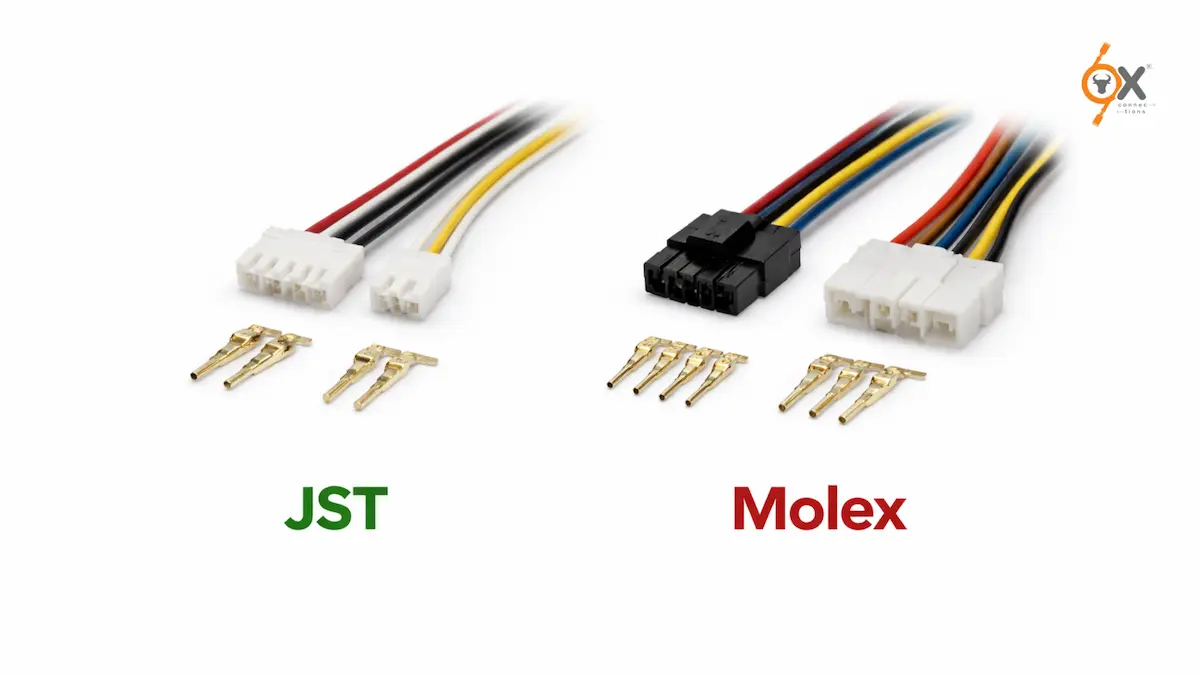
When sourcing connectors for industrial equipment, EV systems, solar applications, home appliances, or medical devices, one question comes up repeatedly: JST vs Molex connectors – which one is better?
Both JST and Molex are globally recognized connector brands used across industries for wire-to-board and wire-to-wire connections. They offer reliable electrical performance, compact designs, and multiple series suited for different applications. But when it comes to pricing, lead times, MOQ requirements, and sourcing flexibility, buyers often find themselves looking for a smarter alternative.
This is where understanding the real difference between JST vs Molex connectors becomes important – not just from an engineering perspective, but also from a procurement and production standpoint.
Let’s break it down.
Understanding JST and Molex Connectors
What Are JST Connectors?
JST (Japan Solderless Terminal) connectors are widely used in compact electronics, consumer appliances, battery packs, automotive electronics, and industrial control systems. Popular series include XH, PH, VH, and SH.
These are known for:
- compact form factor
- secure locking systems
- reliable contact retention
- suitability for PCB applications
Many OEMs use JST connectors for signal transmission and low-to-medium power applications.
What Are Molex Connectors?
Molex connectors are commonly found in industrial automation, power supplies, automotive systems, medical devices, and telecom equipment. Popular families include Micro-Fit, Mini-Fit Jr., KK, and Mega-Fit.
They are known for:
- higher current handling
- rugged housing
- strong mechanical retention
- industrial-grade reliability
Molex is often preferred where higher power and stronger durability are required.
JST vs Molex Connectors : Key Differences
Here’s a practical comparison buyers actually care about:
| Feature | JST Connectors | Molex Connectors |
| Typical Use | Small electronics, appliances | Industrial, EV, power systems |
| Current Rating | Low to medium | Medium to high |
| Connector Size | Compact | Wider range including heavy-duty |
| Locking Strength | Good | Stronger for rugged use |
| Availability | Often MOQ-based | Can be expensive |
| Lead Time | Can be long | Often long for specific series |
| Cost | Premium for original parts | Usually expensive |
This is why many buyers searching for Molex connector alternative options also compare JST equivalents before making a purchase decision.
Current Rating Comparison
One of the biggest selection factors is current capacity.
JST Common Series
- PH Series → around 2A
- XH Series → around 3A
- VH Series → around 10A
Molex Common Series
- KK Series → around 4A
- Micro-Fit 3.0 → around 5A
- Mini-Fit Jr. → around 9A+
- Mega-Fit → significantly higher power handling
This is why Molex is often chosen for power-heavy applications, while JST remains common in control circuits and compact assemblies.
However, connector selection should never be based on current rating alone – temperature rise, mating cycles, vibration, and housing design also matter.
Why Buyers Look for Alternatives
In real procurement situations, technical performance is only half the story.
The bigger challenge is often:
- long procurement cycles
- high minimum order quantities
- expensive branded parts
- production delays due to stock shortages
Original JST and Molex connectors can become expensive, especially for OEMs scaling production or managing cost-sensitive manufacturing.
This is where businesses start searching for a reliable JST connector equivalent or a dependable Molex connector alternative.
The OX Connections Advantage
At OX Connections, we work closely with OEMs across:
- solar manufacturing
- EV systems
- renewable energy
- medical devices
- home appliances
- industrial electronics
Many customers approach us after facing the same issue – JST and Molex connectors are reliable, but expensive, slow to source, and often tied to high MOQ commitments.
OX offers:
- equivalent connector solutions at nearly half the cost
- no long lead times
- ready stock availability
- UL, RoHS, and CE compliant products
- support for bulk OEM requirements
- faster turnaround for production lines
Instead of waiting weeks for imported branded parts, manufacturers can source dependable connector equivalents quickly and efficiently.
That directly impacts production continuity.
Can JST and Molex Be Used Interchangeably?
This is one of the most common questions.
The short answer: not always.
Even if pitch size looks similar, factors like:
- housing dimensions
- latch design
- terminal structure
- current specifications
- pin retention
- mating tolerances
can differ significantly.
For example, a JST XH and a Molex KK may appear similar in pitch, but they are not necessarily drop-in replacements.
This is why choosing a true JST connector equivalent requires proper engineering review – not visual matching.
At OX, this compatibility support becomes part of the solution.
Which One Is Better?
The better question is not JST vs Molex.
It is:
Which connector is right for your application?
Choose JST if:
- you need compact PCB connectors
- the application is signal-focused
- space-saving matters most
Choose Molex if:
- power handling is higher
- vibration resistance matters
- industrial durability is critical
OX equivalent connectors if:
- cost optimization matters
- lead time is urgent
- MOQ flexibility is important
- production continuity is the priority
That is often the real business decision.
Final Thoughts
The debate around JST vs Molex connectors is not simply about which brand is better.
It is about balancing:
- technical performance
- pricing
- sourcing reliability
- production speed
- long-term procurement efficiency
Both JST and Molex are trusted brands. But in today’s manufacturing environment, buyers also need flexibility, faster delivery, and cost control.
That is why more OEMs are actively exploring better sourcing strategies instead of staying locked into expensive connector ecosystems.
If you’re searching for a trusted Molex connector alternative or a high-quality JST connector equivalent, OXConnections helps bridge that gap – with certified solutions, better pricing, and faster supply.
Because in manufacturing, the best connector is the one that performs reliably and arrives on time.
FAQs
1. What is the main difference between JST and Molex connectors?
The main difference in JST vs Molex connectors is their typical application and power handling. JST connectors are commonly used for compact electronics, PCB assemblies, and low-to-medium current applications, while Molex connectors are often preferred for industrial systems, automotive applications, and higher current requirements where stronger mechanical retention is needed.
2. Are JST and Molex connectors interchangeable?
Not always. Even if the pitch size looks similar, differences in housing dimensions, latch design, terminal structure, and current rating can make them incompatible. Before choosing a JST connector equivalent or a Molex connector alternative, proper technical verification is necessary.
3. Why are OEMs looking for Molex connector alternatives?
Many OEMs search for a reliable Molex connector alternative because original branded connectors can be expensive, come with long lead times, and require high MOQs. Equivalent connectors from trusted suppliers like OX Connections help reduce procurement costs while maintaining performance and compliance.
4. Does OX Connections provide JST connector equivalents?
Yes. OX Connections offers high-quality JST connector equivalent solutions and Molex-compatible alternatives for industries like solar, EV, medical devices, home appliances, and renewable energy. These connectors come with UL, RoHS, and CE compliance, better pricing, and faster availability compared to traditional sourcing channels.