
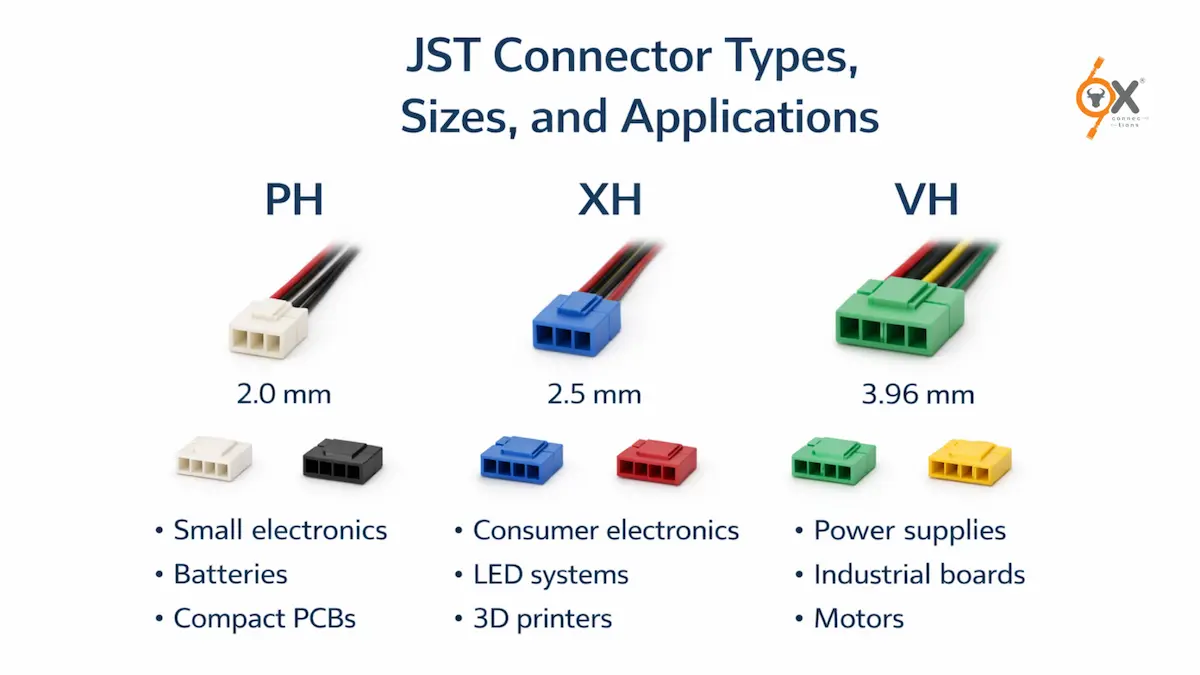
Among the most widely used interconnect solutions, JST connectors remain a preferred choice for engineers and manufacturers. But with multiple series, varying pitch sizes, and application-specific requirements, selecting the right one requires a clear understanding of JST connector types, JST connector sizes, and how to interpret a JST connector size chart effectively.
India’s electronics manufacturing landscape is evolving rapidly – from large OEM hubs in Mumbai and Pune to fast-growing clusters in Bengaluru, Chennai, and Noida. In this environment, even small components like connectors can influence production timelines, product reliability, and overall cost.
This guide breaks it down in a practical, India-focused way.
Understanding JST Connectors in the Indian Context
JST (Japan Solderless Terminal) connectors are commonly used for wire-to-board connections in compact electronic systems. They are valued for:
- Reliable contact design
- Consistent performance in PCB assemblies
- Availability across multiple configurations
However, Indian OEMs – especially in Tier 1 cities like Mumbai and Bengaluru—often deal with additional challenges:
- Tight production deadlines
- Cost sensitivity in large-scale manufacturing
- Import dependencies and sourcing delays
This makes understanding JST connector types and JST connector sizes not just a technical requirement, but a business necessity.
What Are JST Connector Sizes?
When we talk about JST connector sizes, we are primarily referring to the pitch – the distance between two adjacent pins.
Common pitch sizes include:
- 0mm – Compact applications (PH series)
- 5mm – General-purpose use (XH series)
- 96mm – High-power applications (VH series)
In Indian manufacturing, especially in cities like Chennai (appliances) and Pune (automotive/EV), choosing the correct pitch ensures:
- Proper PCB layout compatibility
- Efficient space utilization
- Reliable electrical performance
Using the wrong size can lead to redesign costs or performance issues, which are expensive in high-volume production.
Overview of JST Connector Types
To make the right selection, you need to understand the most commonly used JST connector types:
1. PH Series (2.0mm Pitch)
- Ideal for compact electronics
- Widely used in consumer devices
- Suitable for low-current applications
2. XH Series (2.5mm Pitch)
- One of the most commonly used connectors in India
- Balanced for size and current handling
- Used in home appliances and industrial control boards
3. VH Series (3.96mm Pitch)
- Designed for higher current requirements
- Common in power electronics, solar, and EV systems
- Preferred in industrial setups across Mumbai and Gujarat
4. HY Series
- Used as a functional alternative in certain applications
- Offers flexibility in design and sourcing
Understanding these JST connector types helps engineers align their connector choice with application needs instead of relying on trial and error.
Reading a JST Connector Size Chart
A JST connector size chart is one of the most useful tools for engineers and procurement teams.
Typically, it includes:
- Pitch (mm)
- Current rating (approximate range)
- Voltage rating
- Compatible wire gauge (AWG)
- Application suitability
For example:
- A 2.0mm connector will support lower current and thinner wires
- A 3.96mm connector supports higher current and thicker wires
In cities like Bengaluru, where startups and electronics prototyping are common, engineers frequently rely on a JST connector size chart to quickly validate design decisions before moving to mass production.
Applications Across Indian Industries
Different industries across India rely on specific JST connector types and JST connector sizes based on their requirements.
1. Home Appliances (Mumbai, Chennai)
- Use: Washing machines, air conditioners, microwaves
- Preferred connectors: PH and XH
- Reason: Compact design and moderate current handling
2. Electric Vehicles – EV (Pune, Bengaluru)
- Use: Battery systems, control units
- Preferred connectors: VH
- Reason: Higher current capacity and durability
3. Solar & Renewable Energy (Gujarat, Rajasthan)
- Use: Inverters, junction boxes
- Preferred connectors: VH
- Reason: High power handling and reliability in outdoor conditions
4. Medical Equipment (Hyderabad, Bengaluru)
- Use: Diagnostic devices, monitoring systems
- Preferred connectors: PH/XH
- Reason: Precision and consistent connectivity
Across all these industries, referring to a JST connector size chart ensures the connector matches both electrical and mechanical requirements.
Tier 1 City Comparison: Mumbai vs Bengaluru
Mumbai
- Strong presence of OEMs and trading networks
- Faster access to imported components
- High dependency on reliable supply chains
Bengaluru
- Hub for R&D, prototyping, and startups
- Focus on design flexibility and quick iterations
- Frequent use of connector variants during development
In both cities, engineers prioritize JST connector sizes that align with their design constraints, while procurement teams focus on availability and cost.
Practical Challenges in the Indian Market
While JST connectors are widely used, Indian manufacturers often face:
- Higher costs compared to local expectations
- Long lead times due to import cycles
- High minimum order quantities (MOQs)
- Limited flexibility for small batches
This is particularly challenging for mid-sized OEMs and startups trying to scale quickly.
Smarter Sourcing for Indian OEMs
To address these challenges, many manufacturers are now exploring alternatives that offer:
- Equivalent performance to standard JST connectors
- Faster availability within India
- More flexible order quantities
For example, suppliers like OX provide compatible connector solutions that:
- Deliver similar performance across common JST connector types
- Cover widely used JST connector sizes
- Eliminate long lead times
- Offer certifications such as UL, RoHS, and CE
- Serve OEMs across solar, EV, home appliances, and medical sectors
This shift is helping Indian manufacturers stay competitive without compromising on quality.
Common Mistakes to Avoid
Even with access to a JST connector size chart, mistakes can happen:
- Selecting connectors based only on price
- Ignoring current and voltage requirements
- Choosing incorrect pitch for PCB design
- Overlooking environmental factors like heat and humidity
- Not planning for supply chain delays
A clear understanding of JST connector types and JST connector sizes helps avoid these costly errors.
Final Thoughts
In India’s fast-paced manufacturing ecosystem, connectors are more than just components—they’re critical to product performance and production efficiency.
By understanding JST connector types, evaluating JST connector sizes, and using a JST connector size chart effectively, engineers and OEMs can:
- Improve design accuracy
- Reduce production risks
- Optimize sourcing strategies
- Scale operations with confidence
Whether you’re building in Mumbai, designing in Bengaluru, or manufacturing in Pune, making the right connector choice is a small decision that delivers a big impact.