
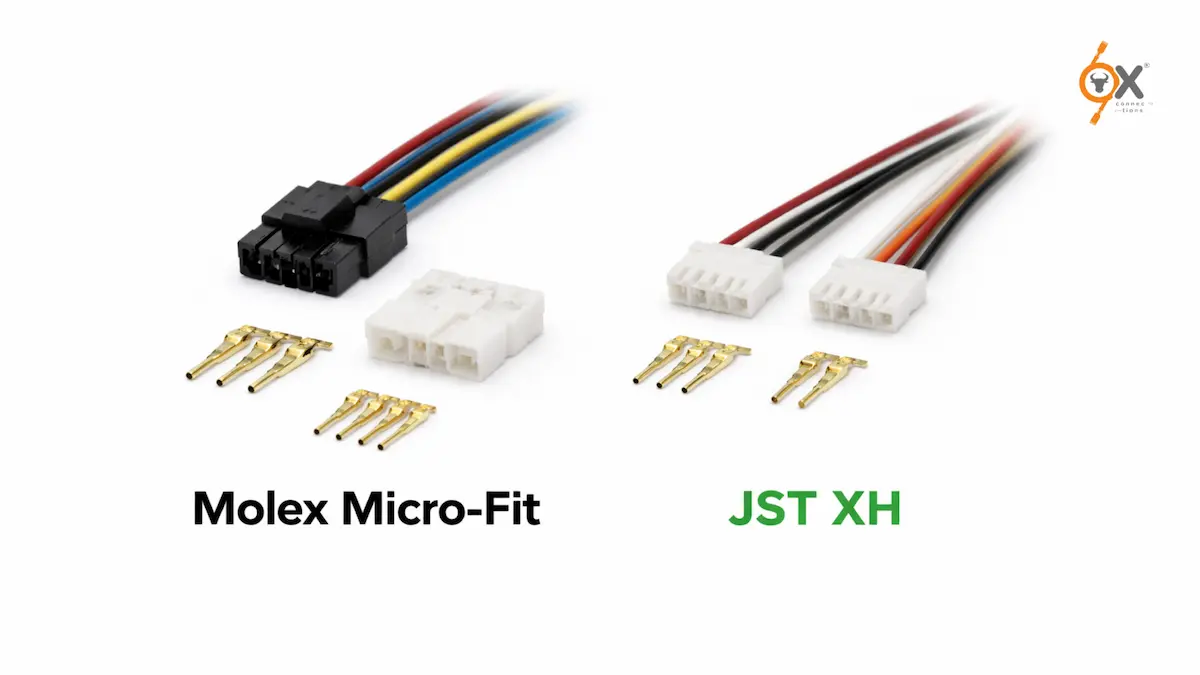
When OEMs choose connectors for industrial equipment, solar systems, EV applications, home appliances, and medical devices, the decision often comes down to one important question – should you go with Molex Micro-Fit vs JST XH?
Both are trusted connector families, but they serve very different purposes. One is built for compact signal applications, while the other is designed for higher current and stronger mechanical reliability.
If you’re comparing Molex Micro-Fit vs JST XH, the answer depends on more than just brand preference. It involves current rating, design requirements, sourcing cost, lead times, and long-term production efficiency.
Let’s break it down in a practical way.
Understanding the Two Connector Types
What Is Molex Micro-Fit?
Molex Micro-Fit 3.0 is a compact wire-to-wire and wire-to-board connector system designed for higher current applications where space is limited. It is widely used in:
- industrial automation
- power supplies
- EV charging systems
- battery management systems
- medical devices
- telecom equipment
Its 3.0 mm pitch allows compact design while still supporting relatively high current loads. It also offers strong locking features and better vibration resistance.
This makes it a strong choice when engineers need performance and durability together.
What Is JST XH?
JST XH is one of the most commonly used PCB connectors in electronics. It is known for its simplicity, reliability, and affordability in compact assemblies.
You’ll commonly find JST XH in:
- consumer electronics
- home appliances
- LED lighting
- control boards
- battery packs
- small industrial systems
It has a 2.5 mm pitch and is mainly used for signal and low-to-medium current applications rather than heavy power transmission.
This is where the main difference in Molex Micro-Fit vs JST XH begins.
Key Comparison: Molex Micro-Fit vs JST XH
Here’s the practical side-by-side comparison:
| Feature | Molex Micro-Fit | JST XH |
| Pitch Size | 3.0 mm | 2.5 mm |
| Current Rating | Higher (up to around 5A+ depending on circuit) | Lower (typically around 3A) |
| Typical Use | Power + signal applications | Signal + low-power PCB applications |
| Locking System | Strong positive lock | Standard friction lock |
| Vibration Resistance | Higher | Moderate |
| Industrial Use | Heavy-duty OEM systems | Small electronics |
| Cost | Higher | Lower |
| Availability | Often expensive |
For power-heavy applications, Molex usually wins. For smaller PCB designs, JST XH often remains the practical choice.
Current Rating Matters More Than People Think
Many buyers compare connectors only by size, but current handling is often the deciding factor.
JST XH is excellent for low-power signal transmission and compact boards. However, if your system handles motors, power modules, battery charging, or industrial loads, JST XH may not be enough.
Molex Micro-Fit is built for applications where heat control, current stability, and secure mating are critical.
That’s why engineers looking for a reliable Molex Micro-Fit alternative must focus on performance – not just physical compatibility.
Why OEMs Start Looking for Alternatives
In real manufacturing, the challenge is rarely just technical.
It is usually procurement.
Many OEMs face:
- high prices for original branded connectors
- long lead times
- import dependency
- large minimum order quantities
- delays in production schedules
This is especially true for Molex and JST branded parts.
That is why buyers actively search for a dependable JST XH connector equivalent or a cost-effective Molex Micro-Fit alternative.
They need reliability without slowing down production.
Where OX Connections Makes the Difference
At OX Connections, we work with OEMs across:
- solar manufacturing
- EV systems
- renewable energy
- home appliances
- medical devices
- industrial electronics
Many customers come to us after facing the same problem – original connectors are good, but expensive and difficult to source quickly.
OX provides equivalent connector solutions that help manufacturers maintain both quality and production speed.
Our advantages include:
- nearly half the cost compared to original branded connectors
- no long lead times
- ready stock availability
- UL, RoHS, and CE compliant solutions
- support for bulk OEM requirements
- faster procurement cycles
Whether you need a trusted JST XH connector equivalent or a reliable Molex Micro-Fit alternative, the goal is simple: keep production moving without unnecessary cost.
That’s where OX becomes a practical partner, not just a supplier.
Which Connector Should You Choose?
If your application involves compact PCB design, signal circuits, and lower current requirements, JST XH is often the better fit.
If your application requires stronger locking, higher current handling, vibration resistance, and industrial durability, Molex Micro-Fit is the stronger option.
But if cost, lead time, and sourcing flexibility are becoming a challenge, connector equivalents from OX can offer a smarter long-term solution.
The best connector is not always the most famous brand – it is the one that performs reliably and arrives when production needs it.
Final Thoughts
The comparison of Molex Micro-Fit vs JST XH is not really about which one is universally better.
It is about selecting the right connector for the right application.
JST XH works brilliantly for compact electronics and control boards.
Molex Micro-Fit performs better in power-focused and industrial environments.
And for OEMs balancing performance with procurement efficiency, trusted alternatives often make the strongest business case.
That is why more manufacturers today are moving beyond brand names and focusing on supply reliability, certifications, and total production cost.
Because in the end, engineering decisions are also business decisions.
FAQs
1. Is Molex Micro-Fit better than JST XH?
It depends on the application. For higher current, stronger locking, and industrial durability, Molex Micro-Fit is usually better. For compact PCB applications and lower current requirements, JST XH is often the better choice.
2. Can JST XH replace Molex Micro-Fit?
Not directly. They differ in pitch size, current rating, housing design, and locking mechanisms. A proper technical review is necessary before selecting a JST XH connector equivalent for replacement.
3. Why do OEMs look for Molex Micro-Fit alternatives?
Most OEMs look for a reliable Molex Micro-Fit alternative because original connectors can be expensive, have long lead times, and require high MOQs. Equivalent solutions from OX help reduce cost while maintaining performance and compliance.