
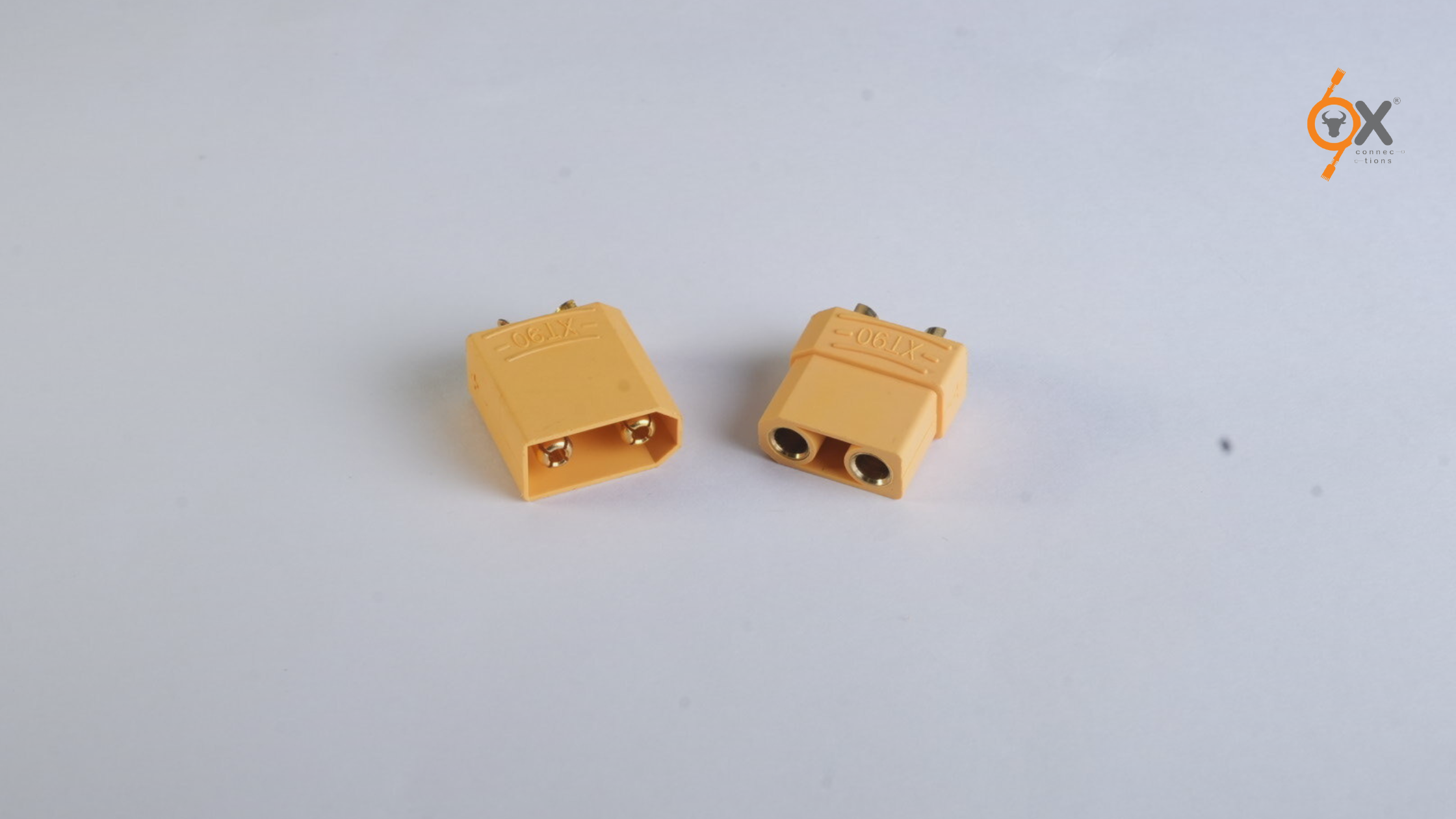
Choosing between XT30 vs XT60 vs XT90 connectors looks simple until real money is on the line. For e-bikes, battery packs, drones, and solar systems, picking the wrong XT connector can lead to overheating, warranty failures, and expensive rework. Most guides either drown you in electrical theory or give conflicting advice. This article breaks the decision down using one practical calculation and real-world examples, so you can confidently choose the correct XT connector size based on current, voltage, and application—no engineering degree required.
The Thing Nobody Tells You About XT30 vs XT60 vs XT90 Connectors
They’re named after their continuous current rating.
XT30 = 30 amps continuous
XT60 = 60 amps continuous
& XT90 = 90 amps continuous
That’s it. That’s the entire naming system.
So why is everyone confused?
Because nobody teaches you the ONE calculation that matters:
Current (Amps) = Power (Watts) ÷ Voltage (Volts)
Example 1: 750W motor, 48V battery
→ 750 ÷ 48 = 15.6 amps
→ XT60 (15.6 is well under 60A rating)
Example 2: 1500W motor, 48V battery
→ 1500 ÷ 48 = 31.2 amps
→ XT60 still works (31.2 < 60A)
→ XT90 if you want extra margin
Example 3: 500W solar panel, 48V system
→ 500 ÷ 48 = 10.4 amps
→ XT30 sufficient (10.4 < 30A)
See? Not complicated.
The Real Comparison: What Actually Matters
Forget the spec sheets. Here’s what you need to know:
| If Your Continuous Current Is… | Use This | Why |
| Under 20A | XT30 | Lighter, cheaper, good enough |
| 20-45A | XT60 | Sweet spot – most e-bikes live here |
| 45-70A | XT90 | High-power e-bikes, large battery packs |
| Over 70A | XT90 or bigger | Or use two XT60 in parallel |
But What About Peak Current? (The Thing That Confuses Everyone)
Scenario: Your motor specs say “80A peak current.”
What most people think: “I need XT90 because 80A!”
What actually matters: Peak lasts 2-3 seconds during hard acceleration. The connector spends 99% of its life handling continuous current.
The rule:
- Size for continuous current (what your system draws during normal operation)
- Add 50% safety margin
- Don’t oversize based on brief acceleration spikes
Example:
- Motor: 1000W continuous, 2000W peak (2 seconds)
- Battery: 48V
- Continuous current: 1000W ÷ 48V = 20.8A
- With margin: 20.8A × 1.5 = 31.2A
- Answer: XT60 (60A rated handles this easily)
Don’t let “peak” scare you into oversizing.
Three applications of XT30 vs XT60 vs XT90 Connectors (And Which XT They Actually Need)
E-Bikes and E-Scooters
36V systems (250-500W):
- Continuous: 7-14A
- XT30 works, XT60 if you like margin
48V systems (500-1500W):
- Continuous: 10-31A
- XT60 is the standard choice
High-power (1500W+, 52V/72V):
- Continuous: 29-55A
- XT90 for peace of mind
Real talk: 90% of e-bikes = XT60. Unless you’re building something extreme, XT60 is your answer.
Battery Packs
The formula: Check battery discharge rating, not capacity.
Example:
- 13S4P battery (48V nominal)
- Each cell: 3A continuous discharge
- 4 cells in parallel = 12A total
- XT30 sufficient, XT60 if future-proofing
Another example:
- High-discharge 10S2P pack
- Each cell: 20A continuous
- 2 cells in parallel = 40A total
- XT60 minimum, XT90 recommended
The mistake: People look at “20Ah capacity” and think bigger connector. Wrong. Capacity ≠ discharge current.
Solar Systems
Match your charge controller input rating:
| Controller Rating | XT Connector |
| Up to 30A | XT30 |
| 30-60A | XT60 |
| 60A+ | XT90 |
Pro tip: Solar doesn’t have “peak” current like motors. Panel output is steady. Sizing is simpler.
The Mistakes That Cost You Money
Mistake 1: “Bigger is Always Safer”
What people do: Use XT90 for a 20A application “just to be safe”
The cost:
- XT90 weighs 2x more than XT60 (matters for drones)
- XT90 costs 40% more
- XT90 needs thicker wire (10AWG vs 12AWG)
Better thinking: Use appropriate size. XT60 at 20A runs cool and costs less.
Mistake 2: “All XT60 Are The Same”
The physics: Contact resistance creates heat. At 40A continuous, this matters.
Quality XT60: 0.5mΩ resistance
→ Heat generated: 0.5mΩ × (40A)² = 0.8W (barely warm)
Fake XT60: 4mΩ resistance
→ Heat generated: 4mΩ × (40A)² = 6.4W (too hot to touch)
That’s an 8x difference in heat generation.
For hobby RC where you run 2-minute cycles? Maybe acceptable.
For production e-bikes running continuous 30-minute commutes? Unacceptable.
Mistake 3: Wrong Wire Gauge
The pairing:
- XT30 → 14-16 AWG wire
- XT60 → 10-12 AWG wire
- XT90 → 8-10 AWG wire
What happens if mismatched:
- Thin wire in big connector = loose connection, arcing
- Thick wire in small connector = won’t fit properly
Match them. Always.
Quality: What You’re Actually Paying For
The marketplace XT60 (₹25-35 typical):
- Contact material: Copper-plated steel
- Spring tension: Weak (loose connection after 20 cycles)
- Housing: Recycled nylon (brittle)
- Testing: None
The quality XT60 (₹45-55 range):
- Contact material: Brass/phosphor bronze
- Spring tension: Consistent (100+ cycles)
- Housing: Virgin nylon, UL94-V0
- Testing: Batch resistance verification
The math for OEMs:
- Price difference: ~₹25/connector × 1,000 = ₹25,000
- Warranty return cost: ONE failure = ₹50,000+
OX Connections: What We Actually Stock
Available now:
- XT30 (30A rated) – Male/Female pairs
- XT60 (60A rated) – Male/Female pairs
- XT90 (90A rated) – Male/Female pairs
Quality standard:
- Imported with material verification
- Contact resistance <0.5mΩ (XT30/60), <0.3mΩ (XT90)
- Consistent batch quality
OEM support:
- Volume orders: 500-10,000+ pieces
- Application sizing consultation
- Custom specifications available
- Batch testing data on request
Not Sure Which Size You Need?
Send us three numbers:
- Voltage (V)
- Power (W) OR Current (A)
- Application (e-bike/drone/solar/battery pack)
We’ll reply with:
- Calculated continuous current
- Recommended XT connector
- Wire gauge suggestion
Quick Answers to Questions You’re Probably Googling Right Now
Q: Can I use XT60 for a 30A application?
A: Yes. That’s 50% of rated capacity. Runs cool, long lifespan. Smart choice.
Q: My motor says “80A peak” – do I need XT90?
A: Probably not. What’s continuous current? Most motors: continuous = 40-50% of peak. If it’s under 45A continuous, XT60 handles it. Over 45A continuous, consider XT90 for better thermal performance.
Q: XT30 vs XT60 for 500W 36V e-bike?
A: 500W ÷ 36V = 13.9A continuous. XT30 works (13.9 < 30A). XT60 if you want headroom for future motor upgrade.
Q: Can I mix XT30 and XT60 in same system?
A: Physically they won’t mate (different sizes). Electrically fine if each connector sized for current at that point.
Q: How do I know if my connectors are fake?
A: Measure contact resistance with multimeter. >2mΩ = suspicious. Quality should be <0.5mΩ. Or request test data from supplier.
Q: Wire gauge for XT60?
A: 10-12 AWG recommended. But here’s what matters more: your wire must handle the current. If you’re running 50A continuous, you need 10AWG minimum regardless of connector size. The connector doesn’t fix undersized wire.
The Bottom Line
Sizing XT connectors:
- Calculate continuous current (Watts ÷ Volts)
- Add 50% margin
- Match to XT30 (30A) / XT60 (60A) / XT90 (90A)
- Verify wire gauge matches connector
Most common answer: XT60
When to size up: High current (>45A continuous) or want future upgrade headroom
When to size down: Weight-critical (drones) and current <15A
Quality matters when:
- Production/OEM (warranty liability)
- High current (>40A continuous)
- Safety-critical (e-bikes, battery packs)
Quality optional when:
- Prototyping/testing
- Low current (<20A)
- Hobby/personal use
Need sizing help? Three numbers. One email. 24-hour response.
om.advani@oxconnections.com
Subject: “XT connector sizing”
Include: Voltage, Power/Current, Application