
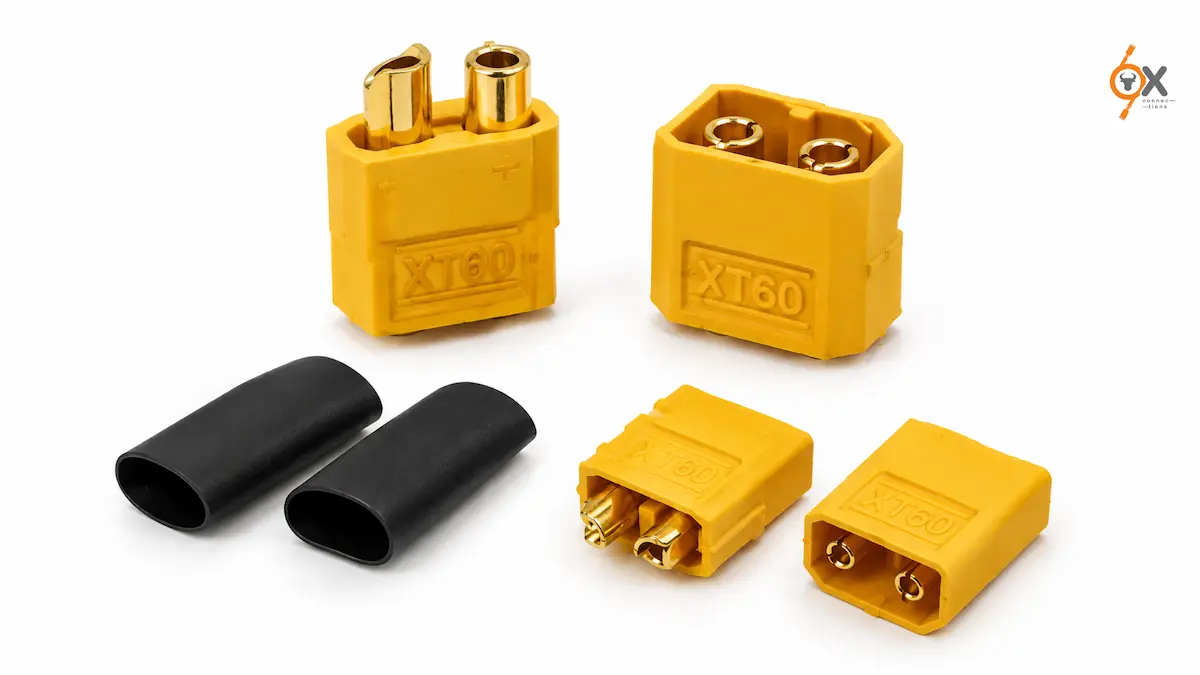
What happens to a connector rated for 30A the moment your circuit starts pulling 45? It heats up, the housing softens, and the joint you trusted starts to fail quietly, long before anything trips. This is the exact gap the XT60 connector is built to close. It sits in the middle of the XT family, carrying meaningfully more current than an XT30 while staying far more compact than the larger XT90.
What Is an XT60 Connector?
The XT60 connector is a two-pin, polarised connector rated for around 60A continuous current, with a short surge tolerance well above that.
Like the rest of the XT range, its housing has male and female halves that only mate one way. This removes the guesswork and the risk of a reversed-polarity connection during assembly.
The contact pins are noticeably thicker than an XT30’s. This allows the higher current rating without a large jump in housing size.
It remains cable mounted and hand-solderable, so it fits into existing production workflows without needing specialised tooling.
Where XT60 Connectors Are Actually Used
The clearest way to map XT60 connector applications is by mid-range continuous load. This is the band that sits above what an XT30 comfortably handles and below where an XT90 becomes necessary.
Mid-size battery packs and lithium modules: packs in the 500W to 1500W range typically draw well within XT60’s window.
This makes it the default choice for e-bike, e-rickshaw, and portable storage battery leads in Indian production lines. Solar charge controllers: a 1kW panel array on a 24V system draws roughly 40A.
This sits comfortably inside XT60’s rated capacity with reasonable headroom. RC cars, boats, and larger drones: this is where XT60 first became an industry standard.
It remains the default across mid-power RC electronics. Portable power stations and backup units: mid-capacity units that need a quick-disconnect battery lead often standardise on XT60 over bulkier alternatives.
XT60 vs. XT30 vs. XT90: Getting the Size Right
Sizing a connector off a datasheet’s peak current figure is a common and costly mistake. Peak current is a brief spike, usually a few seconds during startup.
The connector spends nearly all its working life carrying the continuous load. If your circuit’s continuous draw sits between roughly 30A and 60A, XT60 is the right call.
Going with an XT90 in that range adds cost and bulk with no real benefit. An XT30 would run hot under sustained load.
Wire gauge has to match the connector’s rating too. A correctly rated XT60 connector on undersized wire will not protect the circuit. The wire, not the connector, becomes the weak point.
Sourcing XT60 Connectors in India
For OEMs building e-bike, solar, and portable power products out of Pune, Bengaluru, Chennai, and the NCR belt, XT60 availability is usually the bottleneck, not the design.
Import lead times of 12 to 16 weeks are common when sourcing from overseas suppliers. That timeline stretches further during the monsoon shipping season into Indian ports.
Before locking in an XT60 connector India supplier, confirm three things:
- genuine local stock versus import-on-demand
- consistent contact and housing quality across batches
- the ability to support both a prototype run and a full production order without a fresh quote cycle each time
Installation Tips for a Reliable XT60 Connection
A connector is only as good as the joint behind it. When soldering an XT60 connector onto a wire, pre-tin both the wire end and the contact pin before joining them.
This gives a stronger bond than trying to melt solder into the joint cold. Use heat-shrink tubing over each contact individually before sliding the outer housing sleeve on.
A bare joint touching its neighbour under vibration is a common cause of intermittent connections in battery packs. Avoid over-heating the housing itself. XT60 shells can handle reasonable soldering temperatures, but prolonged direct heat can soften the plastic around the contact.
This can loosen the pin’s fit over time. A fast, well-tinned joint beats a slow one every time, both electrically and mechanically.
Common Mistakes to Avoid with XT60 Connectors
Two errors show up repeatedly on production floors. The first is mixing connector generations or third-party clones with genuine XT60 housings.
Tolerances shift slightly between manufacturers, and a loose-fitting pair can arc under load even though both sides are individually rated for 60A.
The second is skipping a pull test after assembly. A connector that looks correctly soldered can still have a cold joint that only fails once the pack is under real vibration in the field.
A quick tug test before final assembly catches most of these before they leave the line.
Getting the Right Fit for Your Build
XT60 sits at a genuinely useful middle ground. It provides enough current headroom for real battery loads without the size penalty of the larger XT90.
Match it to your continuous draw, size your wire correctly, install it with clean solder joints, and choose a supplier that can deliver on your production timeline, not just your prototype.
OxConnections stocks XT-series connectors, including XT60, ready for dispatch from Indian warehouses.
This means OEMs building e-bike, solar, and portable power products are not left waiting on an overseas shipment. Share your current rating and volume, and the team can confirm fit and availability directly.
Frequently Asked Questions
1. What is the current rating of an XT60 connector?
An XT60 connector handles approximately 60A continuous current, with a short-duration surge tolerance above that figure.
This places it above the XT30 and below the XT90 in the same connector family.
2. When should I choose XT60 instead of XT30 or XT90?
Base the decision on your circuit’s continuous draw, not its peak. If that figure sits roughly between 30A and 60A, XT60 is the right size.
An XT30 would run hot under sustained load. An XT90 adds unnecessary bulk and cost for no real benefit at that current level.
3. Are XT60 connectors readily available in India, or do they need to be imported?
Availability depends on the supplier. Some Indian distributors hold genuine local stock, while others source on an import-on-demand basis with lead times of 12 to 16 weeks. It is worth confirming actual stock status, not just listed availability, before committing to a production timeline.