
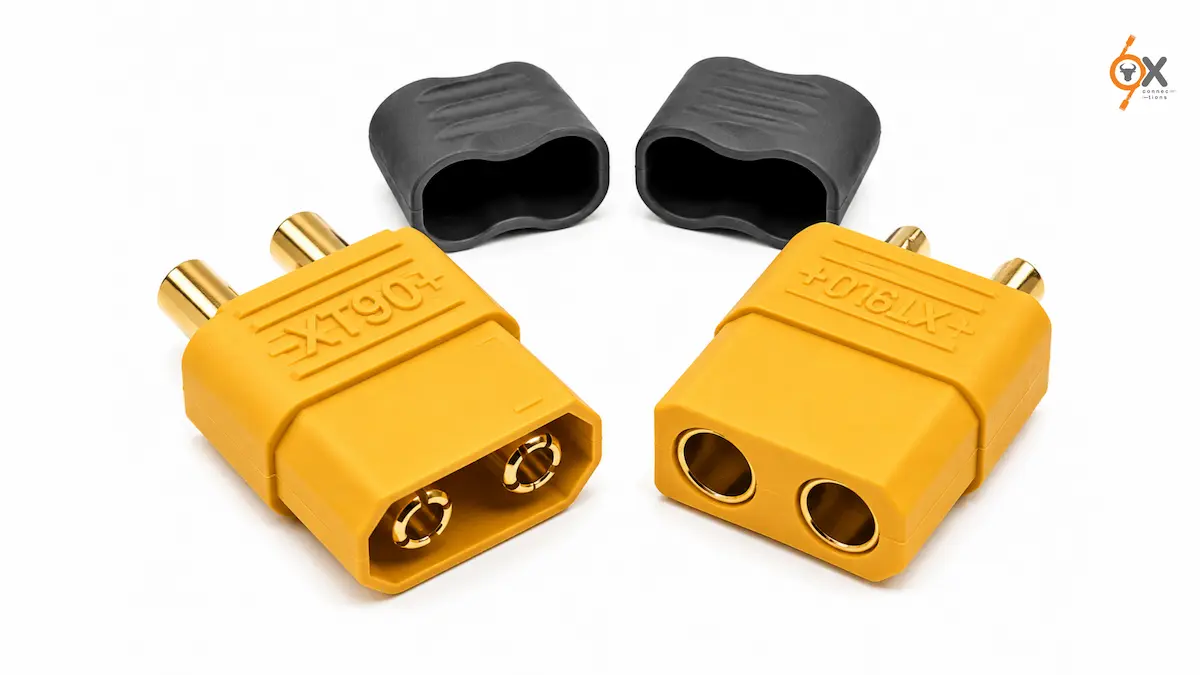
What connector do you reach for when a circuit is pulling well past 60A and failure isn’t an option? At that current level, a standard XT60 starts running hot, and a loose or undersized joint can become a genuine safety risk rather than just an inconvenience. This is where the XT90 connector comes in, the largest and highest-current member of the XT family, built for the heaviest loads a compact bullet connector can safely carry.
What Is an XT90 Connector?
The XT90 connector has two polarised pins. It supports approximately 90A of continuous current, with a surge rating that goes considerably higher for brief periods. The housing is visibly larger than an XT60’s, with thicker gold-plated contact pins. These are designed to keep resistance, and therefore heat build-up, to a minimum under sustained heavy load.
Like the rest of the XT range, the male and female halves use a one-way mating design. This removes the risk of a reversed connection during assembly or field replacement. XT90 uses a cable-mounted, hand-solderable design. The larger pin size does demand a higher-wattage soldering iron than an XT30 or XT60 would need.
Where XT90 Connectors Are Actually Used
The clearest way to map XT90 connector applications is by identifying circuits where continuous current regularly exceeds 60A. This is the point at which an XT60 stops being the safer choice.
Large lithium battery packs and EV-adjacent systems: e-bike and e-rickshaw battery packs at the higher end of the power range. Light EV subsystems also routinely draw current that calls for XT90-level headroom.
High-capacity solar installations: a 2kW panel array on a 24V system draws close to 80A. This sits comfortably within XT90’s rated capacity, where an XT60 would be pushed to its limit.
Large drones and heavy-lift RC platforms: bigger multirotor builds and RC boats with high-power motors rely on XT90. These connectors handle current draw that would overheat a smaller connector.
Industrial and backup power systems: battery banks feeding inverters or backup power units in commercial installations often standardise on XT90 for the main power leads.
XT90 vs. XT60: Knowing When You Actually Need It
The most common sizing mistake in this range works in both directions. Some engineers under-specify and use XT60 on a circuit that regularly exceeds 60A. This risks heat damage over time. Others over-specify, fitting an XT90 onto a circuit that peaks briefly but rarely sustains high current. This adds unnecessary bulk and cost to the harness. The deciding factor is always the continuous current your circuit carries in normal operation, not the occasional peak.
Wire gauge needs to scale with the connector too. At 80 to 90A continuous, undersized wire becomes a fire risk well before the connector itself is the limiting factor. This is not a spec to estimate loosely.
Sourcing XT90 Connectors in India
For OEMs building e-bike, solar, and industrial battery systems out of Pune, Bengaluru, Chennai, and the NCR belt, XT90 tends to be harder to source locally than its smaller siblings. Demand and stock volumes are both lower. Many overseas suppliers quote import lead times of 12 to 16 weeks. That window often stretches further during the monsoon shipping season into Indian ports.
Before finalising an XT90 connector India supplier, confirm genuine local stock versus import-on-demand. Also confirm consistent pin plating and housing tolerance across batches. Check whether the supplier can support both a prototype order and a full production run without a fresh quote each time.
Installation Tips for a Safe XT90 Connection
Given the current this connector carries, joint quality matters even more here than on smaller XT parts. Pre-tin both the wire and the contact pin before soldering. Use a soldering iron rated for the larger thermal mass of the XT90 pin. An underpowered iron will produce a cold joint that looks fine but fails under load.
Heat-shrink each contact individually before sliding on the outer housing. Always run a pull test after assembly. A marginal joint at 90A fails faster and hotter than the same fault would on an XT30 or XT60.
Getting the Right Fit for Your Build
XT90 is not a connector to reach for by default. It is the right call specifically when continuous current regularly runs past 60A. Using it there gives real headroom and safety margin that a smaller connector cannot.
Match it to your actual load, size your wire correctly, and source from a supplier that can back a production timeline.
OxConnections stocks XT-series connectors, including XT90, ready for dispatch from Indian warehouses. This means OEMs building high-current battery, solar, and industrial power systems are not left waiting on an overseas shipment. Share your current rating and volume, and the team can confirm fit and availability directly.
Frequently Asked Questions
1. What is the current rating of an XT90 connector?
An XT90 connector is rated for approximately 90A continuous current, with a higher short-duration surge tolerance. It is the highest-current option in the standard XT connector range. It sits above both XT30 and XT60.
2. When should I choose XT90 instead of XT60?
Base the decision on continuous current, not peak draw. If your circuit regularly exceeds 60A during normal operation, XT90 gives the safety margin an XT60 cannot. Using XT60 in that range risks heat build-up over time.
3. Is XT90 easy to source in India, or does it usually need to be imported?
Suppliers generally hold less local stock of XT90 than XT30 or XT60 because demand volumes are lower. Many suppliers work on an import-on-demand basis with lead times of 12 to 16 weeks. It is worth confirming genuine stock availability before committing to a production schedule.