
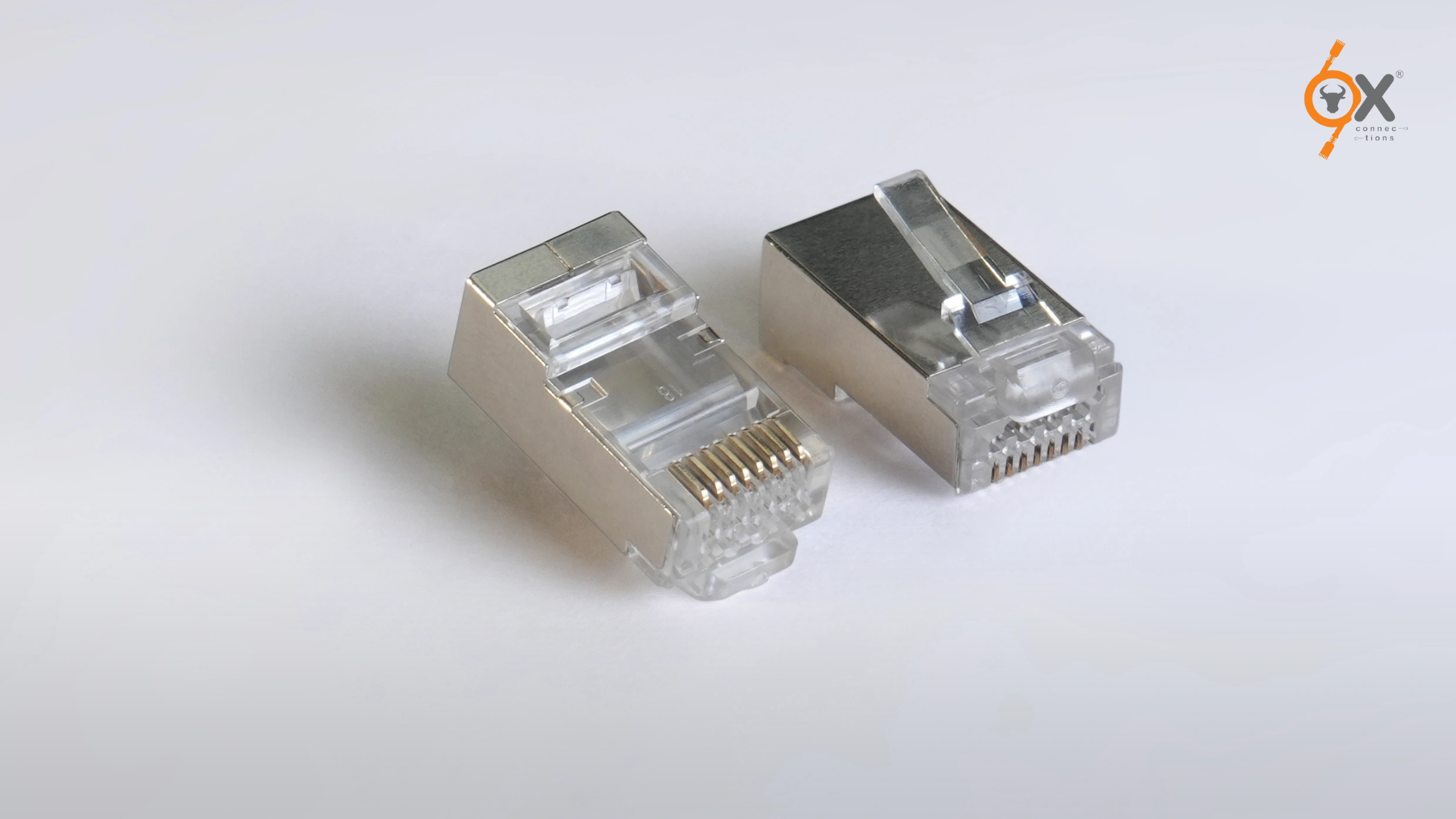
An RJ45 connector is a standardized Ethernet connector used to terminate twisted-pair network cables and connect devices within a local area network. Commonly found on Ethernet cables, routers, switches, and computers, the RJ45 connector enables reliable data transmission for wired networking. Its simple modular design supports high-speed communication, making the RJ45 connector a foundational component in modern networking systems.
Why RJ45 Connector Terminations Fail: The Three Most Common Causes
Before choosing connectors, understand why terminations fail:
- Wrong Connector Design for Cable Type
The problem: Solid wire vs stranded wire require different contact designs.
Solid wire (building installations):
- Contacts have piercing blades that bite into solid conductors
- Designed for 22-24 AWG solid copper
- NOT compatible with stranded wire
Stranded wire (patch cables, flexible applications):
- Contacts have crimping channels for stranded bundles
- Designed for 24-26 AWG stranded copper
- Will NOT reliably terminate solid wire
Mixing these = intermittent connections, failures under vibration, contact resistance issues.
Most “universal” connectors compromise on both types and excel at neither.
- Poor Quality Contact Plating
What fails:
- Thin or missing gold plating on contacts
- Oxidation on exposed copper
- Inconsistent contact spring tension
Quality indicators:
- 50-microinch gold plating minimum (check specifications)
- Phosphor bronze or beryllium copper contacts (not plain brass)
- Visible consistent plating on all 8 contacts
Cheap connectors: Often have 10-15 microinch plating or no gold at all. Works initially, degrades within months.
- Inadequate Cable Strain Relief
The failure mode: Cable pulls out of connector under normal handling.
What to check:
- Boot design: Should grip cable jacket firmly
- Crimp bar: Must compress onto cable jacket, not just conductors
- Material: Flexible but strong (not brittle plastic)
Cheap connectors use hard plastic boots that crack during crimping or become brittle over time.
Understanding RJ45 Categories: Cat5e, Cat6, Cat6a
Common misconception: “RJ45 is RJ45. Any connector works with any cable.”
Reality: Cable category determines connector requirements.
| Specification | Cat5e | Cat6 | Cat6a |
| Frequency | 100 MHz | 250 MHz | 500 MHz |
| Contact Spacing | Standard 8P8C | Tighter tolerance | Precision alignment |
| Crosstalk Requirements | Basic | Strict NEXT/FEXT | Very strict AXT |
| Contact Plating | 50μ” gold minimum | 50μ” gold required | 50μ” gold required |
| Cable Compatibility | 24 AWG typical | 23-24 AWG | 23 AWG standard |
Key differences that matter:
Cat5e connectors:
- Work for 10/100/1000 Mbps Ethernet
- Less stringent manufacturing tolerances
- Acceptable for most office networks
- Lower cost
Cat6 connectors:
- Required for certified Cat6 installations
- Tighter contact alignment for crosstalk control
- Improved shielding (if using shielded cable)
- Tested to 250 MHz
Cat6a connectors:
- Necessary for 10 Gigabit Ethernet over copper
- Precision-engineered contact geometry
- Often require load bars for proper alignment
- Significantly more expensive
Critical point: Using Cat5e connectors on Cat6 cable = system performs at Cat5e speeds. The connector is the limiting factor.
Shielded vs Unshielded: Application Requirements
Unshielded (UTP) connectors – Standard choice:
- Office and residential environments (90% of installations)
- Indoor, climate-controlled spaces
- Cable runs away from interference sources
- Simpler termination, lower cost
Shielded (STP/FTP) connectors – When needed:
- High EMI environments (near motors, VFDs, power lines)
- Data centers and server rooms
- Industrial equipment requiring noise immunity
- Outdoor installations
Critical: Shielding only works if cable shield connects through connector to equipment ground. Shielded cable + unshielded connector = no benefit.
Industrial-grade options (shielded or unshielded):
For harsh environment applications beyond standard office/residential use:
- IP-rated housings (IP67/IP68 protection from dust/moisture)
- Metal shells (mechanical strength, enhanced EMI shielding)
- Locking mechanisms (vibration-resistant, prevents accidental disconnection)
- Extended temperature (-40°C to +85°C vs standard 0°C to +60°C)
Applications: Factory automation, outdoor cameras, transportation systems, oil & gas, medical equipment.
Cost: 3-5x standard connectors, justified when downtime prevention matters (₹50 connector prevents ₹50,000/hour production loss).
How to Verify Connector Quality Before Bulk Orders
Order samples from 2-3 suppliers. Test these:
Visual Inspection
Good signs:
- Consistent gold plating on all 8 contacts (no copper showing)
- Smooth housing, no burrs or flash
- Clear markings: Cat rating, manufacturer info
Red flags:
- Uneven plating, exposed copper
- Poor molding quality
- No markings or vague “Cat6 compatible” only
Physical Testing
Contact grip test:
- Insert/remove wire in contact channel
- Should grip firmly and consistently across all 8 contacts
Boot strength:
- Crimp onto cable, pull-test
- Should require 20+ pounds to separate
- Boot shouldn’t crack
Housing integrity:
- Crimp normally (don’t over-crimp)
- Check for cracks around latch or contacts
- Quality connectors withstand proper crimping
Installation Trial
Terminate 10 connectors from each supplier:
- Count failures during crimping
- Quality connectors: <5% failure rate
- Poor connectors: 15-30% failure rate
This 30-minute test saves hours of re-work on actual job.
Common Installation Mistakes to Avoid
Mistake 1: Using Pass-Through Connectors Without Proper Tool
Pass-through design: Wire extends through connector, crimped and trimmed in one operation.
Requires: Specific pass-through crimp tool (different from standard tool).
Common error: Using standard crimp tool on pass-through connectors = incomplete crimp, failures.
Mistake 2: Over-Untwisting Cable Pairs
The rule: Untwist maximum 12.5mm (0.5 inch) of cable pairs.
Why critical: Cat6/Cat6a performance depends on pair twist maintaining signal balance.
Common error: Untwisting 20-30mm for easier wire insertion = crosstalk, failed certification tests.
Mistake 3: Not Verifying Cable Gauge Compatibility
Cable gauge varies: 22 AWG (thick), 23 AWG (standard), 24 AWG (thin), 26 AWG (very thin stranded).
Connector compatibility: Most rated for 23-24 AWG.
Mismatch issues:
- 22 AWG in 24 AWG connector = difficult crimp, poor connection
- 26 AWG in 23 AWG connector = loose fit, unreliable
Solution: Check connector specifications against actual cable gauge before ordering bulk.
Mistake 4: Mixing Solid and Stranded Connector Types
Not interchangeable:
- Solid wire connectors use piercing contacts (won’t grip stranded properly)
- Stranded wire connectors use crimp channels (won’t pierce solid reliably)
Solution: Label connector stock clearly. Keep separate containers.
OX Connections RJ45 Connector Solutions
OX Connections RJ45 connectors are imported with focus on industrial and OEM applications where reliability matters.
Available categories:
- Cat5e, Cat6, Cat6a rated connectors
- Shielded and unshielded versions
- Solid wire and stranded wire types
- Standard and industrial-grade options
Quality features:
- 50-microinch gold plating on all contacts
- Phosphor bronze contact material
- Proper strain relief design
- Tested for rated category performance
Target applications:
- OEM equipment manufacturers requiring reliable connectivity
- Industrial automation and control systems
- Professional network installations demanding certified performance
- System integrators specifying quality components
Frequently Asked Questions
Q: Can I use Cat6 connectors on Cat5e cable?
A: Yes, Cat6 connectors work with Cat5e cable. You get Cat5e performance (limited by cable, not connector). Going the other way (Cat5e connector on Cat6 cable) limits system to Cat5e performance.
Q: How do I know if I need shielded connectors?
A: If you’re using shielded cable (STP/FTP), you MUST use shielded connectors. If using unshielded cable (UTP), shielded connectors provide no benefit. Match connector to cable type.
Q: What’s the difference between 2-piece and 3-piece connectors?
A: 2-piece: connector body + boot. 3-piece: adds separate load bar for wire alignment. 3-piece designs (common in Cat6/Cat6a) provide better alignment and easier termination for thick cables.
Q: Can I mix brands between cable and connectors?
A: Yes, but verify gauge compatibility. For certified installations, some certification programs require cable and connectors from same manufacturer. Check your certification requirements.
Q: Why do some connectors cost ₹3 and others ₹10+?
A: Contact plating quality, plastic material (virgin vs recycled), manufacturing tolerances, and testing. ₹3 connectors often have thin/no gold plating and loose tolerances. ₹8-12 connectors typically have proper plating and consistent quality. For professional work, the price difference is minimal compared to re-work costs.
Q: How many connectors should I expect to waste during installation?
A: With quality connectors and proper technique: 2-5% waste is normal. With poor quality connectors: 15-30% failure rate is common. Budget accordingly.
Conclusion
RJ45 connector selection isn’t about finding the cheapest option on the market. It’s about matching connector specifications to your cable type, understanding the environment, and choosing quality that prevents failures during installation and operation.
The economics are clear: A ₹4 difference in connector cost (₹6 quality vs ₹10 industrial) is negligible compared to:
- Re-work time (₹200-500 per hour labor)
- Wasted connectors and cable
- Failed certification tests
- Customer callbacks for intermittent connections
For professional installations—whether commercial network builds or industrial equipment connectivity—the connector is not the place to cut costs.
Key takeaways:
- Match connector to cable type (solid vs stranded, Cat rating, gauge)
- Verify quality before bulk orders (test samples, check plating, measure contact resistance)
- Use shielded connectors only with shielded cable (and ground properly)
- Don’t over-untwist cable pairs (12.5mm maximum for Cat6/Cat6a)
- Consider industrial-grade for harsh environments (vibration, temperature, outdoor)
For technical guidance on connector selection:
Whether you’re specifying for a new installation, troubleshooting failures, or evaluating suppliers, OX Connections provides application-specific recommendations.
📧 om.advani@oxconnections.com
📞 9152394134
Subject: “RJ45 technical consultation – [your application]”
Include: Cable type, environment, quantity needed, any specific requirements.
Response time: 24-48 hours with technical recommendations and product specifications.
 Tags:
Tags: