
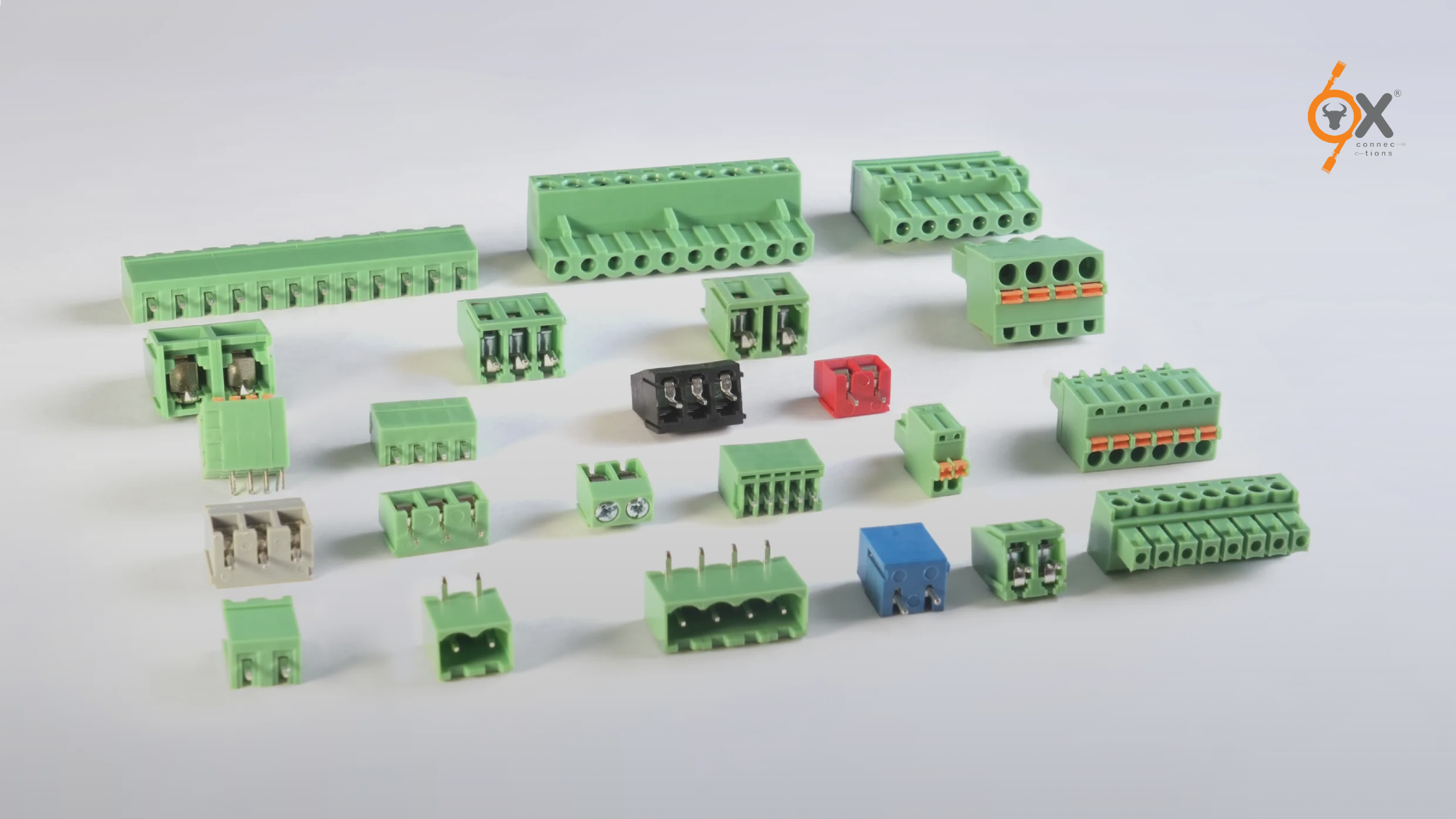
Complete Terminal Block selection guide for control panels. Compare Phoenix Contact vs alternatives. Specs, certifications, pricing for Indian OEMs.
Terminal Block Basics: What You’re Actually Choosing
Before comparing brands or prices, it’s important to understand what a terminal block actually does and which parameters matter for your application.
A terminal block is not just a plastic connector. It is a current-carrying, safety-critical component that affects panel reliability, certification approval, and long-term maintenance.
Connection Methods Explained
Screw terminals
The most common and widely accepted method. Wires are clamped using screw pressure, offering strong mechanical retention and long-term reliability.
Push-in / spring-cage terminals
Tool-free wire insertion, faster assembly, and consistent clamping force. Increasingly popular in high-volume panel production.
Combination terminals
Support both screw and push-in methods in the same block, offering flexibility for installers and maintenance teams.
Key Terminal Block Specifications
| Specification | What It Means | Typical Range |
| Pitch | Center-to-center spacing between terminals | 2.5mm – 10mm |
| Current Rating | Maximum continuous current | 10A – 125A+ |
| Voltage Rating | Maximum working voltage | 300V – 1000V |
| Wire Size | Acceptable conductor size | 0.2mm² – 35mm² |
| DIN Rail | Mounting standard | 35mm (industry standard) |
Important: A lighting control panel, HVAC system, and 3‑phase motor panel all require very different terminal block ratings. Always size for the application, not convenience.
The Four Critical Criteria for Terminal Block Selection
- Current Rating (Never Undersize)
Terminal blocks must be selected with a thermal safety margin, not just nominal current.
Example:
- Circuit current: 18A continuous
- Panel ambient temperature: 45°C
- Recommended derating: ~30%
Correct choice: Terminal rated 24A or higher
Common industrial current ratings include:
10A, 15A, 20A, 24A, 30A, 41A, 76A, 125A
Undersizing terminals leads to heat buildup, loose connections, and audit failures.
- Wire Size Compatibility
The wire must match the terminal block’s clamping range.
- Small wire in a large terminal = poor contact
- Large wire in a small terminal = won’t fit
Typical guidelines:
- 2.5mm pitch → up to 2.5mm² (AWG 14)
- 5.0mm pitch → up to 6mm² (AWG 10)
- 7.5mm pitch → up to 16mm² (AWG 6)
- 10mm pitch → up to 35mm² (AWG 2)
Always verify datasheets before finalizing.
- Certifications & Compliance
For commercial and industrial panels, certifications are non-negotiable:
- UL Recognition – required for North America and many Indian OEMs
- CE Marking – European compliance, increasingly demanded in India
- RoHS Compliance – environmental requirement
- IEC 60947 – international low-voltage switchgear standard
- Flammability Rating – UL94‑V0 preferred
Without proper certifications, your panel may fail customer audits or third‑party approvals.
- Environmental Conditions
Standard terminals work for most indoor panels. Upgrade if you face:
- High vibration → enhanced wire retention designs
- Extreme temperatures → verify -40°C to +105°C ratings
- Humidity or dust → better material quality and IP protection
Premium Terminal Block Brands vs Practical Requirements
Many panel builders automatically specify Phoenix Contact, Wago, or Weidmuller because:
- “That’s what we’ve always used”
- “Customers recognize the brand”
But the real question is:
Does your application truly require premium-brand features, or are you paying mainly for brand recognition?
What Premium Brands Offer
- Global brand acceptance
- Extremely wide product portfolios
- Proprietary connection technologies
- Specialized ratings for harsh or niche environments
What Most Panels Actually Need
- UL and CE certified terminal blocks
- Standard current ratings (10A–125A)
- Standard pitch sizes (2.5mm–10mm)
- Reliable screw or push-in connections
- 35mm DIN rail mounting
- Fast availability at competitive cost
If your customer mandates a specific brand or you need specialized features, premium brands make sense.
If not, certified alternatives provide the same functional performance at significantly lower cost.
When Cost-Effective Alternatives Like Xinlaiya Make Sense
Xinlaiya (also known as Xinya) terminal blocks are manufactured in China and supplied with UL, CE, RoHS, and IEC compliance.
They are designed for standard industrial and commercial control panels, not experimental or unproven use.
Typical Applications
- Power distribution panels
- HVAC control panels
- Lighting control systems
- Industrial machinery control boxes
- Building automation systems
- Motor control centers
Why Xinlaiya Is a Viable Choice
- UL recognized, CE marked, RoHS compliant
- Standard IEC designs
- 2.5mm to 10mm pitch
- 10A to 125A+ current ratings
- Screw and push-in types available
- 35mm DIN rail compatibility
The trade-off is simple: you get functional equivalence, not brand prestige.
Phoenix Contact vs Xinlaiya: Practical Comparison
| Factor | Phoenix Contact | Xinlaiya (via OX) |
| Manufacturing | Germany | China |
| Certifications | UL, CE, VDE, IEC | UL, CE, RoHS, IEC |
| Pitch Range | 2.5mm – 10mm+ | 2.5mm – 10mm |
| Current Range | 6A – 232A | 10A – 125A+ |
| Connection Types | Screw, Push-in, Combo | Screw, Push-in |
| Lead Time (India) | 6–8 weeks | 2–3 days ex-stock |
| MOQ | Often 500+ | 10 – 50,000+ |
| Pricing | Premium | ~50% of Phoenix |
Illustrative market pricing:
- Phoenix Contact 5.0mm / 24A: ₹80–100
- Xinlaiya equivalent: ₹40–50
Same rating. Same certification. Roughly half the cost.
OX Connections: Xinlaiya Stock Availability
Ex-stock, fast-moving models:
- 126 Series – 2.5mm pitch, 10A–20A
- 127 Series – 3.5mm pitch, 15A–24A
- 128 Series – 5.0mm pitch, 20A–30A
- 129 Series – 7.5mm pitch, 30A–41A
Also available:
- Push-in terminals
- Barrier terminal blocks
- End plates, jumpers, markers
Lead Time:
- Ex-stock: 2–3 days (often next-day)
- Non-standard specs: 4–6 weeks
MOQ: 10 pieces to 50,000+ — no forced overbuying.
How to Decide What’s Right for Your Application
Choose Xinlaiya If:
- You build standard control or power panels
- Cost sensitivity matters
- You need fast delivery
- Certifications (UL/CE) are required
- Operating range is standard (-25°C to +85°C)
Evaluate Carefully If:
- Customer contract mandates premium brands
- Extreme environmental or safety-critical conditions exist
- Proprietary brand-specific systems are used
This is not about safety vs non-safety. Xinlaiya terminals are certified. The real question is requirement vs assumption.
Frequently Asked Questions
Is Xinlaiya as good as Phoenix Contact?
For standard industrial panels, yes in functional performance. Phoenix excels in specialized applications.
Are Xinlaiya terminal blocks UL approved?
Yes. UL recognition, CE, RoHS, and IEC documents are available.
Can Xinlaiya replace Phoenix terminals directly?
Often yes, but always verify dimensions and test-fit samples.
What is the minimum order quantity?
As low as 10 pieces for samples.
How fast is delivery in India?
2–3 days for ex-stock models.
Getting Started with OX Connection
Step 1: Define Requirements
Current rating, wire size, pitch, quantity, certifications
2: Email Technical Team
📧 technical@oxconnections.com
Subject: Terminal block inquiry – [your application]
3: Evaluate Samples
We provide samples, datasheets, certifications, and pricing.
4: Decide Based on Facts
Test physically. Verify compliance. Compare cost. Choose confidently.
OX Connections – Certified terminal blocks with local stock, flexible MOQ, and fast delivery for Indian OEMs and panel builders.