
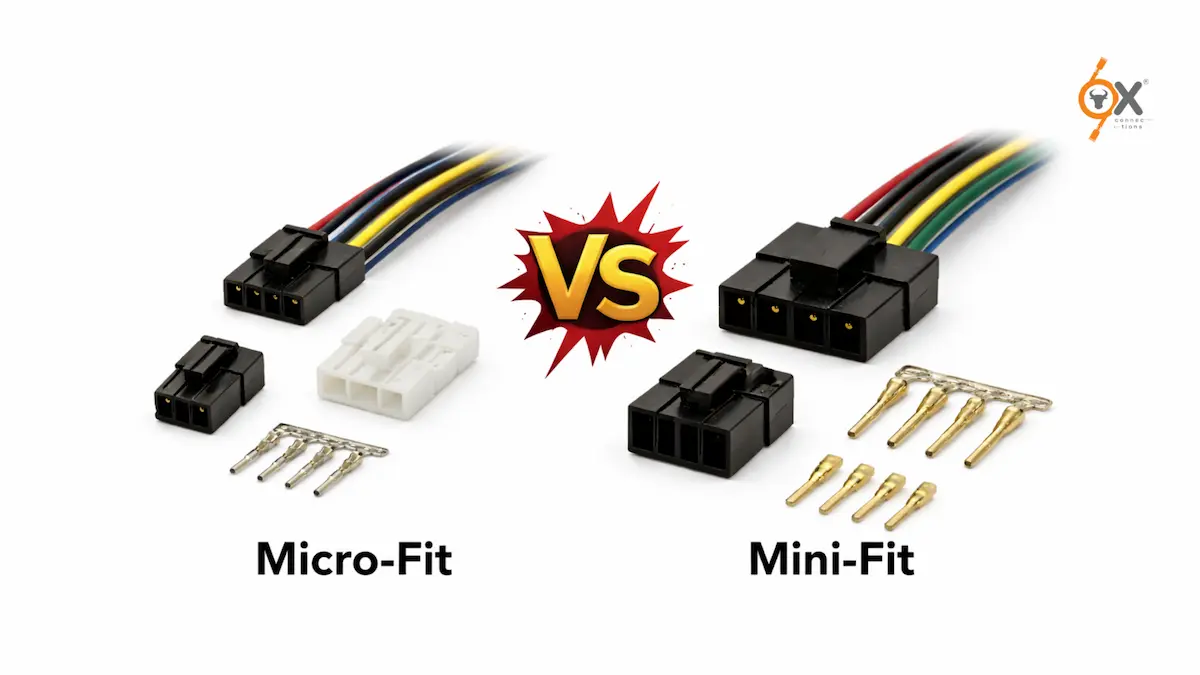
If you’ve ever been stuck choosing between two similar-looking connectors and wondering “does this small difference really matter?” – you’re not alone. The debate around Micro-Fit vs Mini-Fit connectors comes up all the time, especially when space, power, and reliability are all competing priorities.
In fast-growing manufacturing ecosystems like India – whether it’s a production unit in Mumbai or an EV startup in Pune – this decision isn’t just technical. It directly impacts cost, availability, and long-term performance.
Let’s break it down in a way that actually helps you decide.
Why Connector Pitch Size Is a Bigger Deal Than It Looks
Before comparing anything else, you need to understand connector pitch size – because that’s where the real difference begins.
Pitch size simply refers to the distance between the center of one pin to the next. It might sound like a small detail, but it controls:
- How compact your design can be
- How much current the connector can safely handle
- How easy (or difficult) it is to assemble and maintain
In practical terms, smaller pitch means more compact designs, but usually at the cost of lower current capacity.
Micro-Fit vs Mini-Fit Connectors: The Core Difference
At a glance, both connectors look similar. But once you start working with them, the differences become clear.
Micro-Fit Connectors (Typically 3.0 mm Pitch)
Micro-Fit connectors are designed for compact, space-constrained applications. With a smaller pitch, they allow more connections in a tighter footprint.
They’re commonly used in:
- Consumer electronics
- Compact industrial devices
- Embedded systems
Because of their size, they are ideal when space-saving is critical, but they come with limitations in current handling.
Mini-Fit Connectors (Typically 4.2 mm Pitch)
Mini-Fit connectors, on the other hand, are built for higher power applications. The larger pitch allows better spacing between contacts, which improves current capacity and heat dissipation.
You’ll see them in:
- Power supplies (especially desktop PCs)
- Industrial equipment
- Appliances
- EV subsystems
This makes them a preferred choice when reliability under load matters more than compactness.
Current Rating: Where the Difference Really Shows
When comparing Micro-Fit vs Mini-Fit, current rating is often the deciding factor.
Micro-Fit connectors typically handle lower current per circuit, making them suitable for signal and moderate power applications.
Mini-Fit connectors, with their larger pitch and robust design, can handle significantly higher current per pin, making them ideal for power-heavy environments.
But here’s the part that matters in India:
In real-world conditions – especially in high-temperature industrial setups in cities like Mumbai – connectors rarely perform at their theoretical maximum. Heat, humidity, and continuous usage all affect performance.
So in practice:
- Micro-Fit = compact, but more sensitive to load and heat
- Mini-Fit = bulkier, but more forgiving under stress
A Practical Molex Connector Comparison
If you’re looking for a quick Molex connector comparison, here’s a simplified way to think about it:
| Feature | Micro-Fit | Mini-Fit |
| Pitch Size | Smaller (around 3.0 mm) | Larger (around 4.2 mm) |
| Current Capacity | Moderate | High |
| Size | Compact | Slightly bulkier |
| Applications | Electronics, compact devices | Power supplies, industrial systems |
| Heat Handling | Limited | Better heat dissipation |
Instead of thinking “which is better,” the real question is:
What does your application actually need—space saving or power handling?
Where Indian Manufacturers Often Get Stuck
On paper, the choice is simple. But in reality – especially across India’s manufacturing sector – it gets complicated.
Procurement teams often face:
- Limited stock availability
- High import costs
- Long lead times for branded connectors
- Minimum order quantities that don’t make sense for smaller batches
This is particularly common in cities like Mumbai, where production timelines are tight and delays can disrupt entire supply chains.
The Shift Towards Smarter Sourcing
Because of these challenges, many OEMs are no longer just comparing Micro-Fit vs Mini-Fit from a technical standpoint. They’re also asking:
- Can I get this connector quickly?
- Is there a cost-effective equivalent?
- Will it meet certifications and reliability standards?
This is where companies like OXConnections (Mumbai-based) are quietly changing the game.
Instead of relying solely on imported connectors, manufacturers now have access to:
- Equivalent Micro-Fit and Mini-Fit compatible connectors
- Nearly half the cost compared to traditional brands
- No long lead times
- Certifications like UL, RoHS, and CE
For industries like EV, solar, appliances, and medical devices, this isn’t just convenient – it’s becoming essential.
Choosing the Right Connector for Your Application
If you’re still deciding between the two, here’s a more practical way to approach it:
Go for Micro-Fit if:
- Your design is space-constrained
- Power requirements are moderate
- You’re working on compact electronics
Go for Mini-Fit if:
- Your application involves higher current
- Heat and durability are concerns
- You need long-term reliability under load
But beyond the technical decision, always consider: availability, cost, and supply consistency
Because the best connector on paper doesn’t help if it delays your production.
Final Thoughts
The comparison between Micro-Fit vs Mini-Fit Connectors isn’t about which one is superior – it’s about fit for purpose.
Understanding connector pitch size gives you the foundation, while a clear Molex connector comparison helps you align your choice with real-world needs.
And in today’s Indian manufacturing landscape – especially in fast-moving hubs like Mumbai – the smartest decisions are the ones that balance:
- performance
- cost
- and availability
Because at the end of the day, a connector isn’t just a component. It’s a small decision that can impact your entire production line.