
In electronics manufacturing, the quality of electrical connectors can decide whether a product runs smoothly for years or starts showing failures within months. From solar systems and EV charging units to medical devices, home appliances, and industrial control panels, connectors are the silent backbone that keeps everything functioning safely and efficiently.
Have you ever wondered why two products with almost the same design can perform so differently in the real world?
Often, the answer lies in one small but critical component – the connector.
For manufacturers across India – especially in fast-growing industrial hubs like Mumbai, Pune, Ahmedabad, and Bengaluru – connector selection is no longer just a technical decision. It is a business decision. The right connector improves reliability, speeds up production, reduces downtime, and controls overall project cost.
This is where many OEMs face a common sourcing challenge.
Many global connector brands are known for strong market presence and trusted performance. However, for Indian manufacturers, challenges such as higher procurement costs, longer lead times, and strict minimum order quantities can often impact production flexibility and planning.
This is where OX Connections, based in Mumbai, offers a smarter sourcing advantage.
OX provides high-quality, certified connector solutions for major industry-standard series – at nearly half the cost, with faster availability, no long lead time pressure, and much better procurement flexibility. For OEMs across India, this means smoother production planning, better margins, and reliable quality without unnecessary delays.
Let’s explore the most widely used electronic connectors in electronics manufacturing and how choosing the right connector types can directly impact OEM success.
Why Connectors Matter More Than Most OEMs Realize
A connector may look like a small plastic housing with metal terminals, but it is often one of the most failure-sensitive components in any electrical system.
Poor connector selection can lead to:
- overheating
- voltage drops
- poor signal quality
- vibration-related failures
- expensive field maintenance
- delayed product approvals
The right electrical connectors improve:
- system reliability
- assembly speed
- serviceability
- safety compliance
- long-term customer satisfaction
This is especially important in industries like renewable energy, automotive electronics, medical devices, and home appliances where reliability is non-negotiable.
Top Electrical Connectors Types Used in Electronics Manufacturing
Let’s look at the most widely used connector types across OEM applications.
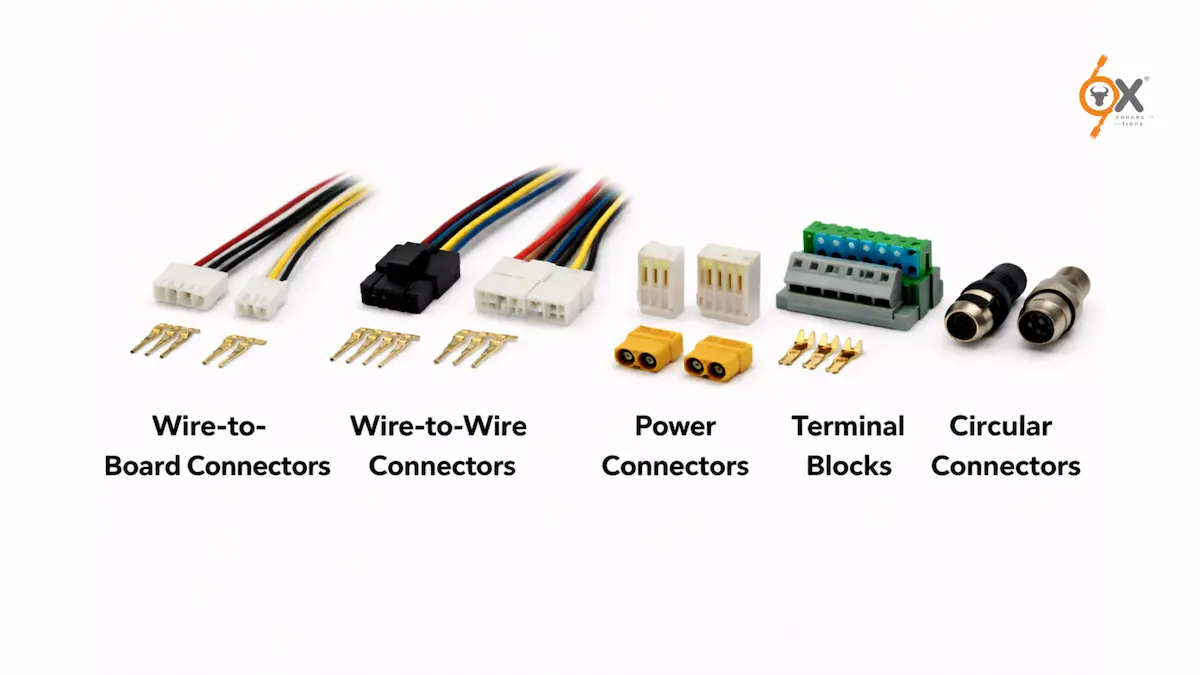
1. Wire-to-Board Connectors
These are among the most common electronic connectors used in PCB-based systems.
They connect individual wires or cable assemblies directly to a printed circuit board and are widely used in:
- power supplies
- LED drivers
- consumer electronics
- solar controllers
- industrial automation systems
Popular examples include JST XH, PH, VH, and Molex KK series.
These connectors are compact, reliable, and easy to integrate into production lines.
At OX Connections, equivalent solutions for these high-demand families are available with better procurement flexibility—especially valuable for Indian OEMs who want to avoid long import delays and unstable supply chains.
2. Wire-to-Wire Connectors
These electrical connectors are used when two wire harnesses need to be joined securely without direct PCB involvement.
Common applications include:
- automotive wiring
- battery systems
- EV charging units
- home appliances
- industrial machinery
They are designed for durability and often include locking systems to prevent accidental disconnection.
For vibration-heavy environments, choosing the right locking wire-to-wire connector becomes critical.
3. Board-to-Board Connectors
Used for connecting one PCB to another, these electronic connectors are common in compact electronic assemblies where space optimization matters.
You’ll find them in:
- telecom equipment
- industrial control systems
- medical instruments
- embedded systems
- advanced consumer electronics
They help reduce wiring complexity and improve modular design flexibility.
Precision and tolerance matter heavily here, so sourcing from a reliable industrial connectors supplier is essential.
4. Power Connectors
When current handling becomes the priority, power connectors become the backbone of the design.
These are widely used in:
- solar inverters
- battery management systems
- EV infrastructure
- UPS systems
- industrial power supplies
Examples include Mini-Fit, Micro-Fit, XT series, and terminal block systems.
Many OEMs in India face pricing and supply challenges with imported power connector solutions. OX helps solve this by offering certified alternatives with strong current ratings, dependable performance, and faster local availability.
5. Terminal Blocks
Terminal blocks are highly preferred in industrial control systems where organized wiring and maintenance accessibility are important.
Applications include:
- control panels
- PLC systems
- switchgear
- industrial cabinets
- automation systems
These industrial connectors allow secure wire termination and easy field servicing.
They are especially useful where future maintenance and technician access are part of the system design.
6. Circular Connectors
These are used in harsh environments where dust resistance, vibration resistance, and durability are required.
Common industries include:
- medical devices
- aerospace
- industrial robotics
- outdoor equipment
- renewable energy systems
Their strong locking design makes them highly reliable for demanding applications.
Why Indian OEMs Are Rethinking Connector Sourcing
For years, many manufacturers have relied heavily on globally established connector suppliers.
Today, however, OEMs across Mumbai and other industrial cities are looking for smarter sourcing strategies.
The reasons are practical:
Cost Efficiency
Connector selection directly impacts BOM cost, especially in high-volume manufacturing.
Faster Availability
Long procurement cycles can delay production schedules and customer commitments.
Flexible MOQ Requirements
Growing manufacturers often need supply flexibility rather than rigid order quantities.
Reliable Local Support
Quick technical support and faster delivery make a major difference during urgent project timelines.
This is where OX Connections becomes a stronger sourcing partner.
OX provides equivalent connector solutions for major industry-standard series with certifications like UL, RoHS, and CE – along with faster delivery, better pricing, and dependable support for OEM applications.
For Indian manufacturers, this is not just cost saving – it is production stability.
How to Choose the Right Connector
Selecting the right electrical connectors should never be based on appearance alone.
Here’s what OEM buyers should evaluate:
Current Rating
Can it safely handle the required load?
Voltage Rating
Will it support the application environment safely?
Pitch Size
Does it fit the PCB layout and assembly requirements?
Locking Mechanism
Is secure retention needed for vibration-heavy applications?
Certifications
Does it meet required compliance standards?
Supply Reliability
Can your supplier deliver consistently without delays?
The last point is often ignored – but in real manufacturing, supply chain reliability is just as important as technical specifications.
Final Thoughts
In electronics manufacturing, connectors are not “small parts.” They are reliability points.
The right electronic connectors improve safety, product life, serviceability, and customer trust. The wrong ones create production delays, maintenance issues, and unnecessary costs.
Understanding the right connector types helps OEMs make smarter purchasing decisions and stronger product designs.
And today, smart sourcing matters just as much as smart engineering.
That is why more manufacturers across India are choosing OXConnections – not just for competitive pricing, but for faster availability, certified quality, and dependable support across industries like solar, home appliances, medical devices, EV systems, and industrial automation.
Because in manufacturing, reliability is never optional – and neither is the right connector partner.