
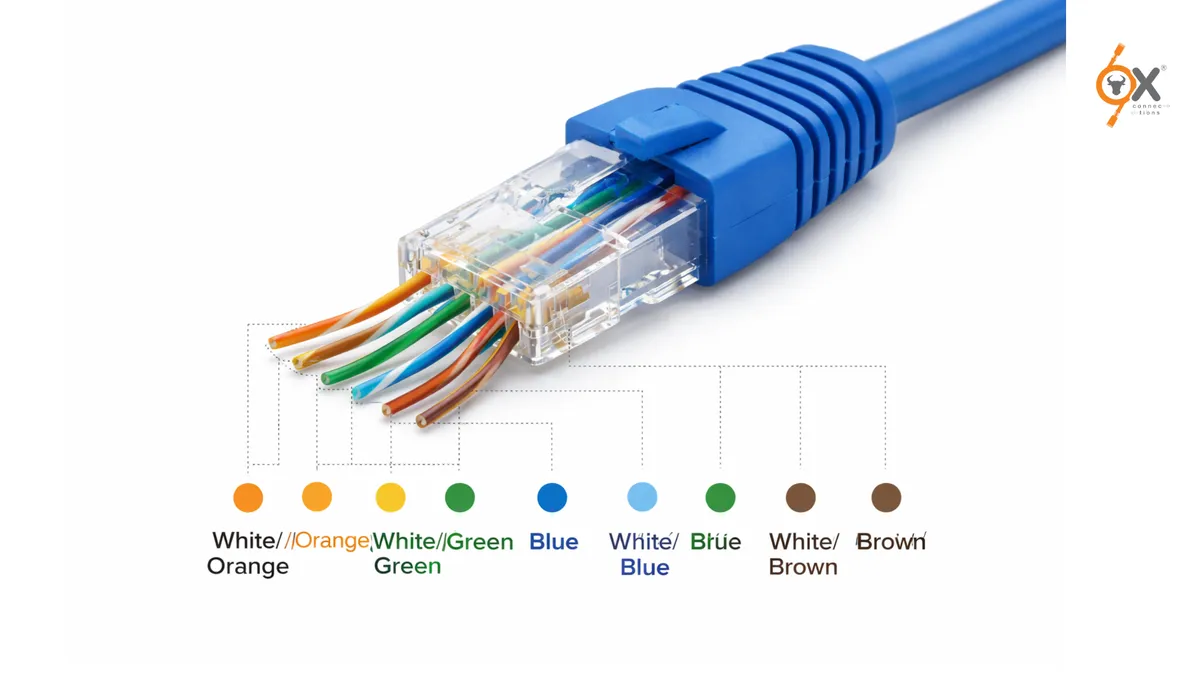
Have you ever looked at a LAN cable and wondered how many wires are actually inside it? It may look simple from the outside, but the internal wiring of an RJ45 Connector plays a major role in network speed, signal quality, and long-term reliability.
Whether it is office networking, CCTV systems, industrial automation panels, solar monitoring setups, or factory communication systems, the quality of your Ethernet connection depends heavily on how the cable and connector are built. Across India, especially in industrial hubs like Mumbai, Pune, Ahmedabad, and Bengaluru, businesses rely on strong network infrastructure where even a small connection issue can cause downtime.
That is why understanding the wire structure inside an RJ45 connector is more important than most people think.
What is an RJ45 Connector ?
An RJ45 Connector is the standard connector used for Ethernet networking. It is attached to both ends of a LAN cable and helps devices communicate through wired internet connections. Computers, routers, switches, servers, PLC systems, CCTV cameras, and industrial machines all commonly use RJ45 connectors for stable data transfer.
In industrial environments, this becomes even more important because network interruptions do not just slow down internet speed – they can affect machine communication, remote monitoring, ERP systems, and automation processes.
This is why choosing the right connector matters just as much as choosing the right cable.
How Many Wires Are in an RJ45 Connector ?
The answer is simple: an RJ45 Connector uses 8 wires.
These 8 wires are arranged as 4 twisted pairs inside the Ethernet cable.
8 = 4 \text{ twisted pairs}
Each pair is designed to reduce signal interference and improve transmission quality. This structure helps maintain stable connectivity, especially in industrial environments where electrical noise can affect performance.
The eight wires are usually color-coded as white-orange, orange, white-green, blue, white-blue, green, white-brown, and brown. This standard arrangement is why many people search for Ethernet Cable 8 Wires when trying to understand LAN cable structure.
These wires are not random – they are carefully arranged to ensure high-speed and low-loss communication.
Why Does Ethernet Use 8 Wires?
The reason Ethernet cables use 8 wires is simple: stability and speed.
Modern networks require fast data transfer, minimal signal loss, and strong resistance to interference. The 8-wire structure allows the network to handle all of this more efficiently. In industrial setups where automation systems, PLCs, and smart monitoring depend on uninterrupted communication, this becomes even more critical.
Even a single incorrect wire connection can cause slow internet, packet loss, machine failure, or unstable communication between systems. That is why following the correct RJ45 Wiring Diagram is essential during installation.
This is not just a technical detail – it directly affects operational reliability.
Understanding the RJ45 Wiring Diagram
When technicians install Ethernet cables, they follow a proper RJ45 Wiring Diagram to ensure all 8 wires are placed correctly.
There are two common standards used worldwide: T568A and T568B. Both use the same 8 wires, but the wire arrangement is slightly different.
In India, T568B is more commonly used for office networking, factory systems, and industrial LAN setups because it has become the practical standard across most industries.
Using the correct wiring pattern ensures proper signal transmission, device compatibility, and long-term network performance. Poor wiring, even with a good cable, can still lead to major connectivity issues.
This is why professionals never ignore wiring standards.
Straight Through vs Crossover Cable
Another important part of Ethernet wiring is understanding straight-through and crossover cables.
A straight-through cable is the most commonly used type. It connects devices like computers to switches, routers to switches, and PLC systems to industrial networks. Most standard office and factory networking uses this setup.
A crossover cable is used to connect similar devices directly, such as computer-to-computer or switch-to-switch connections. While modern devices often support automatic detection, understanding this difference is still useful for industrial troubleshooting and legacy systems.
For most OEM buyers today, straight-through wiring remains the standard choice.
Why Connector Quality Matters More Than People Think
Many buyers focus only on cable quality, but poor connector quality often causes the real problem.
Low-grade RJ45 connectors can lead to loose fitting, unstable signals, frequent maintenance, and costly downtime. In industries like solar, EV manufacturing, medical equipment, and automation-heavy factories, these failures are expensive.
A poor connector can compromise the performance of even the best Ethernet cable.
This is why industrial buyers prefer reliable, certified connector solutions rather than cheap short-term options.
The cost difference may seem small during purchase, but the long-term operational impact is huge.
Why Many OEMs Choose OX Connections
Across India, many businesses struggle with imported connector brands because they are expensive, come with long lead times, and often require high minimum order quantities.
This creates delays in production planning and unnecessary pressure on procurement teams.
At OXConnections, businesses get reliable equivalent connector solutions that offer the same performance standards without the pricing burden. Their products are widely used across solar, home appliances, renewable energy, EV manufacturing, medical systems, and industrial automation.
Along with RJ45 Connector solutions, OX also supplies JST equivalent connectors, TE equivalent connectors, terminal blocks, modular plugs, and wire-to-board connectors.
The advantage is simple – better pricing, faster availability, lower MOQ requirements, and certifications like UL, RoHS, and CE compliance.
You can explore more at OXConnections.
For OEMs looking for performance without paying premium imported prices, this becomes a practical long-term solution.
Final Thoughts
So, how many wires are there in an RJ45 Connector?
The answer is 8 wires arranged as 4 twisted pairs.
But behind that simple answer lies the foundation of reliable industrial networking. Whether you are building office LAN systems or managing large-scale factory automation, understanding Ethernet structure helps prevent failures and improves long-term performance.
Choosing the right cable matters.
Choosing the right connector matters even more.
For serious industrial buyers, reliability is never just about price – it is about performance, uptime, and trust. That is exactly why more OEMs are paying closer attention to connector quality today.
FAQs
1. Does every RJ45 Connector use 8 wires?
Yes, standard Ethernet RJ45 connectors use 8 wires arranged in 4 twisted pairs for stable data transmission.
2. Why do people search for Ethernet Cable 8 Wires ?
Because standard LAN cables used with RJ45 connectors contain 8 wires that support faster and more reliable Ethernet communication.
3. What is the most common RJ45 Wiring Diagram used in India?
T568B is the most commonly used wiring standard across offices, factories, and industrial networking systems in India.