
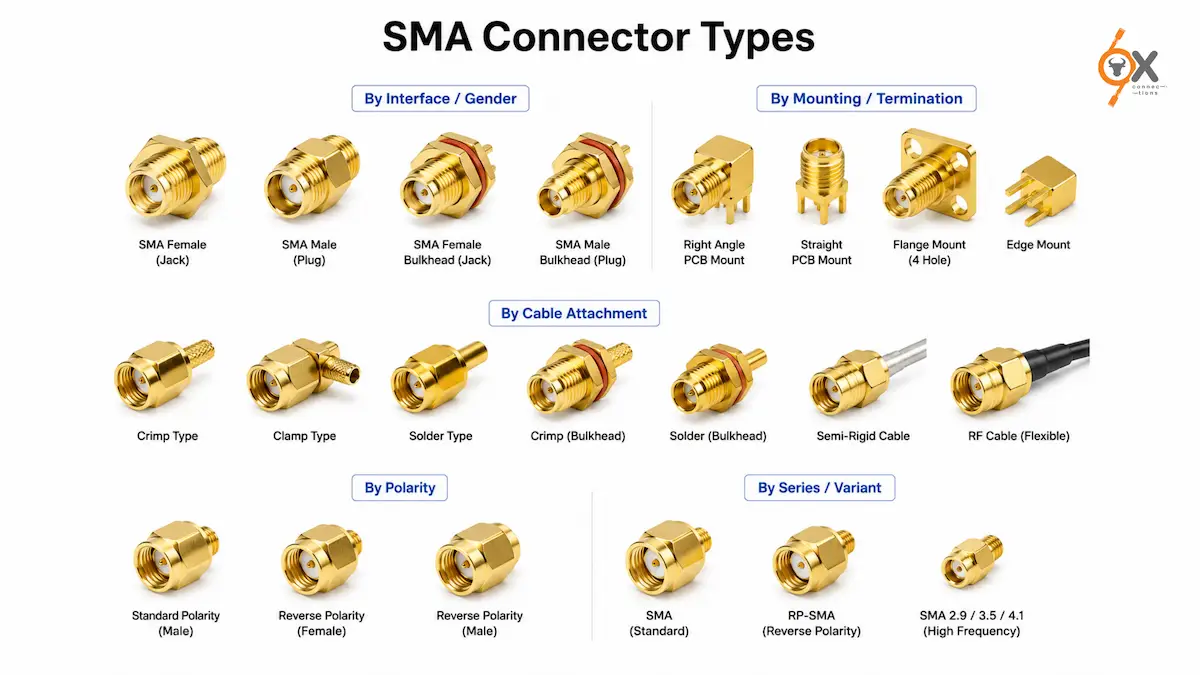
This guide explains the various SMA connector Types, configurations, common applications, key selection considerations, and what buyers should evaluate before procurement.
Understanding SMA Connector Types: A Practical Guide for OEMs and Procurement Teams
In RF system design, choosing the right connector is rarely an afterthought. The performance of wireless communication equipment often depends on the quality, reliability, and suitability of the connector used throughout the signal chain.
Among the many RF interconnect solutions available today, the SMA connector remains one of the most widely adopted standards across telecommunications, IoT devices, industrial electronics, wireless infrastructure, test equipment, GPS systems, and embedded RF applications.
For design engineers, sourcing teams, and OEM procurement professionals, understanding different SMA connector types can help avoid compatibility issues, reduce assembly challenges, and improve long-term product reliability.
What Is an SMA Connector?
An SMA connector (SubMiniature Version A connector) is a threaded RF connector designed for high-frequency signal transmission. Its compact size, secure threaded coupling mechanism, and broad compatibility have made it an industry standard across numerous wireless and RF systems.
Unlike push-fit connectors, SMA connectors use threaded mating, helping maintain stable electrical connections in environments exposed to vibration, movement, or frequent handling.
Today, SMA connectors are found in:
- Wireless communication equipment
- GPS devices
- RF modules
- Antenna assemblies
- Test and measurement instruments
- Industrial IoT systems
- Embedded wireless electronics
- Telecom infrastructure
As wireless technologies continue expanding across India and global markets, the demand for reliable RF connector solutions continues to grow.
Why Understanding SMA Connector Types Matters
Many procurement teams mistakenly assume that all SMA connectors are interchangeable.
In reality, multiple SMA connector types exist, each designed for specific mounting methods, cable assemblies, enclosure requirements, and RF applications.
Selecting the wrong connector can result in:
- Assembly difficulties
- Mating incompatibility
- Increased maintenance
- Signal degradation
- Mechanical reliability concerns
Understanding connector variants early in the design phase can simplify manufacturing and reduce procurement risks later.
Common SMA Connector Types
1. SMA Male Connectors
SMA male connectors feature an internal thread and center pin.
These connectors are commonly used in:
- RF cable assemblies
- Antenna cables
- Test equipment
- Wireless modules
They are frequently paired with SMA female connectors in antenna systems and RF interconnect assemblies.
2. SMA Female Connectors
SMA female connectors feature external threads and a center receptacle.
Applications include:
- PCB-mounted RF interfaces
- Wireless communication equipment
- GPS modules
- Telecom hardware
Female SMA interfaces are often integrated directly into equipment housings, allowing easy field connection of antenna cables and accessories.
3. Straight SMA Connectors
Straight SMA connectors maintain a direct cable exit path.
These are typically selected when:
- Space constraints are minimal
- Cable routing is straightforward
- Signal paths need simplified mechanical design
Straight connectors are widely used in laboratory instruments and telecom assemblies.
4. Right-Angle SMA Connectors
Right-angle configurations allow cables to exit at a 90-degree angle.
These connectors become valuable when:
- PCB space is limited
- Enclosure dimensions are restrictive
- Cable bend management is critical
Many IoT and compact wireless devices utilize right-angle SMA designs to optimize internal packaging.
5. PCB Mount SMA Connectors
PCB mount SMA connectors are designed for direct integration onto printed circuit boards.
They are commonly used in:
- RF modules
- Wireless gateways
- GPS tracking devices
- Industrial communication systems
Proper footprint selection and board layout considerations are essential for achieving reliable performance.
6. Bulkhead SMA Connectors
Bulkhead connectors are designed for panel and enclosure mounting.
Applications include:
- Outdoor communication equipment
- Control panels
- Antenna feed-through assemblies
- Industrial cabinets
These connectors provide a robust transition point between internal electronics and external RF connections.
Key Applications of SMA Connectors
The popularity of the SMA connector stems from its versatility across multiple industries.
Telecommunications
Telecom equipment manufacturers frequently use SMA interfaces in:
- Base station equipment
- Signal distribution systems
- Wireless infrastructure
- RF testing environments
The threaded coupling mechanism helps ensure stable connectivity in demanding installations.
IoT and Smart Devices
India’s rapidly expanding IoT ecosystem has increased demand for reliable RF interconnects.
SMA connectors are commonly found in:
- Smart metering systems
- Industrial monitoring devices
- Wireless sensors
- Edge computing equipment
As industrial IoT deployments scale, connector reliability becomes increasingly important.
GPS and Navigation Systems
GPS systems require dependable signal transmission between antennas and receiver modules.
SMA connectors are often selected because of their proven performance and widespread compatibility with RF equipment.
Applications include:
- Vehicle tracking systems
- Fleet management devices
- Surveying equipment
- Navigation hardware
Test and Measurement Equipment
Laboratories and engineering teams frequently utilize RF connector solutions such as SMA interfaces in:
- Spectrum analyzers
- Signal generators
- RF testing setups
- Calibration equipment
The standardized design simplifies equipment interoperability.
Industrial Electronics
Industrial wireless systems increasingly rely on RF communication.
Examples include:
- Factory automation systems
- Remote monitoring equipment
- Renewable energy installations
- Industrial networking hardware
In these environments, connector durability becomes a critical procurement consideration.
Selection Checklist for Procurement Teams
When evaluating SMA connector types, procurement professionals should consider more than just part availability.
1. Compatibility Requirements
Verify:
- Male versus female interface requirements
- Mating connector standards
- System-level compatibility
Connector mismatches can create unnecessary sourcing and assembly challenges.
2. Mounting Configuration
Determine whether the application requires:
- PCB mount connectors
- Cable mount connectors
- Bulkhead connectors
- Panel mount connectors
The mounting style should align with the overall product architecture.
3. Mechanical Constraints
Evaluate:
- Available enclosure space
- Cable routing paths
- Connector accessibility
Compact devices often benefit from right-angle solutions, while larger systems may use straight configurations.
4. Environmental Conditions
Consider operating environments such as:
- Industrial facilities
- Outdoor installations
- Telecom cabinets
- Renewable energy projects
Environmental conditions often influence connector selection and long-term reliability expectations.
5. Supply Chain Stability
Many OEMs focus heavily on technical specifications while overlooking procurement risks.
Before finalizing a sourcing strategy, evaluate:
- Product availability
- Lead times
- Inventory support
- Supplier responsiveness
- Long-term supply continuity
Reliable sourcing can significantly reduce project delays.
Common Procurement Challenges Facing Indian OEMs
Across sectors such as telecom, renewable energy, consumer electronics, medical devices, and industrial automation, procurement teams frequently encounter:
- Long lead times
- Limited stock availability
- High minimum order quantities
- Supplier inconsistency
- Quality variation between batches
These challenges can impact production schedules and increase sourcing complexity.
For many manufacturers, partnering with a supplier capable of maintaining inventory and supporting recurring demand can simplify procurement operations.
Why Quality Matters in an RF Connector
While connectors may represent a relatively small portion of overall system cost, they play a critical role in system performance.
A high-quality RF connector contributes to:
- Consistent signal transmission
- Reliable mechanical connections
- Easier assembly
- Improved product longevity
- Reduced maintenance concerns
For OEMs producing commercial equipment, connector quality should be viewed as a long-term reliability investment rather than a commodity purchase.
Conclusion
Understanding different SMA connector types is essential for engineers, sourcing teams, and OEM procurement professionals involved in RF system development.
Whether selecting straight connectors, right-angle variants, PCB mount designs, or bulkhead configurations, the right choice depends on application requirements, mechanical constraints, system architecture, and procurement considerations.
As wireless technologies continue expanding across telecommunications, industrial IoT, GPS systems, renewable energy infrastructure, and embedded electronics, demand for dependable SMA connector and RF connector solutions will continue to grow.
About OX Connections
OX Connections supplies a broad range of RF interconnect solutions designed to support OEMs, system integrators, manufacturers, and engineering teams across multiple industries.
Disclaimer
Product suitability depends on application requirements, system architecture, environmental conditions, and engineering specifications. Buyers should evaluate compatibility and performance requirements before final selection.
Partner with OX Connections
For OEMs seeking dependable sourcing support, OXConnections positions itself as a stocking distributor carrying a comprehensive range of SMA connectors, RF connectors, and SP Series connector solutions. With competitive cost positioning, consistent quality standards, and a proven track record supporting OEM customers across industries, OX Connections focuses on building long-term supply relationships rather than one-off transactions. Engineering teams, procurement professionals, and manufacturers can engage with OX Connections for project-specific requirements, recurring production demand, and ongoing sourcing support.