
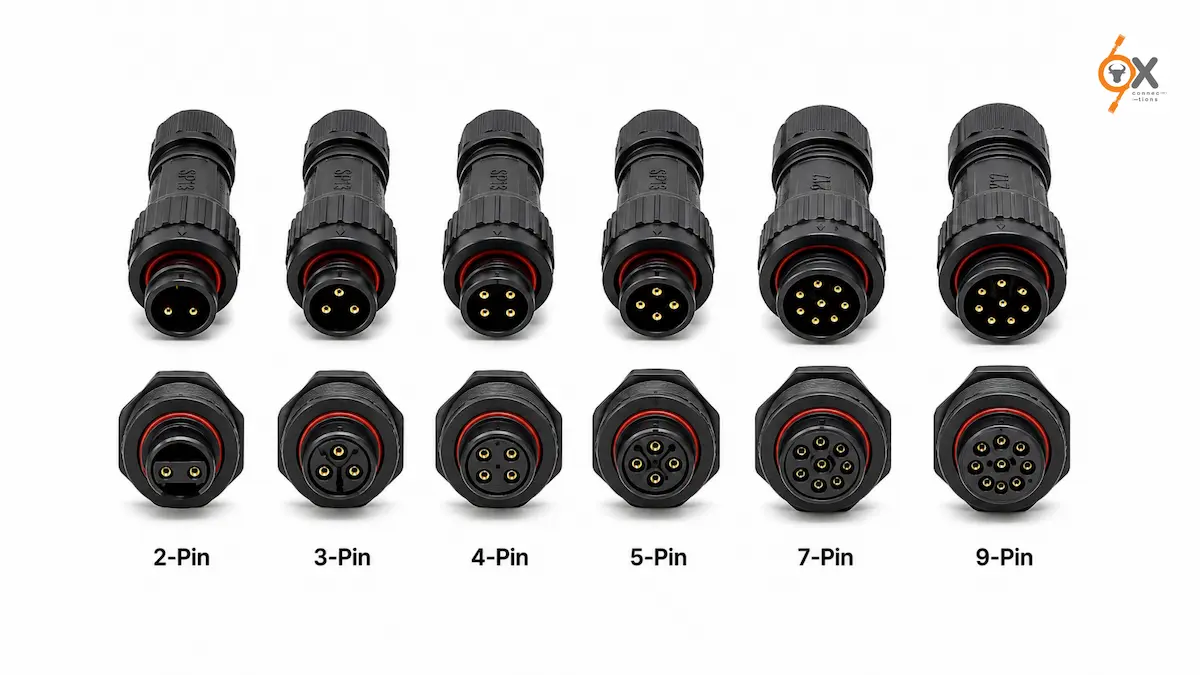
This guide explains how to choose between 2, 3, 4, 5, 7 & 9-Pin Connector configurations and the applications each is best suited for.
Selecting the right connector goes beyond choosing a product that simply fits the available space. In industrial environments, the number of pins directly affects how efficiently power, signals, and communication lines are managed within a system. Choosing too few contacts can limit functionality, while selecting more than necessary can increase costs and occupy valuable installation space.
This is where understanding SP Series Connector pin configurations becomes important. Whether you’re designing industrial automation equipment, EV charging infrastructure, renewable energy systems, medical devices, or outdoor electronic equipment, selecting the correct pin count helps create reliable and serviceable electrical connections.
At the same time, engineers also need connectors capable of operating in demanding environments. A high-quality Waterproof Circular Connector with an IP68 Connector rating provides dependable performance even when exposed to dust, moisture, vibration, and harsh outdoor conditions.
Why Pin Count Matters
Every electrical system has unique circuit requirements. Some applications only require power transmission, while others need a combination of power, control signals, sensors, communication, and grounding.
The pin configuration determines:
- Number of electrical circuits supported
- Separation of power and signal lines
- Ease of wiring
- Future scalability
- Overall connector size
- System reliability
Rather than selecting the highest pin count available, engineers generally choose the configuration that matches the application’s electrical architecture while allowing room for future expansion if required.
Understanding the SP Series Connector
The SP Series Connector is a family of circular connectors designed for demanding industrial applications. These connectors are widely used because they combine compact construction with secure locking mechanisms and dependable environmental sealing.
Depending on the series, they are commonly available in multiple pin configurations, allowing designers to standardize connectors across different product lines while accommodating varying electrical requirements.
Typical applications include:
- Industrial automation
- Solar energy systems
- EV charging equipment
- Battery management systems
- Marine electronics
- Medical equipment
- LED lighting
- Outdoor communication equipment
- Test and measurement devices
Their versatility makes them suitable for both low-voltage signal transmission and higher-current power applications.
Selecting the Right Pin Configuration
2-Pin Connectors
A 2-pin connector is the simplest configuration and is primarily intended for straightforward power delivery.
Typical applications include:
- DC power supplies
- LED drivers
- Battery charging
- Portable equipment
- Simple control circuits
If your application only requires positive and negative power connections, a 2-pin connector is often sufficient.
3-Pin Connectors
Adding one extra contact allows separation of protective earth, control, or signal wiring.
Common uses include:
- AC power connections
- Sensor systems
- Single-phase industrial equipment
- Monitoring devices
The third pin can improve safety or enable additional functionality without significantly increasing connector size.
4-Pin Connectors
Four-pin configurations are widely used where both power and communication signals need to coexist.
Typical applications include:
- Industrial sensors
- Servo controls
- Camera systems
- Communication modules
This configuration provides flexibility while keeping wiring relatively simple.
5-Pin Connectors
Five-pin variants support more sophisticated equipment requiring additional signal paths.
Common examples include:
- Automation controllers
- Instrumentation
- Motor control systems
- Industrial communication interfaces
These connectors are often selected where designers need separate power, communication, and feedback circuits within a single connector.
7-Pin Connectors
As industrial equipment becomes more advanced, additional contacts are often required.
Typical applications include:
- Multi-sensor systems
- Robotics
- Battery Management Systems (BMS)
- Industrial monitoring equipment
- Renewable energy controllers
Seven-pin connectors provide increased flexibility without requiring multiple connectors on the same enclosure.
9-Pin Connectors
Nine-pin configurations support highly integrated equipment where numerous signals must pass through a single connector.
Applications include:
- Complex automation systems
- Test equipment
- Communication devices
- Industrial control panels
- Multi-channel monitoring systems
By consolidating multiple circuits into one connector, installation becomes cleaner and maintenance is simplified.
Why a Waterproof Circular Connector Is Often the Better Choice
Many industrial systems operate in environments where dust, rain, humidity, oil, or vibration are unavoidable. Standard connectors may perform well indoors but struggle when exposed to harsh operating conditions.
A Waterproof Circular Connector offers several advantages:
- Reliable environmental sealing
- Secure mechanical locking
- Protection against accidental disconnection
- Long operational life
- Consistent electrical performance
- Better resistance to vibration
These benefits make waterproof circular connectors particularly suitable for outdoor installations and mission-critical equipment.
The Importance of Choosing an IP68 Connector
Environmental protection is often as important as electrical performance.
An IP68 Connector is designed to prevent the ingress of dust and withstand prolonged exposure to water under specified conditions. For applications installed outdoors or in demanding industrial settings, this level of protection helps improve long-term reliability and reduce maintenance requirements.
Industries that commonly specify IP68-rated connectors include:
- Solar energy
- EV charging infrastructure
- Marine equipment
- Agriculture
- Industrial automation
- Outdoor lighting
- Telecommunications
- Construction equipment
Selecting the appropriate protection rating early in the design phase can significantly reduce the risk of connector-related failures over the product lifecycle.
Other Factors to Consider Before Selecting a Connector
While pin count is an important consideration, engineers should also evaluate:
- Current and voltage requirements
- Wire gauge compatibility
- Panel or cable mounting requirements
- Locking mechanism
- Operating temperature
- Mating cycle requirements
- Cable diameter
- Environmental exposure
- Available installation space
- Future maintenance requirements
Considering these factors together helps ensure the connector performs reliably throughout the life of the equipment.
Why OEMs Choose OX Connections
At OXConnections, we understand that connector selection affects both product reliability and production efficiency. OEMs and manufacturers require consistent quality, dependable availability, and technical support throughout the procurement process.
We supply a comprehensive range of SP Series connector solutions suitable for industrial automation, renewable energy, medical equipment, EV infrastructure, home appliances, and other demanding applications.
Customers choose OX Connections because we offer:
- Ready stock for faster deliveries
- Competitive pricing
- Consistent product quality
- Reliable supply for OEM production
- Support for volume requirements
- Connectors designed for demanding industrial environments
Whether your project requires a simple 2-pin solution or a more complex 9-pin configuration, our team can help identify the most suitable connector for your application.
Conclusion
Choosing the correct connector is about more than matching the number of available contacts. The right pin configuration improves system performance, simplifies installation, and supports long-term reliability.
Whether your design requires 2, 3, 4, 5, 7 & 9-Pin Connector contacts, selecting the appropriate SP Series Connector ensures the electrical requirements of your application are met without unnecessary complexity. Pairing that with a dependable Waterproof Circular Connector and an IP68 Connector rating provides additional confidence when equipment operates in challenging industrial or outdoor environments.
As a trusted stocking distributor, OX Connections supports OEMs with dependable connector solutions, competitive pricing, responsive service, and ready availability helping businesses keep projects moving without unnecessary procurement delays.
FAQs
How do I choose the right SP Series Connector pin configuration?
Select the pin count based on the number of power, signal, communication, and grounding circuits your application requires. It’s also wise to consider future expansion and maintenance needs.
Why should I use a Waterproof Circular Connector instead of a standard connector?
A Waterproof Circular Connector offers better protection against dust, moisture, vibration, and harsh environmental conditions, making it ideal for industrial and outdoor applications.
What does an IP68 Connector rating mean?
An IP68 Connector is designed to provide complete protection against dust ingress and withstand water immersion under specified conditions, making it suitable for demanding industrial and outdoor environments.