
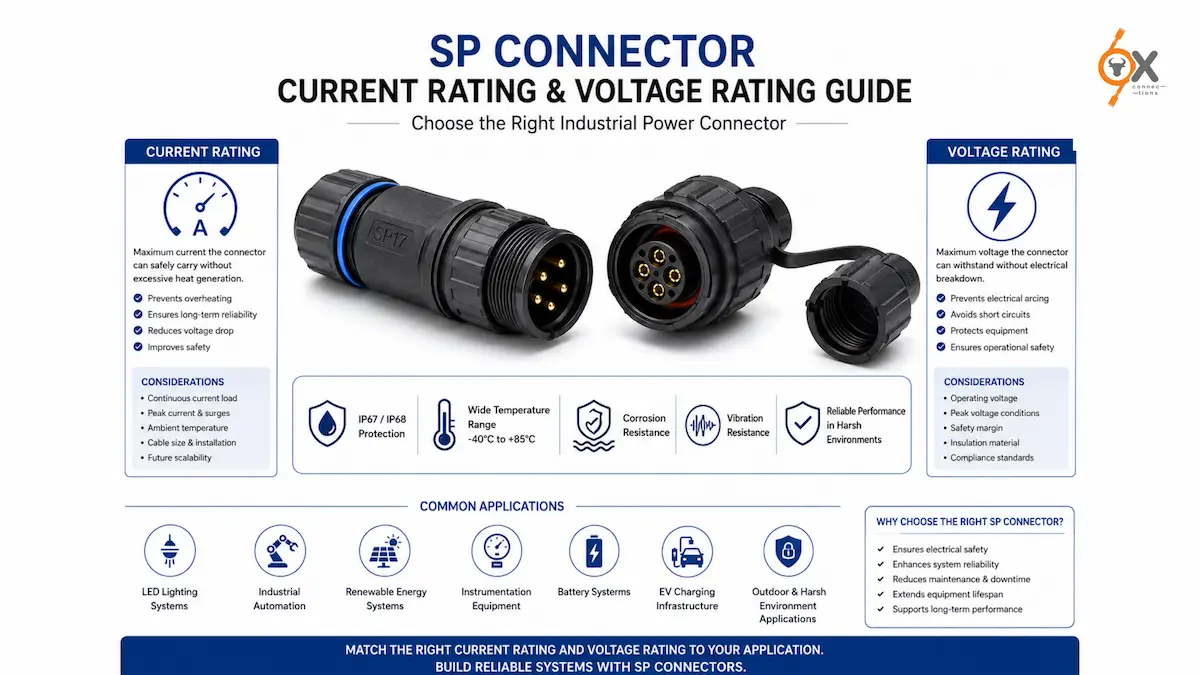
This guide explains how SP Connector current Rating and voltage ratings work, what factors influence them, and how to match the right SP connector to your power requirements.
Selecting the right connector for an industrial application is about much more than finding a component that physically fits your design. Engineers and procurement teams must consider electrical performance, environmental conditions, reliability requirements, maintenance expectations, and long-term supply availability.
One of the most common mistakes during connector selection is focusing on size and mounting style while overlooking current and voltage ratings. A connector that appears suitable mechanically may not be capable of safely handling the electrical load of the application.
This is where understanding SP Connector Current Rating and SP Connector Voltage Rating becomes essential.
SP Series connectors are widely used across industrial equipment, LED lighting systems, automation devices, renewable energy solutions, instrumentation, and outdoor electronics because they combine reliable electrical performance with robust environmental protection. However, selecting the wrong variant can lead to overheating, voltage breakdown, reduced lifespan, and unexpected field failures.
Understanding Current Rating in SP Connectors
The current rating of a connector refers to the maximum electrical current that can safely pass through its contacts without causing excessive heat generation or performance degradation.
When electrical current flows through a connector, resistance within the contacts creates heat. If the connector is undersized for the load, temperatures can rise significantly and create issues such as:
- Contact damage
- Insulation deterioration
- Reduced connector lifespan
- Increased voltage drop
- Equipment failure
- Safety risks
For this reason, engineers should always verify the required current load before selecting a connector.
In industrial environments, current demand may vary depending on:
- Motors
- Power supplies
- LED lighting systems
- Battery systems
- Industrial control equipment
- Renewable energy devices
- Automation systems
A connector should be selected based not only on its normal operating current but also on expected peak loads and future expansion requirements.
Why SP Connector Current Rating Matters
Many industrial systems operate continuously for long periods. Even a small mismatch between connector capacity and actual load can have long-term consequences.
For example:
A connector operating near its maximum current capacity may perform adequately during testing but experience elevated temperatures during real-world operation.
Factors that influence thermal performance include:
- Ambient temperature
- Cable size
- Ventilation
- Duty cycle
- Installation conditions
- Contact quality
Choosing an SP connector with sufficient current handling capability provides a safety margin that improves reliability and longevity.
For OEMs and equipment manufacturers, this can reduce warranty claims, maintenance costs, and unexpected downtime.
Understanding Voltage Rating in SP Connectors
While current rating determines how much electrical current can safely flow through a connector, the SP Connector Voltage Rating defines the maximum voltage the connector can withstand without electrical breakdown.
Voltage rating depends on factors such as:
- Contact spacing
- Insulation material
- Connector design
- Environmental conditions
- Safety standards
If a connector is exposed to voltages beyond its designed limits, insulation failure may occur.
Potential consequences include:
- Electrical arcing
- Short circuits
- Equipment damage
- Reduced reliability
- Safety hazards
Voltage considerations become especially important in:
- Industrial power systems
- Renewable energy equipment
- EV charging infrastructure
- Battery management systems
- Outdoor installations
Proper voltage rating selection helps ensure long-term operational safety.
The Relationship Between Current and Voltage Ratings
Current and voltage ratings are often discussed together, but they serve different purposes.
A connector may have:
- Adequate voltage capacity but insufficient current handling
- Adequate current handling but insufficient voltage insulation
- Suitable mechanical fit but inadequate electrical performance
Therefore, both ratings must be evaluated simultaneously.
When reviewing connector specifications, engineers should consider:
Current Requirements
- Continuous current load
- Peak current load
- Startup surges
- Future scalability
Voltage Requirements
- Operating voltage
- Peak voltage conditions
- Safety margin requirements
- Compliance standards
Ignoring either factor can compromise system reliability.
Common Applications for SP Series Connectors
SP Series connectors are popular because they offer a balance of electrical performance, durability, and environmental protection.
Typical applications include:
LED Lighting Systems
Outdoor LED installations often require connectors capable of handling power delivery while maintaining reliable performance in exposed environments.
Examples include:
- Signage
- Architectural lighting
- Street lighting
- Display systems
Industrial Automation
Modern automation systems depend on reliable connections between sensors, controllers, motors, and power distribution equipment.
SP connectors are frequently used in:
- PLC systems
- Control panels
- Machine tools
- Robotics
Renewable Energy Systems
Solar and renewable energy installations require connectors that can operate reliably in demanding environments.
Applications include:
- Solar monitoring equipment
- Energy storage systems
- Power distribution modules
- Outdoor control systems
Instrumentation Equipment
Industrial instruments often require stable electrical connections for signal and power transmission.
SP connectors provide reliable connectivity for:
- Monitoring systems
- Testing equipment
- Industrial electronics
- Data acquisition devices
Environmental Factors That Affect Connector Selection
Current and voltage ratings should never be evaluated in isolation.
Environmental conditions often influence actual connector performance.
Temperature
Higher temperatures reduce a connector’s ability to dissipate heat.
Engineers should consider:
- Ambient temperature
- Enclosure temperature
- Internal heat generation
- Thermal cycling
Moisture Exposure
Outdoor equipment may face:
- Rain
- Humidity
- Condensation
- Washdown conditions
Many SP connectors are selected because of their environmental sealing capabilities.
Dust and Contamination
Industrial environments frequently expose connectors to:
- Dust
- Metal particles
- Chemicals
- Oils
Proper connector selection helps maintain long-term reliability.
Vibration and Mechanical Stress
Equipment used in transportation, machinery, and industrial automation may experience continuous vibration.
Connectors must maintain secure electrical contact under these conditions.
How Engineers Typically Select the Right SP Connector
A practical connector selection process usually involves several steps.
Step 1: Determine Electrical Load
Identify:
- Operating current
- Peak current
- System voltage
- Safety requirements
This establishes the baseline electrical specifications.
Step 2: Evaluate Environmental Conditions
Consider:
- Indoor or outdoor installation
- Temperature exposure
- Moisture levels
- Mechanical stress
Environmental requirements often influence connector choice as much as electrical specifications.
Step 3: Select Appropriate Pin Configuration
SP Series connectors are available in multiple pin configurations.
Selection depends on:
- Number of circuits
- Signal requirements
- Power distribution needs
- Future expansion considerations
Step 4: Consider Mounting Requirements
Connector style should align with product design.
Common options include:
- Panel mount
- Cable mount
- Inline configurations
Step 5: Validate Supply Chain Availability
Even the best connector design can create challenges if supply is inconsistent.
Procurement teams increasingly prioritize suppliers that offer:
- Consistent inventory
- Short lead times
- Reliable support
- Flexible order quantities
Common Mistakes to Avoid
Selecting Based on Physical Size Alone
A connector may fit the enclosure but still fail to meet electrical requirements.
Ignoring Future Load Growth
Many systems evolve over time.
Providing electrical headroom can prevent costly redesigns later.
Overlooking Environmental Conditions
A connector operating indoors may perform differently when exposed to outdoor conditions.
Focusing Only on Cost
Connector failure often costs significantly more than the initial component savings.
Reliability should remain a primary consideration.
Not Reviewing Certification Requirements
Industrial projects frequently require components that align with applicable quality and compliance expectations.
Why Supply Reliability Matters as Much as Technical Performance
For OEMs, system integrators, and manufacturers, connector selection is no longer purely an engineering decision.
Supply chain considerations now play a major role.
Long lead times, high MOQs, and inconsistent availability can delay production schedules and increase procurement risk.
Working with a connector supplier that maintains inventory and supports industrial production requirements can help manufacturers avoid disruptions while maintaining consistent product quality.
OX Connections: Supporting Industrial Connector Requirements
At OX Connections, we understand that engineers and procurement teams require more than just a connector. They need dependable supply, consistent quality, and technical support throughout the product lifecycle.
Our SP Series connector range supports applications across:
- Industrial automation
- Renewable energy
- Home appliances
- Medical equipment
- EV-related systems
- LED lighting
- Electronic manufacturing
Whether you’re evaluating SP Connector Current Rating requirements, reviewing SP Connector Voltage Rating specifications, or sourcing reliable Industrial Power Connectors, our team can help identify the right solution for your application.
Explore OX Connections’ SP Series connector range to find connector options designed for dependable performance, efficient sourcing, and long-term industrial reliability.
Frequently Asked Questions
1. What is the difference between current rating and voltage rating in an SP connector?
Current rating refers to the amount of electrical current a connector can safely carry, while voltage rating refers to the maximum voltage it can withstand without insulation breakdown.
2. Why is current rating important when selecting industrial power connectors?
Current rating affects heat generation and overall connector reliability. Selecting a connector with insufficient current capacity can lead to overheating, performance issues, and reduced lifespan.
3. How do environmental conditions affect SP connector performance?
Factors such as temperature, moisture, dust, vibration, and mechanical stress can impact connector reliability. These conditions should always be considered alongside electrical requirements during connector selection.
OX Connections Disclaimer
OXConnections supplies a wide range of industrial connectivity solutions for OEMs, manufacturers, system integrators, and procurement teams. Connector selection should always be validated against application-specific electrical, mechanical, environmental, and regulatory requirements. Product suitability may vary depending on operating conditions, installation practices, and end-use specifications. For detailed technical guidance, consult the OX Connections team before finalizing component selection.