
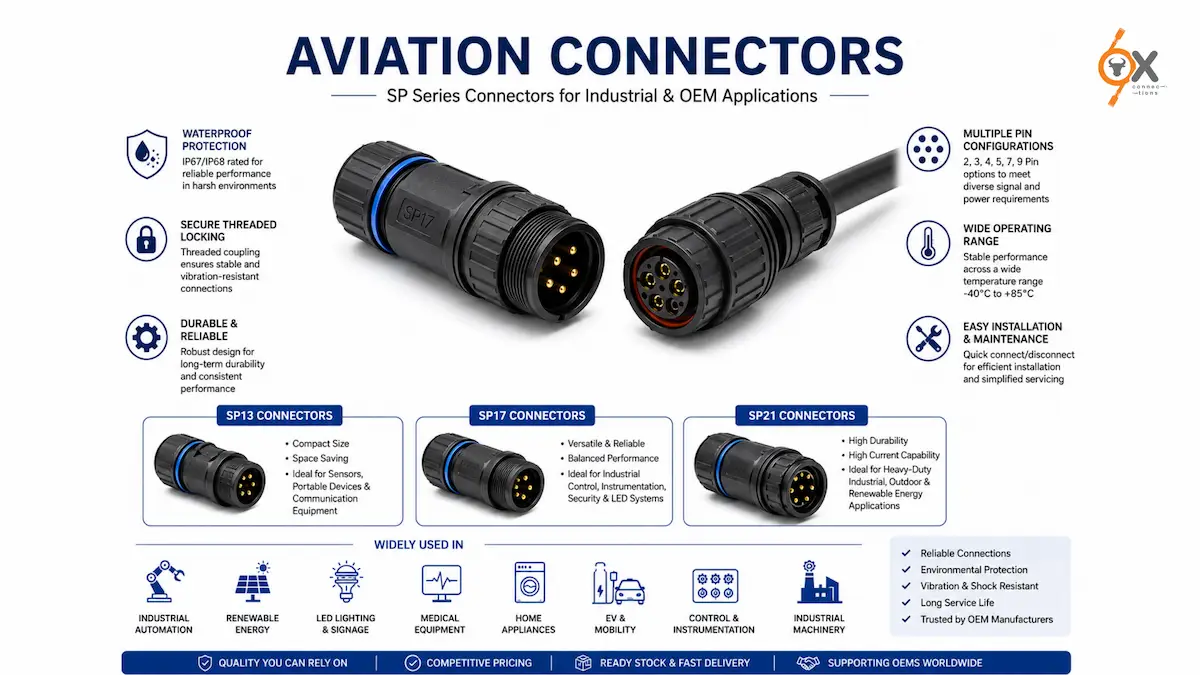
This guide explores what SP Connectors (Aviation Connectors) are, where they’re used, and what engineers and procurement professionals should consider when selecting them.
In industrial product design, electrical connectivity is often an overlooked component until something goes wrong. A connector failure can bring an entire system offline, cause costly maintenance visits, or delay production schedules. That’s why engineers and procurement teams place significant importance on selecting the right connector solution from the beginning.
Among the various connector families used across industries, SP Connectors, commonly known as Aviation Connectors, have become a preferred choice for manufacturers seeking dependable performance in demanding environments.
Whether you’re designing industrial automation equipment, renewable energy systems, medical devices, LED lighting infrastructure, or electronic control systems, understanding SP Connectors can help improve product reliability while simplifying sourcing and maintenance.
What Are SP Connectors (Aviation Connectors)?
SP Connectors are a family of circular connectors designed to provide secure electrical connections in industrial and commercial equipment. They are known for their robust construction, reliable locking mechanisms, and suitability for applications where environmental protection and durability are important.
Unlike many standard connectors that rely on simple push-fit designs, SP Connectors typically feature threaded locking systems that help maintain a stable connection even when exposed to vibration, movement, or challenging operating conditions.
Their combination of compact size, mechanical strength, and environmental resistance has made them a popular solution across multiple industries.
Why Are They Called Aviation Connectors?
The term “Aviation Connector” is widely used throughout the electronics and manufacturing industries. Historically, circular connectors with threaded locking mechanisms were commonly associated with aerospace and aviation applications because of their reliability and secure mating design.
Over time, similar connector designs found their way into industrial machinery, medical equipment, energy systems, and commercial electronics. Today, the terms SP Connector, Aviation Connector, and Circular Connector are often used interchangeably depending on the industry and application.
While not every SP Connector is intended for aerospace use, the nickname has remained popular among engineers, buyers, and suppliers.
Understanding the SP Connector Series
One reason for the widespread adoption of SP Connectors is the availability of multiple sizes and configurations.
SP13 Connectors
SP13 Connectors are compact and designed for applications where installation space is limited.
They are commonly used in:
- Sensors
- Portable devices
- Compact control systems
- Communication equipment
Their smaller footprint makes them ideal when designers need dependable connectivity without sacrificing valuable space.
SP17 Connectors
SP17 Connectors offer a balance between compact size and electrical capability.
Typical applications include:
- Industrial control systems
- Instrumentation equipment
- Security systems
- LED control applications
- Factory automation
For many OEMs, SP17 represents a versatile middle-ground solution.
SP21 Connectors
SP21 Connectors are designed for more demanding industrial environments and applications requiring greater mechanical robustness.
Common uses include:
- Renewable energy equipment
- Outdoor electronics
- Industrial machinery
- Heavy-duty control systems
- Manufacturing equipment
Their larger design makes them suitable for applications where durability and environmental protection are critical.
Key Features of SP Connectors
Secure Threaded Locking
One of the most valued characteristics of SP Connectors is their threaded locking mechanism.
In industrial environments where vibration, movement, or repeated handling occurs, a secure connection is essential. Threaded locking helps reduce the risk of accidental disconnection and contributes to long-term reliability.
Waterproof Protection
Many SP Connector variants are designed as Waterproof Circular Connectors, making them suitable for applications exposed to:
- Rain
- Moisture
- Dust
- Outdoor operating conditions
- Industrial contaminants
This level of protection makes them especially useful for equipment installed outside controlled indoor environments.
Multiple Pin Configurations
SP Connectors are available in various pin counts, allowing engineers to select configurations that match their signal and power requirements.
Common options include:
- 2 Pin
- 3 Pin
- 4 Pin
- 5 Pin
- 7 Pin
- 9 Pin
This flexibility helps standardize designs across multiple product platforms.
Compact and Durable Construction
Industrial equipment designers often face space constraints while still requiring reliable performance.
The circular design of SP Connectors provides a compact solution without compromising durability, making them suitable for both portable and fixed installations.
Ease of Installation and Service
Maintenance teams appreciate connector systems that are easy to inspect, disconnect, and replace when required.
SP Connectors help simplify servicing while supporting long operational lifecycles.
Industrial Applications of SP Connectors
The versatility of SP Connectors has contributed to their widespread adoption across industries.
Industrial Automation
Automation systems depend on reliable communication between controllers, sensors, actuators, and monitoring devices.
SP Connectors provide dependable connectivity in environments where equipment operates continuously and vibration is common.
Renewable Energy Systems
Solar and renewable energy projects often require connectors capable of handling outdoor exposure and demanding environmental conditions.
SP Connectors are frequently used in:
- Solar monitoring equipment
- Power management systems
- Control panels
- Energy storage applications
LED Lighting and Signage
Outdoor LED installations face constant exposure to weather, dust, and environmental contaminants.
Waterproof Circular Connectors help ensure dependable operation while minimizing maintenance requirements.
Medical Equipment
Medical devices require reliable and consistent electrical connections.
SP Connectors are commonly found in:
- Diagnostic systems
- Monitoring equipment
- Laboratory instruments
- Healthcare electronics
Home Appliances
Modern appliances increasingly rely on advanced electronic systems and control modules.
SP Connectors can support dependable internal connectivity across a variety of appliance applications.
EV and Mobility Solutions
As electrification continues to expand, manufacturers require connector solutions that support reliability and long-term performance in supporting systems and industrial applications.
How Engineers Should Select SP Connectors
Choosing the right connector requires more than selecting a series size.
Evaluate Environmental Conditions
Engineers should assess:
- Indoor versus outdoor installation
- Dust exposure
- Moisture levels
- Temperature variations
- Mechanical stress
Environmental requirements often influence connector selection early in the design process.
Determine Pin Requirements
Understanding the number of signals and power connections required helps avoid future redesigns and supports scalability.
Consider Mounting Style
SP Connectors are available in several configurations, including:
- Panel Mount
- Cable Mount
- Inline designs
The chosen mounting style should align with equipment architecture and maintenance requirements.
Plan for Serviceability
Ease of maintenance can significantly impact equipment lifecycle costs.
Selecting connectors that simplify inspection and replacement can improve long-term operational efficiency.
Procurement Challenges Facing OEM Manufacturers
While connector performance remains critical, procurement teams face additional considerations.
Long Lead Times
Unexpected component shortages can delay production schedules and customer deliveries.
High Minimum Order Quantities
Some suppliers require purchasing commitments that may not align with actual project demand.
Cost Management
Procurement teams continuously seek opportunities to improve commercial competitiveness without compromising quality.
Supply Chain Stability
Reliable availability and consistent product quality are essential for maintaining uninterrupted production.
These challenges have encouraged many manufacturers to reassess traditional sourcing strategies and evaluate alternative supply partners.
Why OEMs Are Exploring Alternative Connector Suppliers
The modern manufacturing environment requires greater flexibility than ever before.
Engineering and procurement teams increasingly look for suppliers that can provide:
- Consistent product availability
- Competitive commercial support
- Reliable quality standards
- Certification compliance
- Responsive customer service
Rather than focusing solely on component cost, OEMs are increasingly evaluating total supply chain reliability when selecting connector partners.
Why OX Connections?
For manufacturers seeking dependable connector solutions, sourcing from a supplier with both technical understanding and inventory support can significantly reduce procurement risk.
Related Product Range: Explore OX Connections’ SP Series Connector portfolio for industrial and OEM applications.
OX Connections supports manufacturers across industries including:
- Industrial Automation
- Renewable Energy
- Solar Manufacturing
- Home Appliances
- Medical Equipment
- EV Applications
- LED Lighting Systems
By supporting both engineering and procurement teams throughout the sourcing process, OX helps customers identify suitable connector solutions aligned with their application requirements and production goals.
Conclusion
SP Connectors have become an essential connectivity solution across modern industries because they combine durability, environmental protection, flexibility, and reliable performance.
For engineers, they offer a practical way to improve equipment reliability and simplify system design. For procurement teams, they represent a connector category that can support long-term supply stability and operational efficiency.
As manufacturers continue to prioritize reliability, serviceability, and supply chain resilience, SP Connectors remain a proven choice for industrial and OEM applications worldwide.
Frequently Asked Questions
1. What is the difference between an SP Connector and an Aviation Connector?
In most industrial applications, the terms are used interchangeably. SP Connectors are commonly referred to as Aviation Connectors because of their circular design and threaded locking mechanism.
2. Are SP Connectors suitable for outdoor applications?
Many SP Connector variants are designed as Waterproof Circular Connectors and are commonly used in outdoor industrial, renewable energy, and LED lighting applications.
3. How do I choose between SP13, SP17, and SP21 Connectors?
The selection depends on available space, environmental conditions, cable size, and application requirements. Engineers typically evaluate these factors before selecting the most suitable series.
About OX Connections
OX Connections is a stocking distributor of industrial connector solutions serving OEMs, system integrators, and manufacturers across multiple sectors. Our portfolio includes SP Series Connectors, SMA Connectors, RF Connectors, and associated connectivity solutions designed to support demanding industrial applications.
With competitive commercial support, consistent top-notch quality, dependable availability, and a proven track record supplying multiple OEMs, OX Connections helps engineering and procurement teams reduce sourcing risk while maintaining performance expectations.
Whether you’re qualifying an alternate source, developing a new product, or supporting ongoing production requirements, OXConnections can help identify the right connector solution for your application. Contact our team to discuss your requirements and explore the complete SP Series and SMA/RF connector range.
Disclaimer: Product suitability, certifications, specifications, and performance requirements should always be evaluated based on the intended application. Customers should independently verify technical requirements before finalizing component selection.