
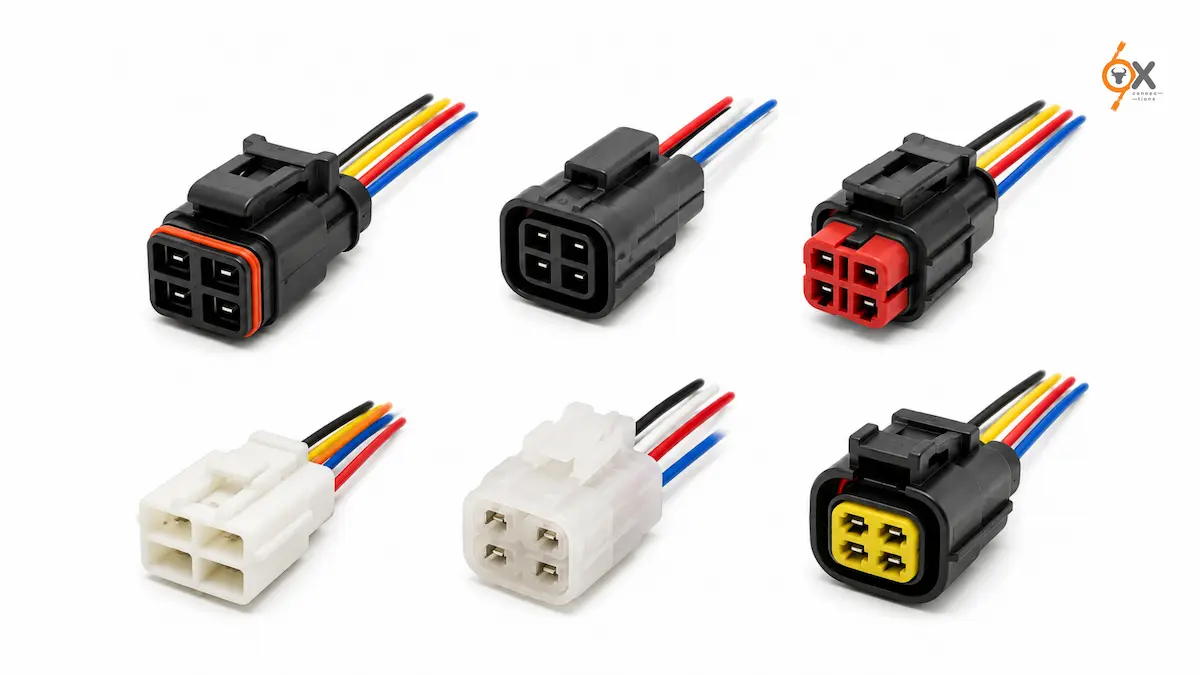
If you’ve spent any real time on a shop floor in Bhiwandi or crimped a harness at 11 PM in a Kurla workshop trying to beat a client deadline, you already know: the 4 way connector types is one of those components nobody talks about until it fails. And when it fails, it usually fails at the worst possible moment – mid-installation, mid-shipment, or worse, after the panel’s already gone live.
After years of sitting in on procurement calls and site visits across Mumbai’s electrical and automotive ancillary belt, I’ve noticed the same pattern repeat: teams buy connectors on price first, spec sheet second, and application fit a distant third. That order needs flipping. This piece is written for the buyers, panel builders, and OEM engineers who’d rather get it right the first time.
Not All Four Pins Are Created Equal
A 4-way connector is, on paper, a simple thing, a housing that brings four circuits together in one interface instead of four separate joins. But the moment you step onto an actual factory floor, whether it’s an ancillary unit off the Eastern Express Highway or a trailer assembly line in Chakan, the differences start to matter a lot.
The core distinction is between what it’s built for and where it’ll live. A connector sitting inside a dry, temperature-controlled control panel has very different demands from one hanging off the back of a truck in Nashik in monsoon season. Conflating the two is how you end up with a 40% field-failure rate and a very uncomfortable call with your client.
The Line-Up: Sorting Through 4 Way Connector Types
Once you start comparing 4 way connector types, three practical buckets tend to cover 90% of B2B use cases in India:
Sealed, weatherproof builds IP67/IP68 rated housings meant for outdoor, automotive, and agri-equipment use. If moisture, dust, or road grime is anywhere in the picture, this is non-negotiable, not a nice-to-have.
Standard indoor/panel-grade – built for control panels, switchgear, and enclosed industrial setups where environmental exposure is minimal but density and ease of servicing matter more.
Locking vs. non-locking plug-in styles – anything that vibrates – vehicles, compressors, DG sets – needs a positive lock, not just friction fit. I’ve seen more warranty claims traced back to a connector that simply worked itself loose than to any actual electrical fault.
The mistake I see most often with first-time buyers is picking based on what a supplier has readily in stock rather than what the application actually calls for. That shortcut is expensive six months down the line.
There’s also a material question that rarely gets asked upfront: housing plastic. Nylon 66 with glass fill handles heat and mechanical stress far better than a generic polypropylene shell, but it costs more per unit. On a 10,000-piece order for a panel builder, that difference adds up fast, which is exactly why so many buyers skip it. The ones who don’t skip it are usually the ones who aren’t fielding replacement calls eighteen months later.
Where 4-Way Wiring Connectors Actually Earn Their Keep
A 4-way wiring connector shows up in more places than most people clock. A few that come up constantly in conversations with clients across Maharashtra’s manufacturing corridor:
Automotive and trailer wiring – tail lamp circuits, indicator harnesses, and auxiliary lighting on commercial vehicles, where a sealed, vibration-resistant connector is standard practice, not an upgrade.
Industrial control panels – linking sensor outputs, relay circuits, or feedback loops inside a panel where quick disconnects during maintenance save real downtime.
Home and commercial electrical junctions — bringing together multiple circuit branches at a distribution point, particularly in retrofit jobs where rewiring an entire junction box isn’t practical.
The common thread across all three: whoever specced the connector understood the environment first, and the electrical spec second. That’s the order that actually holds up on-site.
The Sourcing Reality: Why ‘Built for India’ Actually Matters
A lot of connector specs floating around are lifted straight from European or East Asian datasheets, tested in climate conditions that don’t remotely resemble a Bombay monsoon or a Vidarbha summer. That gap matters more than most procurement teams give it credit for.
Humidity swings of 40% within a single day, dust ingress on open sheds, voltage fluctuation on captive DG power – these aren’t edge cases in Indian industrial settings, they’re Tuesday. A connector rated for a controlled European factory floor can underperform badly the moment it lands in a real site in Taloja or Ambernath. I’ve watched procurement teams import a ‘premium’ connector at a steep landed cost, only to see it fail faster than a locally engineered equivalent built with these exact conditions in mind.
This is also where lead time quietly becomes a spec of its own. An imported connector with a six-to-eight week lead time doesn’t help a panel builder who’s three days from a client delivery. Local manufacturing and stock availability aren’t just a cost play –
they’re often the difference between hitting a deadline and explaining a delay to a client who’s already explained one to their client.
The Three Questions That Actually Decide Your Purchase
Strip away the marketing copy, and choosing between 4 way connector types comes down to three questions, in this order:
What’s the amperage and wire gauge?
Undersizing a connector for the current it’ll actually carry is the single most common cause of heat buildup and eventual failure. Match the rating to real load, not the nameplate optimism.
What’s the environment?
Indoor, outdoor, exposed to vibration, exposed to chemicals or coolant – this single answer eliminates most of the wrong options immediately.
Who’s installing and servicing it?
A connector that’s technically superior but a nightmare for a site electrician to crimp or replace in the field creates more problems than it solves. Ease of installation is a spec, even if it never shows up on a datasheet.
A Few Field Notes on Installation
Keep it simple: dry-fit before crimping, never force a housing that doesn’t seat cleanly, and always check the connector’s rated temperature range against ambient conditions – a control panel in a non-AC shed in Vasai in
May behaves very differently from one in a climate-controlled facility. And test every joint under load before signing off, not just visually.
A few more habits worth building into any installation checklist, gathered from watching both good and bad crews work: strip wire ends to the exact length the housing calls for, not the length that ‘looks about right’ – even 1-2mm of extra exposed copper inside a sealed housing invites moisture tracking over time.
Torque any screw-type terminals to spec rather than ‘hand tight plus a bit,’ since under-torquing causes intermittent connections that are maddening to trace later, and over-torquing can crack the housing outright.
And keep a small batch of spares on-site during commissioning, not just for the connector itself but for the matching pins and seals. Nothing stalls a commissioning day faster than a perfectly good connector rendered useless because one seal ring went missing from the kit.
Getting the Small Connection Right
None of this is complicated once you’ve seen a few installations go sideways and a few go right.
The connector is a small part of the bill of materials, but it’s rarely a small part of the failure report. Get the environment, the load, and the installation reality right, and the connector stops being something you think about at all – which is exactly the point.
If there’s one habit worth carrying forward from all of this, it’s treating the connector spec with the same seriousness as the rest of the bill of materials – not as a line item to fill in after everything else is finalised.
The teams that do this consistently are the ones with fewer field complaints, shorter commissioning cycles, and honestly, fewer late-night calls.
At OxConnections, this is the thinking that goes into every connector we supply out of our Bombay facility – built for how Indian industrial and automotive environments actually behave, not just how a datasheet says they should. If you’re specifying 4-way connectors for your next build, get in touch with our team or browse the full range on our website.