
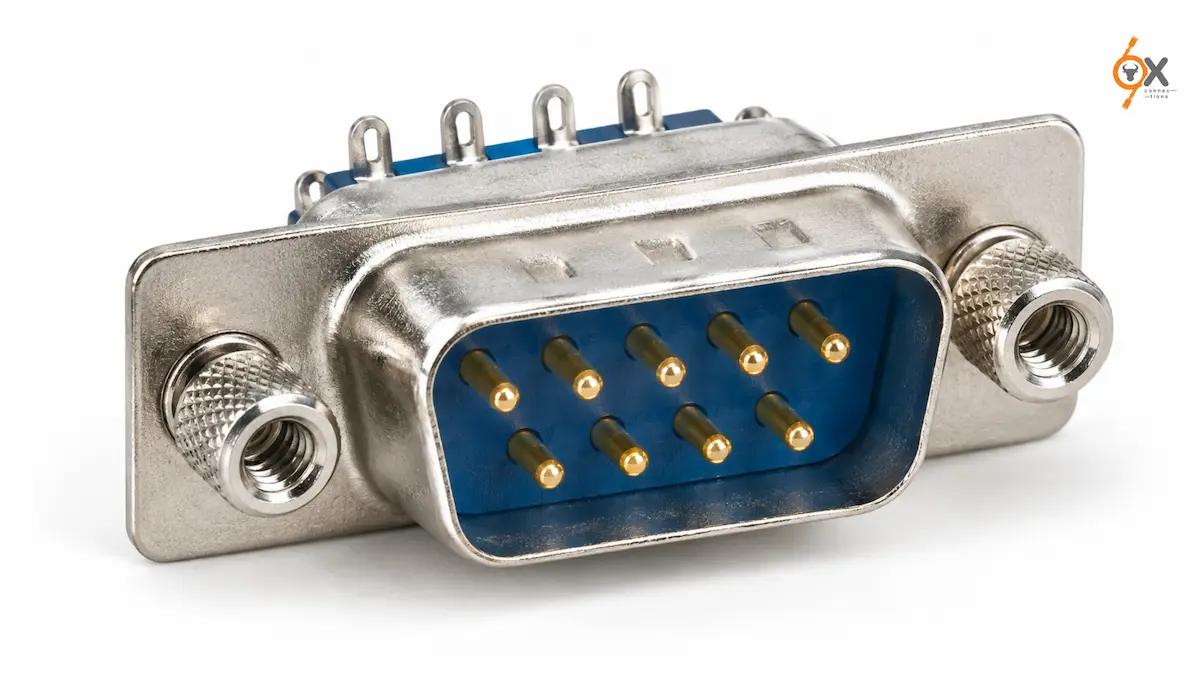
Long before USB took over every desk, one small trapezoidal connector carried serial data between computers, modems, and mice. That connector never really left. The 9-Pin D-Sub Connector still sits inside control cabinets, CNC machines, and industrial equipment today, doing the same steady job it did decades ago.
A Shape Built for Certainty, Not Just Data
The D-Sub family gets its name from the D-shaped metal shell surrounding the pins. That shape does more than look distinctive. It forces the connector to mate in only one orientation, which prevents a technician from ever plugging it in backwards. Nine pins sit arranged in two rows inside that shell, small enough to keep the connector compact but generous enough to carry a full serial data path with room for handshaking signals. That same shell also gives the connector real mechanical strength, protecting the pins from bending during rough handling on a busy factory floor.
What Actually Travels Through Those Nine Contacts
A standard 9-pin layout carries the RS-232 serial standard, historically used to connect computers to modems, mice, and early industrial controllers. Beyond straightforward transmit and receive lines, the remaining pins handle handshaking signals that tell each device when the other is ready to send or receive data. That handshaking capability is exactly why this connector outlasted so many of its contemporaries, since it could manage a genuine two-way conversation rather than a simple one-way signal. Robust mechanical structure and versatile pin configurations are exactly what let this decades-old standard keep pace with equipment built long after it first appeared.
D-Sub Connector Applications That Refuse to Retire
D-Sub Connector Applications for the 9-pin variant cluster heavily around serial communication and control. Industrial automation systems and PLCs still use DB9 ports for programming and diagnostics. Instrumentation and communication equipment rely on it to relay control signals reliably between panels. Medical devices and legacy computing systems keep this connector alive well past the era it was designed for, simply because the interface still works and replacing it across an entire installed base rarely makes financial sense.
Mounting Styles: Matching the Connector to the Assembly Method
Ox Connections offers the 9-pin version across solder-type, crimp, IDC, power, waterproof, and Centronics variants, so the mounting decision rarely forces a compromise. A solder-type version suits a technician terminating a cable by hand, one wire at a time, with a soldering iron. A crimp version suits volume production, where consistency across hundreds of cable assemblies matters more than a single technician’s individual skill. IDC, or insulation displacement contact, versions skip stripping altogether, piercing straight through ribbon cable insulation to save assembly time. Straight and right-angle PCB-mount versions solder directly onto a board in either 90-degree or 180-degree orientation, building the connector straight into the layout.
Why a Screw-Lock Beats a Simple Friction Fit
Most 9-pin D-Sub connectors include a secure locking mechanism, typically a pair of jack screws on either side of the shell, letting a technician thread the connector down tight rather than relying on friction alone. That mechanical detail matters enormously in a control cabinet exposed to vibration from nearby machinery, and it’s a big part of why this connector still holds up in rugged, high-vibration environments. A connector that works loose mid-shift can cause a communication fault that’s maddening to trace, while a properly threaded connection stays put for years without attention. Dust covers and EMI shielding accessories, both available alongside the connector itself, add further protection in dusty or electrically noisy panels.
Sourcing a D-Sub Connector India Panel Builders Can Count On
D-Sub Connector India buyers maintaining legacy industrial equipment need a supplier who still treats this connector as standard stock, not a discontinued relic. Ox Connections stocks the 9-pin version alongside 15, 25, 26, 37, 44, 50, 62, 78, and 104 pin configurations, in metal or plastic shell options with male-to-male and female-to-female adapters available too. With over 5,000 products in stock and quick dispatch across India, panel builders and maintenance teams get a dependable source for both new builds and replacement parts on equipment that has run reliably for years.
Installation Notes Worth Following
Technicians should always tighten the jack screws by hand first, checking alignment before applying any real torque, since forcing a misaligned connector can bend the delicate pins inside. Cables running near motors or variable frequency drives benefit from shielded D-Sub connectors, which reduce the electrical noise that can otherwise corrupt a serial signal. A quick visual inspection during routine maintenance catches bent pins or loosened screws well before they cause an unexplained fault on the line. Keeping a stock of dust covers on hand also protects unused ports on a panel from years of accumulated grime before they’re ever connected.
Final Word
The 9-Pin D-Sub Connector has earned its long service life the honest way, by doing a simple job reliably for decades. Buyers specifying it today should confirm mounting style, shielding, and locking hardware against the exact application, rather than assuming every DB9 part is interchangeable. Ox Connections offers D-Sub connectors across the full 9 to 104 pin range, in solder, crimp, IDC, power, waterproof, and Centronics variants, backed by 5,000-plus products in stock and quick dispatch across India.
Quick Answers
What is a 9-pin D-Sub connector used for?
It carries RS-232 serial communication and control signals, commonly found on industrial PLCs, CNC equipment, encoders, and legacy computing hardware.
Why does the D-Sub shell matter?
Its D-shape forces correct orientation during mating, preventing a technician from connecting it backwards and protecting the pins from misalignment damage.
Should I choose solder, crimp, or IDC termination?
Choose based on assembly method: solder suits hand-built cables, crimp suits volume production, and IDC suits fast ribbon cable termination.
Leave A Comment