
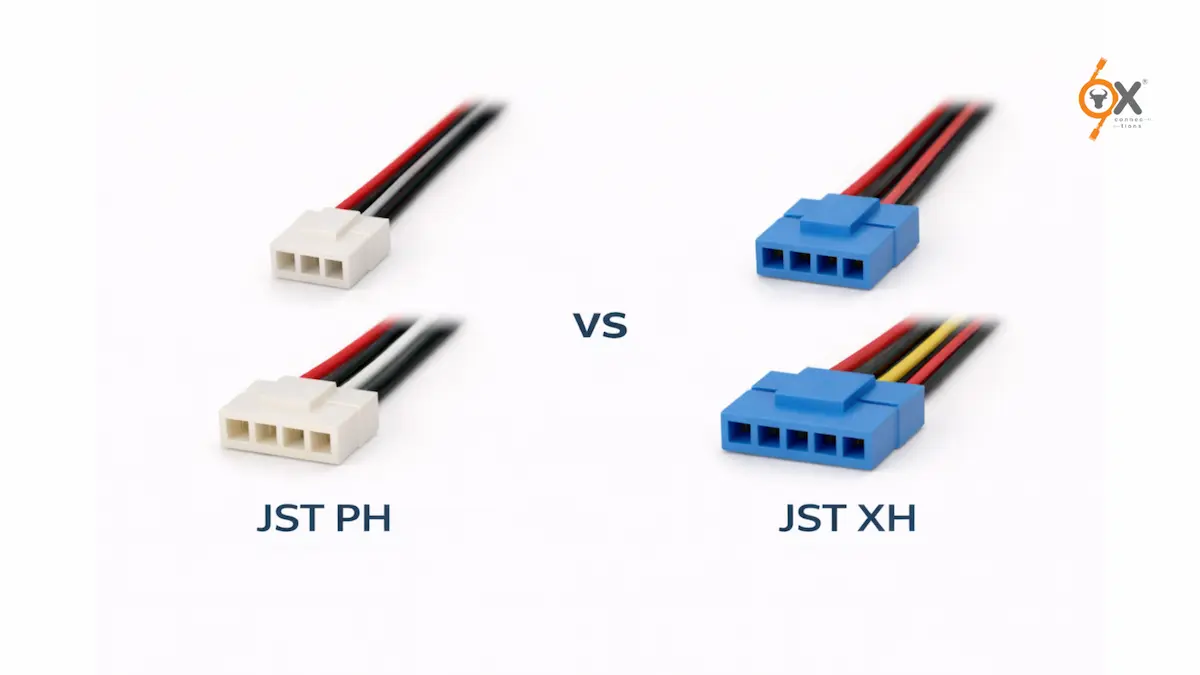
In the world of compact devices, precision matters. Whether you’re designing wearable tech, PCB-based gadgets, battery-powered devices, or IoT modules, choosing the right connector can directly impact performance, durability, and overall product efficiency. This is where the comparison of JST PH vs JST XH connector becomes highly relevant.
Both connectors are widely used in small-scale electronic applications, but they are not interchangeable. Understanding their differences, specifications, and practical use cases is essential—especially for OEMs and manufacturers in India looking to balance performance with cost and availability.
Understanding JST Connectors in Small Electronics
JST connectors are known for their compact design, reliability, and ease of use. They are commonly found in applications where space is limited and secure connections are critical.
When discussing JST connectors for small electronics, the PH and XH series are among the most commonly used due to their versatility and efficiency. However, each serves a different purpose depending on the design constraints and electrical requirements.
JST PH vs JST XH Connector: Core Differences
The debate around JST PH vs JST XH connector comes down to size, pitch, and application.
1. Pitch & Size
The most noticeable difference lies in pitch:
- PH connectors have a 2.0mm pitch
- XH connectors have a 2.5mm pitch
This makes PH connectors smaller and more suitable for tight spaces, while XH connectors are slightly larger but easier to handle and assemble.
2. Application Fit
The JST PH connector specifications make it ideal for ultra-compact devices like wearables, handheld gadgets, and small battery packs.
On the other hand, the JST XH connector specifications are better suited for slightly larger PCBs, LED assemblies, and internal wiring where space is available but reliability is still critical.
3. Ease of Handling
Due to their size, PH connectors require more precision during installation. XH connectors, being slightly bigger, are easier to work with in manufacturing environments.
Specifications Breakdown: PH vs XH
A deeper look at technical aspects helps clarify the JST PH vs JST XH connector comparison.
JST PH
- Compact 2.0mm pitch
- Typically supports lower current ranges
- Ideal for lightweight connections
- Best suited for tight PCB layouts
These JST PH connector specifications make them perfect for applications where space-saving is the top priority.
JST XH
- 5mm pitch
- Higher current handling compared to PH
- Stronger locking mechanism
- More robust for repeated use
The JST XH connector specifications provide a balance between compact design and durability, making them widely used across consumer and industrial electronics.
Use Cases in Small Electronics
When selecting between JST PH vs JST XH connector, application context is everything.
Where PH Connectors Work Best
- Wearable devices
- Bluetooth modules
- Miniature battery packs
- Compact IoT devices
These are scenarios where JST connectors for small electronics need to be extremely compact and lightweight.
Where XH Connectors Are Preferred
- LED lighting systems
- PCB connections in appliances
- DIY electronics projects
- Internal wiring in small devices
In such cases, the slightly larger size defined by JST XH connector specifications offers better durability and ease of use.
India Market Reality: Cost, Availability & OEM Challenges
While technical comparison is important, real-world sourcing challenges cannot be ignored – especially for Indian OEMs.
Both PH and XH connectors are often:
- Expensive when sourced from traditional brands
- Available with long lead times
- Restricted by high minimum order quantities
This makes the JST PH vs JST XH connector decision not just technical, but also commercial.
To address this, many manufacturers are now turning to OX for reliable connector solutions that match JST PH connector specifications and JST XH connector specifications, without the usual procurement issues.
OX offers:
- Cost-effective alternatives (nearly half the price)
- Ready stock availability (no delays)
- Certified quality (UL, RoHS, CE)
- Flexibility for small and large orders
Why OEMs Are Moving Toward Smarter Alternatives
In sectors like EV, solar, medical devices, and home appliances, speed and cost efficiency are critical.
Instead of relying solely on legacy brands, OEMs evaluating JST connectors for small electronics are shifting towards solutions that:
- Maintain performance standards
- Reduce sourcing delays
- Improve cost margins
OX connectors are designed to deliver on all three fronts. They provide equivalents that align with both PH and XH series, making them a practical choice in the evolving Indian manufacturing ecosystem.
Final Verdict: Which Connector Is Better?
The answer depends entirely on your application.
- Choose PH connectors if your priority is ultra-compact design and minimal space usage, based on JST PH connector specifications.
- Choose XH connectors if you need slightly higher durability and easier handling, aligned with JST XH connector specifications.
In both cases, understanding the nuances of JST PH vs JST XH connector helps you make a more informed and efficient decision.
Conclusion: Making the Right Choice for Small Electronics
The comparison of JST PH vs JST XH connector is not about which one is universally better – it’s about which one fits your specific need.
For modern manufacturers and OEMs in India, the decision also extends to sourcing strategy. By choosing reliable alternatives like OX that meet JST connectors for small electronics requirements, businesses can ensure consistent performance while optimizing cost and supply chain efficiency.
In small electronics, every millimeter and every connection counts – choose wisely.