
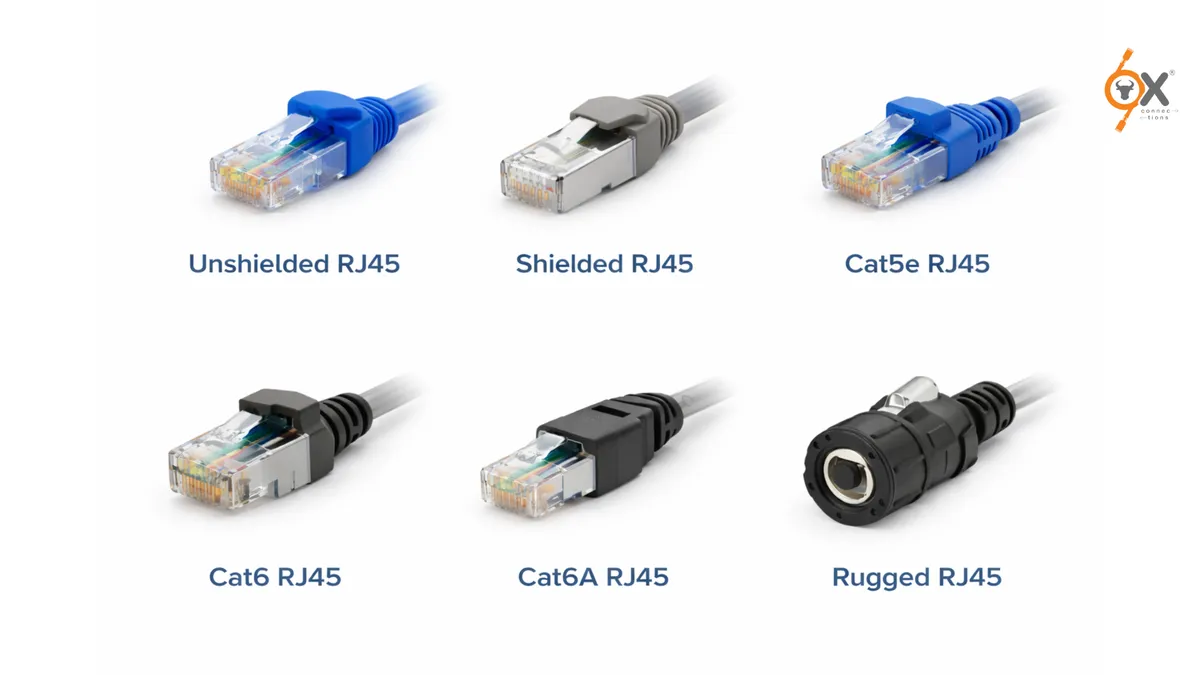
If you have ever used a LAN cable for internet connectivity, chances are you have already used an RJ45 connector. But many people are unaware that there are different Types of RJ45 Connector, each designed for specific networking needs and environments.
In today’s connected world, stable internet and reliable data transmission are essential for homes, offices, factories, and industrial systems. Whether it is a simple office LAN setup or a large-scale automation network, the small connector attached to an Ethernet cable plays a major role in ensuring seamless communication. That connector is known as the RJ45 connector.
This guide explains the different types of RJ45 connectors, their uses, categories, and how to choose the right connector for your networking or industrial application.
What Is an RJ45 Connector?
An RJ45 connector is a standardized connector used for Ethernet networking and LAN cable connections. It is commonly attached to Cat5e, Cat6, Cat6A, and other Ethernet cables to connect devices such as routers, switches, computers, servers, printers, and industrial equipment.
The term RJ45 stands for “Registered Jack 45.” It uses an 8-position, 8-contact (8P8C) modular connector design that supports high-speed data communication.
Today, RJ45 connectors are widely used in:
- Office networking
- Data centers
- Industrial automation
- Smart homes
- Telecom systems
- Security and CCTV systems
- Renewable energy systems
- Medical equipment
Because networking demands continue to grow, selecting the correct Ethernet cable connector has become increasingly important for performance and reliability.
Two Main Types of RJ45 Connectors
The two most common RJ45 connector types are:
1. Unshielded RJ45 Connectors (UTP)
Unshielded RJ45 connectors are designed for standard networking environments where electromagnetic interference is minimal.
These connectors are commonly used in:
- Homes
- Small offices
- Educational institutions
- Basic LAN setups
UTP connectors are affordable, lightweight, and easy to install. They work efficiently for regular internet and networking requirements.
Benefits of Unshielded RJ45 Connectors
- Cost-effective
- Easy termination
- Widely available
- Suitable for everyday networking
However, they may not perform well in environments with high electrical interference or industrial machinery.
2. Shielded RJ45 Connectors (STP)
Shielded RJ45 connectors include additional metallic shielding that protects signals from electromagnetic interference (EMI) and radio frequency interference (RFI).
These connectors are ideal for:
- Industrial automation
- Manufacturing facilities
- Data centers
- Renewable energy systems
- High-noise electrical environments
Shielded connectors provide better signal integrity and stable performance, especially in mission-critical applications.
Benefits of Shielded RJ45 Connectors
- Reduced interference
- Better signal quality
- Higher reliability
- Improved network stability
Industries dealing with sensitive communication systems often prefer shielded LAN cable connectors for uninterrupted performance.
RJ45 Connectors Based on Cable Categories
Apart from shielded and unshielded designs, RJ45 connectors are also classified according to Ethernet cable categories.
Cat5e RJ45 Connectors
Cat5e connectors are commonly used for standard Gigabit Ethernet applications.
They support:
- Speeds up to 1 Gbps
- Frequencies up to 100 MHz
Cat5e is still widely used in homes and small businesses because it offers reliable performance at a lower cost.
Cat6 RJ45 Connectors
Cat6 connectors are designed for higher-speed networks and improved performance.
They support:
- Speeds up to 10 Gbps (short distances)
- Frequencies up to 250 MHz
Cat6 connectors are commonly used in:
- Offices
- Commercial buildings
- CCTV systems
- Smart infrastructure
Cat6A RJ45 Connectors
Cat6A connectors are advanced versions designed for demanding high-speed applications.
They support:
- 10 Gbps over longer distances
- Better shielding
- Improved performance in high-density environments
These connectors are ideal for modern enterprise networks and industrial systems.
Where Are RJ45 Connectors Used?
Because of their versatility, RJ45 connectors are used across multiple industries and applications.
Office Networking
RJ45 connectors are the backbone of office Ethernet networks. They connect:
- Computers
- Printers
- Routers
- Switches
- VoIP systems
Industrial Automation
Factories and industrial plants rely on durable RJ45 connector types for machine communication, automation systems, and industrial Ethernet networks.
CCTV & Security Systems
Most IP cameras and surveillance systems use Ethernet cable connectors for stable data and power transmission.
Renewable Energy Sector
Solar power systems and renewable energy setups require reliable networking for monitoring and communication. Industrial-grade RJ45 connectors are commonly used in these systems.
Data Centers
Data centers require high-performance shielded connectors to maintain stable, high-speed communication between servers and networking equipment.
How to Choose the Right RJ45 Connector
Selecting the correct RJ45 connector depends on several factors.
1. Cable Category
Always match the connector with the cable type:
- Cat5e connector for Cat5e cable
- Cat6 connector for Cat6 cable
Using mismatched components may reduce performance.
2. Shielding Requirement
Choose:
- UTP connectors for regular environments
- STP connectors for industrial or interference-prone areas
3. Application Type
Different applications require different performance levels.
For example:
- Home internet → Cat5e UTP
- Industrial automation → Cat6 shielded
- Data center → Cat6A shielded
4. Build Quality
High-quality connectors improve:
- Signal transmission
- Durability
- Network stability
Poor-quality connectors may cause frequent connectivity issues.
Importance of Quality RJ45 Connectors in Industrial Applications
In industrial settings, network downtime can lead to operational delays and productivity loss. That is why businesses prioritize reliable and certified RJ45 connectors.
High-quality industrial connectors offer:
- Better resistance to vibration
- Improved durability
- Stable signal transmission
- Longer operational life
Many OEMs and manufacturers today also look for cost-effective alternatives to expensive imported connectors without compromising quality.
Companies like OX Connections provide reliable connector solutions for industries such as:
- Solar and renewable energy
- Home appliances
- Medical equipment
- EV manufacturing
- Industrial automation
With certifications like UL, RoHS, and CE, such alternatives are becoming increasingly popular among Indian manufacturers seeking dependable networking components.
Common Mistakes to Avoid While Using RJ45 Connectors
Using the Wrong Connector Type
Using Cat5e connectors on Cat6 cables can impact network performance.
Poor Crimping
Improper crimping may lead to loose connections and unstable internet connectivity.
Ignoring Shielding Requirements
Industrial environments often require shielded connectors for proper performance.
Low-Quality Materials
Cheap connectors may fail quickly and increase maintenance costs.
Future of RJ45 Connectors
Even with the rise of wireless technologies, wired Ethernet networking remains essential for high-speed, low-latency, and reliable communication.
As industries adopt:
- Smart manufacturing
- Industrial IoT
- AI-driven automation
- Renewable energy systems
the demand for advanced RJ45 connector types will continue to grow.
High-speed Ethernet infrastructure will remain critical for businesses that require secure and uninterrupted data communication.
Conclusion
Understanding different RJ45 connector types is important for building reliable networking systems. Whether you are setting up a home LAN, office network, industrial automation system, or data center, selecting the correct LAN cable connector can significantly impact performance and reliability.
The two primary types – shielded and unshielded RJ45 connectors – serve different purposes depending on the environment and application. Additionally, choosing the correct category such as Cat5e, Cat6, or Cat6A ensures optimal speed and efficiency.
As networking technology continues evolving, high-quality Ethernet cable connectors will remain essential for modern communication infrastructure.
FAQs
1. What are the two main types of RJ45 connectors?
The two primary types are unshielded RJ45 connectors (UTP) and shielded RJ45 connectors (STP).
2. What is an RJ45 connector used for?
An RJ45 connector is used to connect Ethernet cables in networking systems such as LAN networks, routers, switches, computers, and industrial communication systems.
3. Which RJ45 connector is best for industrial applications?
Shielded RJ45 connectors are generally preferred for industrial environments because they reduce electromagnetic interference and provide stable signal transmission.