
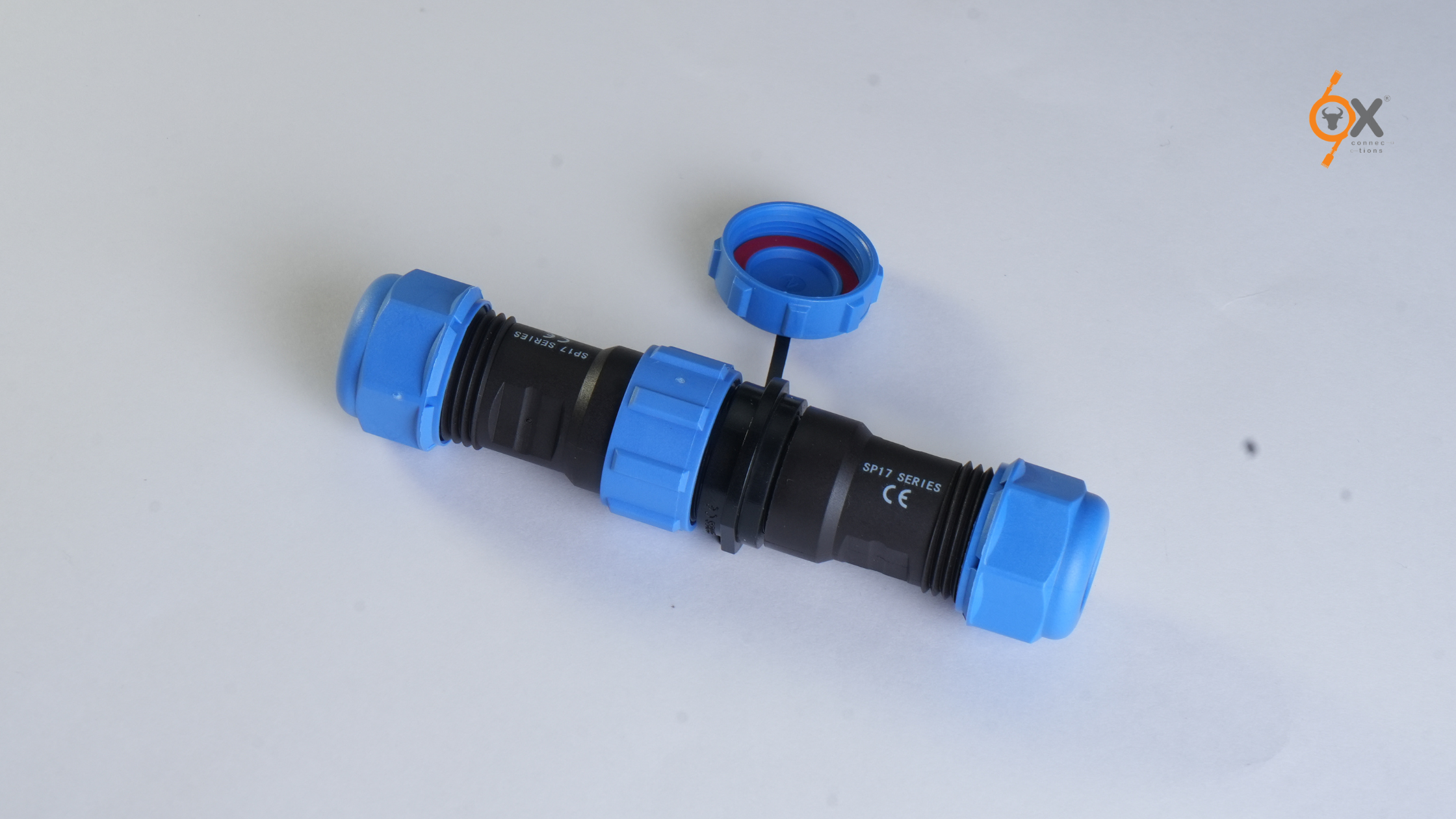
Electronic connections in outdoor environments face challenges indoor installations never encounter moisture from rain or humidity, dust from wind or industrial processes, temperature extremes, and physical stress from vibration. Standard connectors designed for controlled environments fail when exposed to these conditions. Waterproof connectors, particularly the SP series with aeronautical-grade design, address these challenges through proper sealing, robust housing, and corrosion-resistant materials.
The SP Series Waterproof Connectors uses design principles from aerospace applications where connection reliability is critical—threaded coupling for mechanical security, multi-layer sealing for environmental protection, and contact designs that maintain performance under stress. These principles translate to demanding commercial applications like EV charging infrastructure, solar installations, outdoor lighting, and industrial equipment.
Why IP Rating Matters in Real Applications
IP (Ingress Protection) ratings define how well connectors protect against solid particles and liquids. The rating uses two digits: first for solid particle protection (0-6), second for liquid protection (0-8). IP67 means complete dust protection and protection against temporary water immersion. IP68 provides the same dust protection with enhanced water immersion protection for prolonged exposure.
For outdoor installations, adequate IP rating is a functional requirement. Solar installations face monsoon rains for months. EV charging stations experience daily weather exposure while handling high currents. Outdoor lighting must remain reliable through years of seasonal temperature cycling and precipitation.
Without proper IP rating, moisture infiltrates housings, causing corrosion on contacts. Corrosion increases contact resistance. Increased resistance generates heat. Heat accelerates degradation. The failure progression is predictable, and the solution is proper environmental sealing.
SP series connectors achieve IP67 or IP68 through gasket seals at cable entry and between housing halves. Threaded coupling compresses seals uniformly, creating barriers against moisture and dust. This sealing remains effective across the temperature range outdoor equipment experiences.
Applications Where SP Series Waterproof Connectors Work
EV Charging Infrastructure: Charging stations use waterproof connectors for power connections to charging modules, communication links to controllers, and sensor connections for safety monitoring. These connections handle significant current while exposed to weather. Connector reliability directly affects station uptime.
Solar Installations: While panels use MC4 connectors, other components require waterproof connections inverter external connections, combiner box wiring, monitoring systems, and energy storage links all need environmental protection against constant weather exposure.
Outdoor Lighting: Street lighting, parking lot illumination, architectural lighting, and sports field lighting require connections that maintain reliability through years of exposure without maintenance access. LED drivers, control systems, and power distribution need this environmental protection.
Industrial Equipment: Manufacturing equipment operating outdoors or in harsh environments mining, construction, agricultural systems requires connections that withstand dust, moisture, vibration, and mechanical stress. Process sensors, motor connections, and communication links need protection standard connectors can’t provide.
Marine and Coastal Applications: Equipment near water faces aggressive conditions. Salt spray accelerates corrosion on inadequately protected connections. Marine electronics, coastal monitoring, and port equipment require high IP ratings and corrosion-resistant materials.
Understanding SP Series Mounting Options
The SP series offers mounting flexibility for different mechanical requirements. Different applications have different constraints panel mounting, cable-to-cable connections, equipment enclosure penetrations. Multiple mounting options mean you can select connectors that fit your specific design.
Cable Plug: Connector body with cable attached. Used for cable-to-cable connections or where equipment lacks fixed mounting panels.
Cable Butt Socket: Female connector with cable attachment. Mates with cable plug for cable-to-cable waterproof connections. Coupling nut provides mechanical locking.
Rear Nut Socket: Panel-mount socket with mounting nut on rear. Requires access to both panel sides but provides clean front appearance. Common in equipment enclosures with internal access during manufacturing.
Screw Socket: Panel-mount secured with screws. Used where panel access is limited to one side or where screw mounting provides better stability.
Square Socket: Panel-mount with square flange rather than circular. Square flange prevents rotation and provides larger mounting surface area.
Flange Socket: Socket with mounting flange extending from body. Distributes mechanical load and provides robust panel attachment for applications with cable pull forces or vibration.
Curved Cable Plug: Cable plug with angled cable exit. Used where space constraints require cables to route parallel to panel surface rather than perpendicular.
This variety means selecting connectors that fit your mechanical design rather than redesigning around connector limitations.
Material and Construction Considerations
SP series connectors use materials selected for outdoor and harsh environment performance. Housing materials resist UV degradation, maintaining mechanical strength through years of sun exposure. Contact materials and plating resist corrosion when exposed to moisture or industrial contaminants.
The threaded coupling mechanism provides both mechanical strength and environmental sealing. Unlike push-pull connectors that might loosen under vibration, threaded coupling maintains secure connection even in high-vibration applications. The coupling nut also compresses gasket seals uniformly, ensuring consistent environmental protection.
Contact designs maintain reliable electrical performance across the pin count range (2-12 pins typical). Spring-loaded contacts maintain pressure on mating surfaces, compensating for minor dimensional variations and maintaining low contact resistance over repeated mating cycles.
Selection Guidance
Determine IP Rating Requirements: Assess environmental exposure. Temporary rain exposure might require IP67. Equipment regularly exposed to water or submersible applications requires IP68. Consider both dust and moisture exposure in your environment.
Identify Current Requirements: Match connector current rating to your circuit requirements. Consider voltage drop across the connector at full load. Higher current applications may require larger contact sizes or specific pin configurations.
Select Mounting Style: Choose mounting configuration based on your mechanical design. Consider panel access, space constraints, cable routing requirements, and mechanical loading. The mounting style affects installation complexity and connector durability.
Verify Pin Count: Count signal and power connections needed. Include spares if possible—adding circuits later requires connector replacement if pin count is insufficient initially.
Consider Cable Specifications: Verify connector cable entry accommodates your cable diameter. Check that available cable types (pre-wired or field-attachable) match your installation requirements.
Material Compatibility: For marine or corrosive environments, verify housing and contact materials resist your specific environmental conditions. Standard materials work for most applications, but extreme environments may require specialized materials.
Common Questions
What’s the difference between IP67 and IP68 for connectors?
Both provide complete dust protection. IP67 protects against temporary water immersion (typically 30 minutes at 1 meter depth). IP68 provides protection for prolonged immersion, with specific depth and duration defined by manufacturer specifications. For most outdoor applications exposed to rain but not submersion, IP67 is adequate.
Can SP series connectors handle high-current applications?
Current capacity depends on contact size and pin count. SP series connectors handle moderate currents suitable for most control, signal, and moderate power applications. For very high-current applications, verify specific connector ratings against your requirements. We can recommend appropriate configurations based on your current needs.
How do I select the right mounting style?
Consider your panel access and space constraints. Rear nut sockets require access to both sides of the panel. Screw sockets need front access only. Flange sockets distribute mechanical load better. Square sockets prevent rotation. Curved cable plugs reduce projection. Match mounting style to your specific mechanical design constraints.
Are these connectors suitable for automotive applications?
Yes, SP series connectors work in automotive applications requiring environmental protection external sensors, lighting connections, auxiliary equipment. Verify vibration resistance and temperature ratings match your specific automotive environment.
What documentation do you provide with connectors?
We provide technical datasheets including mechanical drawings, electrical ratings, environmental specifications, and material information. Certification documentation is available where applicable for your specific requirements.
Working with OX Connections
We maintain ex-stock inventory of SP series waterproof connectors across common pin configurations and mounting styles. This availability supports both prototyping and production requirements without extended lead times.
For standard configurations, connectors typically ship within days. For specialized requirements specific pin arrangements, custom cable lengths, or material specifications lead times run two to three weeks depending on configuration complexity.
Contact us at om.advani@oxconnections.com with your requirements application context, environmental conditions, current requirements, pin count needed, and preferred mounting style. Include any specific certification or material requirements for your application.
We provide technical specifications, samples for evaluation, and application guidance to ensure selected connectors meet your requirements. Response time is typically 24-48 hours.
When connections need to survive outdoor exposure and harsh environments, proper connector selection from the start avoids field failures and warranty issues.