
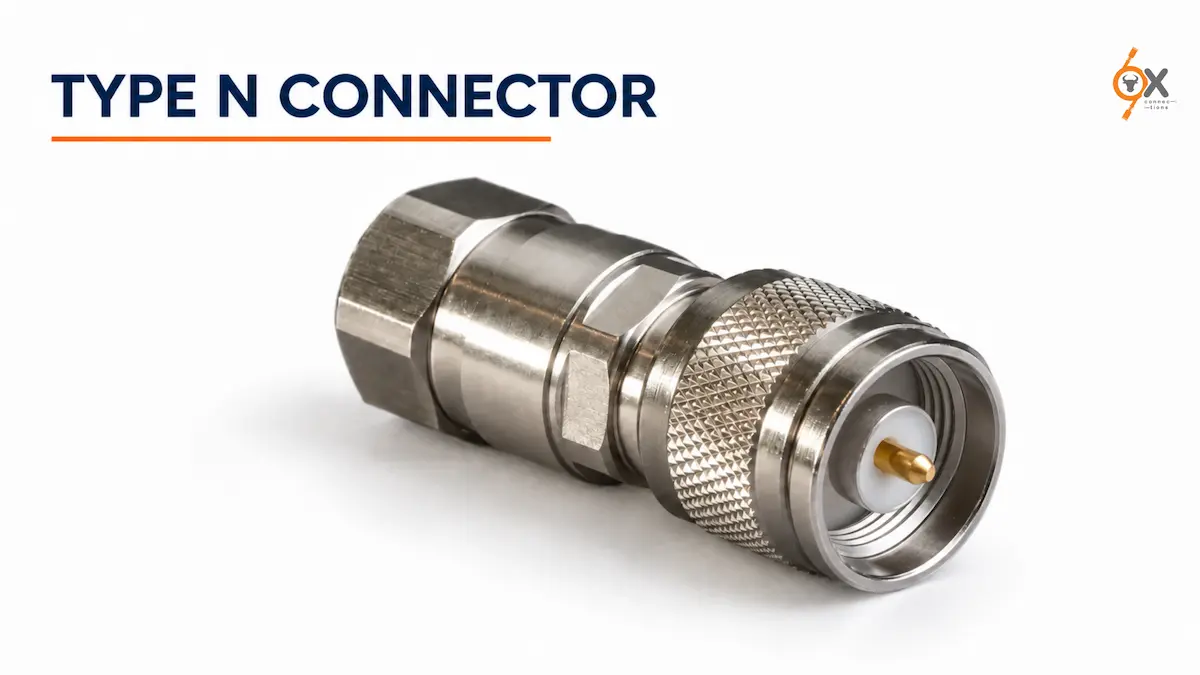
Ever noticed how the connectors on a rooftop antenna in Mumbai survive four months of monsoon without corroding? That’s usually a Type N connector holding the line. Unlike the small snap-on parts inside a laptop or an earbud, this one sits outdoors. It handles rain, heat, and vibration for years at a stretch. If your project touches anything outdoors – telecom towers, broadcast masts, coastal test setups – this connector deserves a closer look. It’s led the RF pack for eight decades running.
Inside a Type N Connector: What Makes This One Different
Paul Neill developed the Type N connector at Bell Labs back in the 1940s. Remarkably, it’s still the go-to choice for demanding outdoor RF work today. The name honors Neill himself, one of the earliest engineers to solve reliable high-frequency connections outside a lab setting. Unlike the snap-on connectors covered earlier, Type N uses a threaded coupling nut. That nut locks down tight and resists loosening from vibration.
Industry specs commonly quoted for Type N connectors show an outer diameter well above MCX or MMCX. This connector handles real power loads rather than squeezing onto a tight board. Standard impedance runs at 50Ω, with a 75Ω variant common in broadcast and cable applications. Frequency coverage typically extends to around 11GHz on standard versions, and precision variants push past 18GHz. Weatherproofing depends on proper O-ring seals at the connection point, not the connector body alone.
Most Type N connectors use stainless steel or nickel-plated brass bodies, since bare brass corrodes fast in humid, salty air. Gold or silver plating on the contact pins keeps resistance low even after years of exposure. That combination is exactly why telecom crews trust this connector on coastal towers and rooftop installs across cities like Mumbai, where salt air and monsoon rain test every seal twice a year.
Where Type N Connector Applications Actually Show Up
Cellular base stations depend on Type N connectors at nearly every RF junction. That includes everything from the antenna feed down to the radio unit. Broadcast towers use the same connector, and for the same reason. It handles high power and won’t work loose forty metres up in the wind. Test and measurement equipment – signal generators, spectrum analyzers, network analyzers – standardizes on Type N too, since lab technicians need a connection that survives thousands of connect-disconnect cycles without degrading.
Military and aerospace RF systems lean on Type N heavily. It tolerates rough handling and extreme temperatures better than smaller alternatives. Closer to everyday commercial work, Type N shows up on outdoor WiFi access points and point-to-point microwave links. Any rooftop antenna setup that needs to survive without a maintenance visit every monsoon usually specs this connector too.
How Type N Stacks Up Against the Rest of the RF Connector Shelf
Set Type N beside MCX, MMCX, or even BNC, and the difference isn’t subtle. Those smaller connectors save board space; Type N gives up that compactness for raw ruggedness and power handling. BNC comes closest in role. Both use a locking mechanism suited to test benches and outdoor gear. But BNC’s bayonet lock trades some vibration resistance for quicker connect-disconnect speed. TNC essentially threads a BNC body, landing somewhere between BNC and Type N on toughness. When a project calls for outdoor exposure, high power, or both, Type N usually wins the spec sheet.
Getting the Most Out of a Connector Over Time
Hand-tighten the coupling nut first, then finish with a proper torque wrench instead of guessing by feel. Over-tightening cracks the dielectric inside; under-tightening lets moisture creep past the O-ring during the first hard monsoon downpour. Check the gasket every year on outdoor installs. UV exposure and heat cycling wear rubber seals faster than most maintenance schedules assume. On coastal or high-humidity sites, a light coat of dielectric grease on the threads keeps corrosion from seizing the connector shut.
Sourcing a Connector in India: What Actually Matters
Buyers sourcing a Type N connector in India usually run into the same decision point early. The first choice is 50Ω or 75Ω, whichever matches the rest of the RF chain. Get that wrong and the mismatch shows up as return loss nobody can explain until someone checks the spec sheet. Termination type matters just as much: solder, crimp, or clamp. Retrofitting an existing cable run to a different termination eats more time than most project timelines allow.
For outdoor and rooftop work across Indian cities, weatherproof rating isn’t optional. An indoor-rated connector corrodes within a season on a Mumbai rooftop or a coastal telecom tower. It pays to confirm gasket quality and plating upfront, rather than discovering the gap after the first monsoon.
Local stock matters as much as spec accuracy here. OX Connections stocks a full RF connector range, covering Type N alongside MCX, MMCX, SMA, SMB, SMC, BNC, and TNC. They offer solder, crimp, and PCB-mounting types across male and female versions. With 5,000+ products in stock, OX Connections dispatches quickly across India, which matters when a tower crew is waiting on parts, not a lab bench. For pre-terminated needs, OX Connections also stocks RF cable assemblies with Type N configurations, cut and crimped to spec with custom lengths and connector orientations.
Bottom Line
A Type N connector doesn’t need to impress anyone on looks. It needs to survive a rooftop in July and a test bench in December. It needs to handle every connect-disconnect cycle in between without complaint. That’s the entire design brief, and eight decades on, it still delivers. For any outdoor, high-power, or long-service RF application, this connector remains the safe, boring, dependable choice. In RF hardware, that’s exactly the compliment you want.
Leave A Comment