
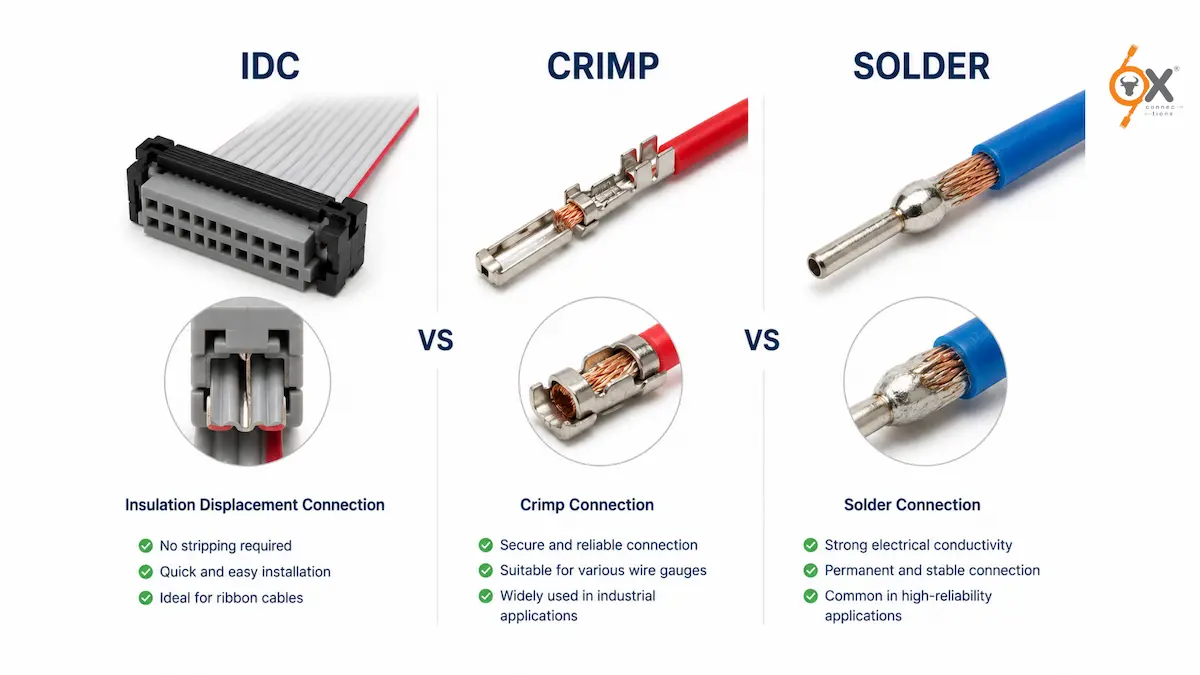
Every wire-to-connector interface in an electronic assembly depends on one critical factor: the quality of the termination. Understanding IDC vs Crimp vs Solder termination methods is essential for selecting the right connection solution for reliability, assembly speed, production cost, and long-term performance. Whether you are building industrial control panels, embedded systems, telecom equipment, consumer electronics, or custom cable assemblies, choosing the correct connector termination method directly impacts reliability, assembly speed, production cost, and long-term field performance.
The three most widely used termination methods in electronics manufacturing are:
- IDC (Insulation Displacement Contact)
- Crimp termination
- Solder termination
Each method creates a completely different electrical and mechanical bond. Each is suited to different environments, cable types, production volumes, and current requirements. Selecting the wrong method is one of the most common causes of intermittent failures, overheating, loose connections, and maintenance issues in cable assemblies.
In this guide, we break down IDC vs crimp connector systems and IDC vs solder termination honestly – including where each performs best, where each struggles, and how to select the right option for your application.
Understanding the Three Main Connector Termination Methods
Before comparing performance and applications, it’s important to understand how each method actually works.
What Is IDC Termination?
IDC, or Insulation Displacement Contact, is a termination method that connects wires without stripping the insulation first.
Inside the IDC connector housing are fork-shaped or V-shaped metal contact beams with sharpened edges. During assembly, a flat ribbon cable is pressed into the connector using an IDC press tool, arbor press, or bench press. The contact blades cut through the insulation and make direct contact with the copper conductor underneath.
The opposing contact beams maintain continuous spring pressure against the conductor, creating a gas-tight electrical connection that resists oxidation over time.
One of the biggest advantages of IDC termination is that all conductors in a ribbon cable are terminated simultaneously in a single press operation.
This is why IDC connectors are widely used for:
- Flat ribbon cable assemblies
- PCB-to-PCB interconnections
- Internal equipment wiring
- Control panels
- Embedded systems
- Consumer electronics
- Telecom equipment
What Is Crimp Termination?
Crimp termination uses controlled mechanical deformation to create the electrical connection.
The wire insulation is stripped first, exposing the conductor. The conductor is inserted into a metal terminal barrel, and a calibrated crimping tool compresses the barrel around the wire under precise force.
This deformation creates a high-pressure metal-to-metal bond that behaves almost like a cold weld.
The crimped terminal is then inserted into a connector housing.
Unlike IDC, crimping is performed one wire at a time. In multi-pin assemblies, each wire must be:
- Stripped
- Crimped
- Inserted individually
Crimp connectors are commonly used in:
- Automotive wire harnesses
- Industrial machinery
- Aerospace systems
- Robotics
- Wire-to-board connectors
- High-current applications
What Is Solder Termination?
Soldering creates the electrical connection using heat and molten solder alloy.
The wire is stripped, positioned onto the connector contact or PCB pad, and heated using a soldering iron. Solder melts and flows between the surfaces, forming a conductive bond once cooled.
Solder termination remains common in:
- Prototype electronics
- Low-volume production
- PCB assemblies
- Aerospace electronics
- Medical devices
- Repair and rework applications
However, soldering requires greater operator skill and introduces thermal stress into the assembly process.
Where IDC Connectors Perform Best
IDC connectors excel in high-volume signal-level cable assembly production.
A 40-pin flat ribbon cable assembly that would normally require forty separate solder joints or forty individual crimp operations can be terminated in one single IDC press cycle.
This dramatically reduces:
- Assembly time
- Labour cost
- Human error
- Pin misalignment risk
For manufacturers producing large quantities of cable assemblies, IDC termination offers major efficiency advantages.
Why IDC Is Popular in Electronics Manufacturing
Fast Assembly
IDC is one of the fastest connector termination methods available. Multi-conductor ribbon cables can be terminated within seconds.
Consistent Quality
Because all conductors terminate simultaneously, assembly consistency is significantly improved compared to manual soldering or hand crimping.
Compact Cable Routing
Flat ribbon cable assemblies route neatly inside enclosures and control panels. They maintain fixed conductor spacing and occupy minimal vertical space.
Reliable Signal Connections
Properly assembled IDC connectors create gas-tight contacts that resist oxidation and maintain stable signal transmission.
Ideal for Signal-Level Applications
IDC is widely used in:
- Industrial electronics
- Embedded systems
- Internal device wiring
- Telecom systems
- Consumer electronics
- PCB interconnects
For most signal-level multi-pin assemblies, IDC remains one of the most cost-effective and production-friendly solutions available.
Limitations of IDC Termination
Although IDC connectors are highly efficient, they are not suitable for every application.
Limited Current Capacity
Standard IDC ribbon cable connectors are generally rated around 1A to 2A per contact.
Using IDC assemblies for higher-current applications can create excessive heat buildup, increased resistance, and long-term reliability problems.
For power-heavy applications, crimp termination is usually the safer option.
Reduced Cable Flexibility
Flat ribbon cable assemblies are less flexible than discrete wire harnesses.
IDC assemblies work best when cables can travel in relatively straight paths with minimal bending.
Applications requiring:
- Tight cable bends
- Complex routing
- Branching wire paths
- Multiple connector transitions
are often better suited to crimped wire assemblies.
Lower Mating Cycle Durability
Most standard IDC connectors are designed for limited insertion/removal cycles, typically around 30 to 50 mating cycles.
For frequently disconnected field-service connectors, crimp-based systems are usually more durable.
Where Crimp Termination Performs Best
Crimp termination is the preferred solution when mechanical strength and vibration resistance are critical.
A properly executed crimp joint creates extremely high contact pressure between the terminal and conductor. This produces strong pull-out resistance and excellent current-carrying capability.
This is why crimp connectors dominate industries such as:
- Automotive manufacturing
- Aerospace
- Industrial automation
- Robotics
- Renewable energy systems
- EV wiring systems
Advantages of Crimp Connectors
Excellent Vibration Resistance
Crimped connections withstand continuous vibration far better than many soldered joints.
High Current Capacity
Crimp connectors can support significantly higher currents compared to standard IDC systems.
Flexible Cable Routing
Discrete wires can be routed individually, allowing:
- Tight bends
- Mixed wire lengths
- Connector pitch transitions
- Custom harness layouts
Strong Mechanical Bond
Crimp joints provide excellent wire retention and strain resistance.
Limitations of Crimp Termination
The biggest drawback of crimping is production complexity.
Every conductor must be individually processed, which increases:
- Labour time
- Assembly cost
- Handling time
Crimp quality also depends heavily on tooling calibration.
An under-crimped or over-crimped terminal may initially appear acceptable but fail later in the field due to high resistance or weak mechanical retention.
High-quality crimp assemblies require:
- Precision tooling
- Proper wire stripping
- Correct terminal selection
- Process control
Where Solder Termination Still Makes Sense
Despite automation trends, soldering remains valuable in certain applications.
Best Applications for Soldering
Prototype Development
Soldering is ideal for low-volume builds where dedicated IDC or crimp tooling would not be cost-effective.
Custom Assemblies
Non-standard connector configurations are often easier to solder manually.
Repair and Rework
Solder joints can be reheated and corrected during development or servicing.
Aerospace and Medical Electronics
Certain high-reliability PCB terminations still use solder under tightly controlled manufacturing standards.
Limitations of Solder Termination
Soldering is the slowest and most operator-dependent termination method.
Common challenges include:
- Inconsistent joint quality
- Thermal damage risk
- Flux contamination
- Cold solder joints
- Fatigue cracking under vibration
In high-volume manufacturing, soldering is generally less efficient than IDC or automated crimping systems.
IDC vs Crimp Connector Systems – Which One Should You Choose?
The right choice depends on four key factors.
1. Current Requirement
If the application exceeds roughly 2A per conductor, crimp termination is generally preferred over IDC.
2. Production Volume
- High-volume production → IDC or automated crimping
- Low-volume or prototype builds → Soldering or manual crimping
3. Operating Environment
- High vibration → Crimp
- Controlled internal electronics → IDC
- Specialized PCB applications → Solder
4. Cable Routing Requirements
- Flat cable routing acceptable → IDC
- Flexible discrete wire routing needed → Crimp
Why IDC Remains Popular in Indian Electronics Manufacturing
For most signal-level internal cable assemblies used in Indian electronics production, IDC remains the fastest and most cost-effective termination method.
Industries across India continue to use IDC ribbon cable assemblies for:
- Control panels
- Industrial automation
- Embedded electronics
- Consumer devices
- Telecom equipment
- PCB interconnections
The combination of fast assembly, consistent quality, and reduced labour cost makes IDC connectors highly practical for production-scale manufacturing.
IDC and Ribbon Cable Solutions from OX Connections
At OXConnections, we supply high-quality IDC and FRC connector solutions for industrial and electronics manufacturing applications across India.
Our range includes:
- 27mm pitch IDC connectors
- 0mm pitch IDC connectors
- 54mm pitch IDC connectors
- 6 to 64 pin configurations
- Matching grey flat ribbon cable
- Wire-to-board crimp connector solutions
With ready stock availability, fast dispatch, and reliable connector quality, OX Connections supports OEMs and manufacturers across industrial automation, embedded systems, consumer electronics, renewable energy, and control panel manufacturing.
Whether you need IDC ribbon cable assemblies or crimp connector alternatives, OX Connections delivers dependable connector solutions built for production environments.
FAQs
Is IDC better than crimp connectors?
IDC connectors are better for fast, high-volume signal cable assembly using flat ribbon cable assemblies. Crimp connectors are better for high-current, vibration-heavy, or flexible wire routing applications.
What is the difference between IDC and solder termination?
IDC creates the connection mechanically by displacing insulation and contacting the conductor directly, while solder termination uses heat and molten solder alloy to bond the conductor electrically.
Are IDC connectors reliable?
Yes, properly assembled IDC connectors create gas-tight contacts that offer reliable signal transmission in controlled environments.
Which termination method is best for ribbon cable assemblies?
IDC termination is generally the preferred solution for flat ribbon cable assemblies because it allows simultaneous multi-conductor termination with fast assembly speed and consistent pin alignment.