
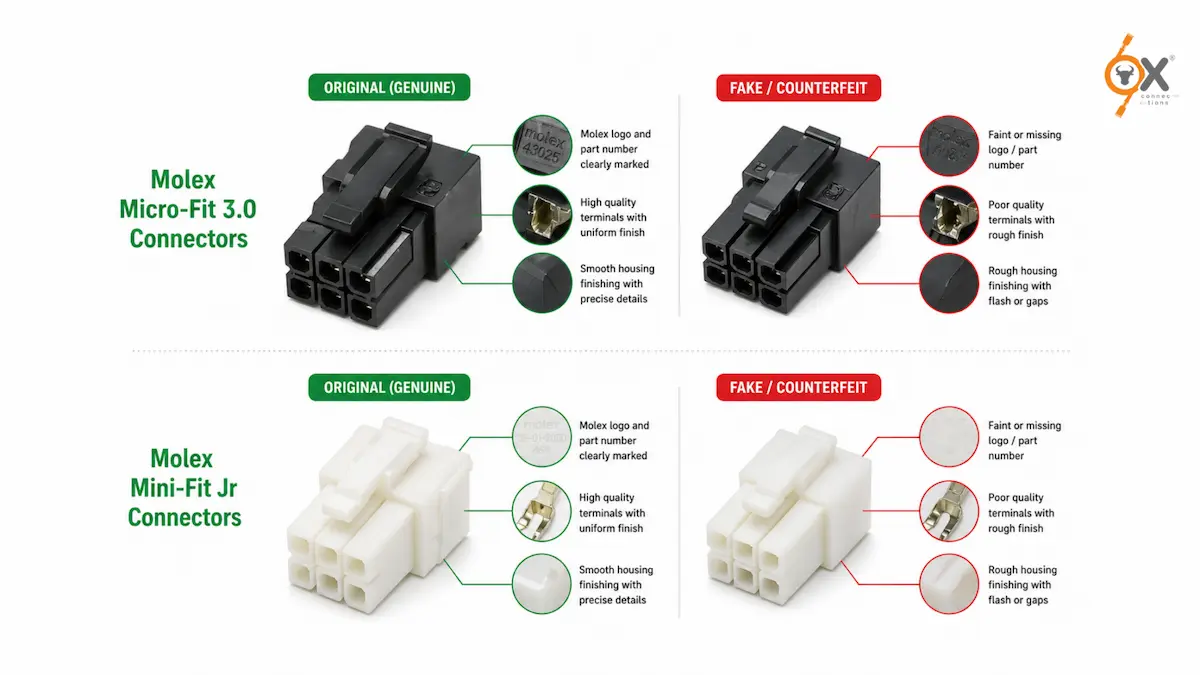
Learn how to identify genuine Molex Micro-Fit 3.0 and Mini-Fit Jr connectors. Avoid fake parts, ensure reliability, and improve performance.
If you’ve ever sourced connectors in India – especially for production in cities like Mumbai – you’ve probably faced this question at some point:
“Is this connector actually genuine?”
It’s a valid concern. With increasing demand across industries like EV, solar, appliances, and industrial automation, the market has seen a rise in lookalike or low-grade connectors that appear identical but perform very differently.
And when you’re working with something like a Molex Micro-Fit 3.0 connector or a Mini-Fit Jr system, even a small compromise in quality can lead to overheating, failure, or long-term reliability issues.
So instead of guessing, let’s break down how to identify genuine Molex connector quality in a practical, real-world way.
Why Identifying Genuine Connectors Matters (Especially in India)
In controlled environments, even average-quality connectors might seem to work fine. But in Indian conditions – where heat, humidity, dust, and continuous load are common – connector quality gets tested quickly.
In manufacturing hubs like Mumbai, we’ve seen cases where:
- Connectors heat up under load
- Terminals loosen over time
- Plastic housings degrade faster than expected
Most of these issues trace back to one thing:
Non-genuine or inconsistent quality connectors
That’s why knowing the difference between Mini-Fit Jr connector original vs fake isn’t just technical knowledge – it’s a necessity.
Visual Identification: The First Check
Let’s start with what you can see.
Genuine connectors usually have:
- Clean, consistent molding
- Sharp and clearly defined edges
- Uniform color and finish
- Proper branding or marking (depending on type)
On the other hand, lower-quality or fake connectors often show:
- Slight discoloration
- Rough or uneven edges
- Inconsistent plastic texture
- Faded or missing markings
It might seem minor, but these visual cues are often the first red flag.
Material Quality: What You Can Feel
A quick hands-on check can tell you a lot.
When you hold a genuine Molex Micro-Fit 3.0 connector, the housing feels:
- Solid
- Slightly dense
- Consistent in finish
In contrast, non-genuine connectors may feel:
- Lightweight or brittle
- Slightly flexible in a way they shouldn’t be
- Inconsistent across batches
This difference becomes more obvious when connectors are used in high-temperature environments like Indian factories.
Terminal Quality: The Real Differentiator
If there’s one place where quality truly shows, it’s in the terminals.
Genuine terminals are:
- Precisely stamped
- Smoothly finished
- Consistent in thickness
Lower-quality versions often have:
- Rough edges
- Uneven plating
- Variations in thickness
This directly affects:
- Crimping quality
- Electrical resistance
- Heat generation
And over time, this is exactly where failures begin.
Fit and Locking Mechanism
One of the easiest ways to identify genuine Molex connector quality is by checking how it fits.
A genuine connector:
- Locks with a clear, firm click
- Holds the terminal securely
- Doesn’t allow easy back-out
A fake or low-grade connector may:
- Feel loose
- Require force to fit properly
- Fail to lock consistently
In high-vibration environments – common in industrial setups – this difference becomes critical.
Performance Under Load
This is where the real test happens.
Even if a connector looks identical, performance tells the truth.
Genuine connectors are designed to:
- Handle rated current without overheating
- Maintain stable contact over time
- Perform consistently across cycles
Lower-quality connectors may:
- Heat up faster
- Show voltage drops
- Degrade quicker under continuous use
In India’s high-load environments, this difference shows up faster than expected.
Why Many OEMs in India Are Rethinking Sourcing
Here’s the reality.
Sourcing genuine branded connectors in India often comes with:
- High pricing
- Long lead times
- Large minimum order quantities
This creates a gap between what manufacturers need and what’s easily available.
That’s exactly where we step in.
A Practical Alternative: Reliable, Certified Connectors Without the Hassle
Instead of depending entirely on imports, many OEMs across India now prefer working with OX Connections.
We offer:
- Micro-Fit 3.0 and Mini-Fit Jr compatible connectors
- At nearly half the cost
- With no long lead times
- Backed by UL, RoHS, and CE certifications
You can explore our connector range here:
Or directly check compatible solutions:
https://oxconnections.com/mini-fit-connectors
For manufacturers in Mumbai and across India, this means:
- Faster procurement
- Consistent quality
- Reliable performance
Without the usual delays and cost pressures.
How to Make the Right Choice
If you’re working on production, here’s a simple way to approach it.
Instead of asking: “Is this connector original?”
Ask:
- Is the build quality consistent?
- Does it perform reliably under load?
- Is it sourced from a trusted supplier?
Because at the end of the day, what matters most isn’t just branding – it’s performance and reliability.
Final Thoughts
Knowing the difference between Mini-Fit Jr connector original vs fake or evaluating a Molex Micro-Fit 3.0 connector isn’t about memorising specs – it’s about recognising quality.
From visual checks to performance under load, every small detail contributes to long-term reliability.
And in India’s fast-growing manufacturing ecosystem – especially in cities like Mumbai – choosing the right connector isn’t just a technical decision.
It’s a business decision.
Because the right connector doesn’t just connect components, it keeps your entire system running smoothly.